Linear-phase EQ: what the latency buys, and why the ringing moves in front of the note
Every EQ changes two things. One is the level at each frequency, which is what the curve on screen shows. The other is timing: around the frequencies it moves, an ordinary EQ shifts some of the signal slightly later than the rest.
A linear-phase EQ removes the second change. It pays for that in two ways, latency and pre-ring, and knowing which one you are paying is most of knowing when to use it.
What a normal EQ does to timing
The EQ in your DAW behaves like an analogue one. Engineers call it minimum phase. It has no latency, and when you boost a band, the energy around that band is held back slightly and rings on after the input that caused it. Everything the filter adds happens after the event.
On a single track that is rarely a problem. FabFilter’s manual describes the phase effects of a simple bell or shelf as very subtle and hardly noticeable, and says steeper low and high cuts are where the timing change starts to affect transients.
Where the timing change starts to matter
The real trouble begins when an EQ’d signal is combined with another version of the same signal that was not EQ’d the same way. The two no longer line up at every frequency, and where they disagree they partly cancel.
That happens more often than it sounds:
- Parallel chains. An EQ on one path, blended back with the dry path.
- Multi-mic sources. An inside and an outside kick mic carry the same hit; EQ one of them and their relationship changes around the band you moved.
- Mid/side EQ. Boost the mid channel only, and when mid and side are decoded back to left and right, the shifted band no longer recombines the way it was recorded.
- Partial EQ in mastering. FabFilter’s own example: EQ applied to one section of a song with crossfades at each end. Across the fade, the filtered and unfiltered versions overlap, and the fade does not behave as intended.
A linear-phase EQ delays every frequency by exactly the same amount. The EQ’d copy then lines up with the original everywhere, with only its level changed, and the cancellation goes away.
The first cost: latency
To delay every frequency equally, the filter has to look at audio on both sides of each moment, so the plug-in holds the whole signal back. The lower and narrower the move, the longer it has to look.
FabFilter publishes the figures for Pro-Q 4 at 44.1 kHz:
- Low: 3,072 samples, about 70 ms
- Medium: 5,120 samples, about 116 ms
- High: 9,216 samples, about 209 ms
- Very High: 17,408 samples, about 395 ms
- Maximum: 66,560 samples, about 1,509 ms
FabFilter recommends High when you need high Q in the low end, and notes that using left/right bands and mid/side bands at the same time doubles the latency. That 1,509 ms is also the figure CARBON Q compares its own 41 ms against.
Your DAW compensates for all of this on playback, so a mix stays in time. What it cannot fix is live monitoring: anything you play or sing through a linear-phase EQ while recording arrives late in your headphones. That is the same reason buffer size matters when tracking.
The second cost: pre-ring
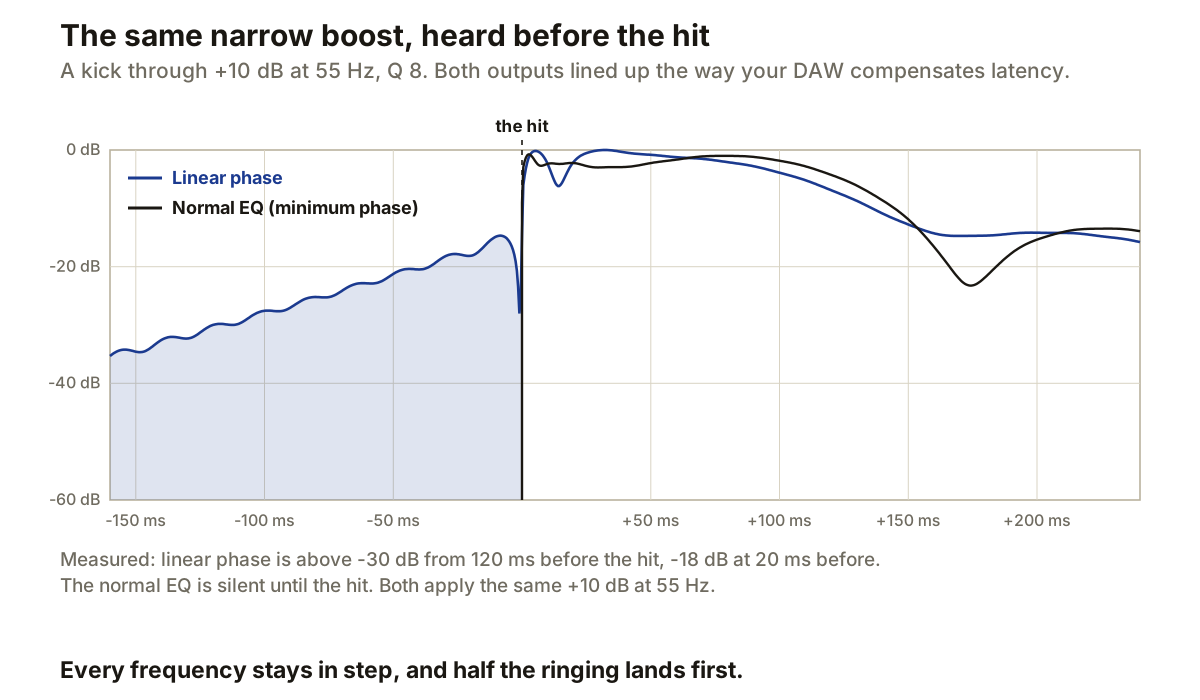
A minimum-phase EQ puts all its ringing after the event, where the ear expects a sound to decay and where the sound itself covers it. A linear-phase filter’s response is symmetric in time. Whatever ringing it adds, it spreads evenly either side, so once the latency is compensated, the boosted band starts to sound before the transient that caused it.
The diagram above shows a synthetic kick through +10 dB at 55 Hz with a Q of 8, once through an ordinary EQ and once through a linear-phase version with an identical boost. The ordinary EQ produces nothing until the hit. The linear-phase version is already above -30 dB 120 ms before the hit, and at -18 dB 20 ms before it. FabFilter’s manual puts the audible result plainly: pre-ring can make transients, a kick drum for example, lose their edge.
Low and narrow is the worst case for a reason. A narrow boost is a resonance, and a resonance takes time to build and to die away. Its decay time scales with Q divided by frequency, so the same Q of 8 that rings for well over 100 ms at 55 Hz dies away within a few milliseconds at 2 kHz. That is also why linear-phase EQs need their longest settings for low-frequency work.
Which one to reach for
FabFilter’s summary is worth keeping: linear-phase processing is not better or more transparent than normal processing, it is different, and it is generally a problem-solving tool for phase cancellation.
Use linear phase when the EQ’d signal will be summed with another version of itself: parallel chains, multi-mic sources, mid/side work and partial edits in mastering. Use an ordinary EQ when you are tracking, and for narrow low boosts on kick, bass and anything else with a sharp attack. For broad, gentle moves on a single track, the difference between the two is small either way.
Producer’s note
Pre-ring is easiest to hear after silence, because nothing before the hit masks it. Before committing to linear phase on a kick or bass bus, solo it and listen to the first hit after a gap, or zoom into the rendered waveform just before a transient. If the low end starts to swell before the attack, widen the band, or ask whether that particular boost needs linear phase at all.