CARBON Q splits a reference track into four stems and EQs your mix against each
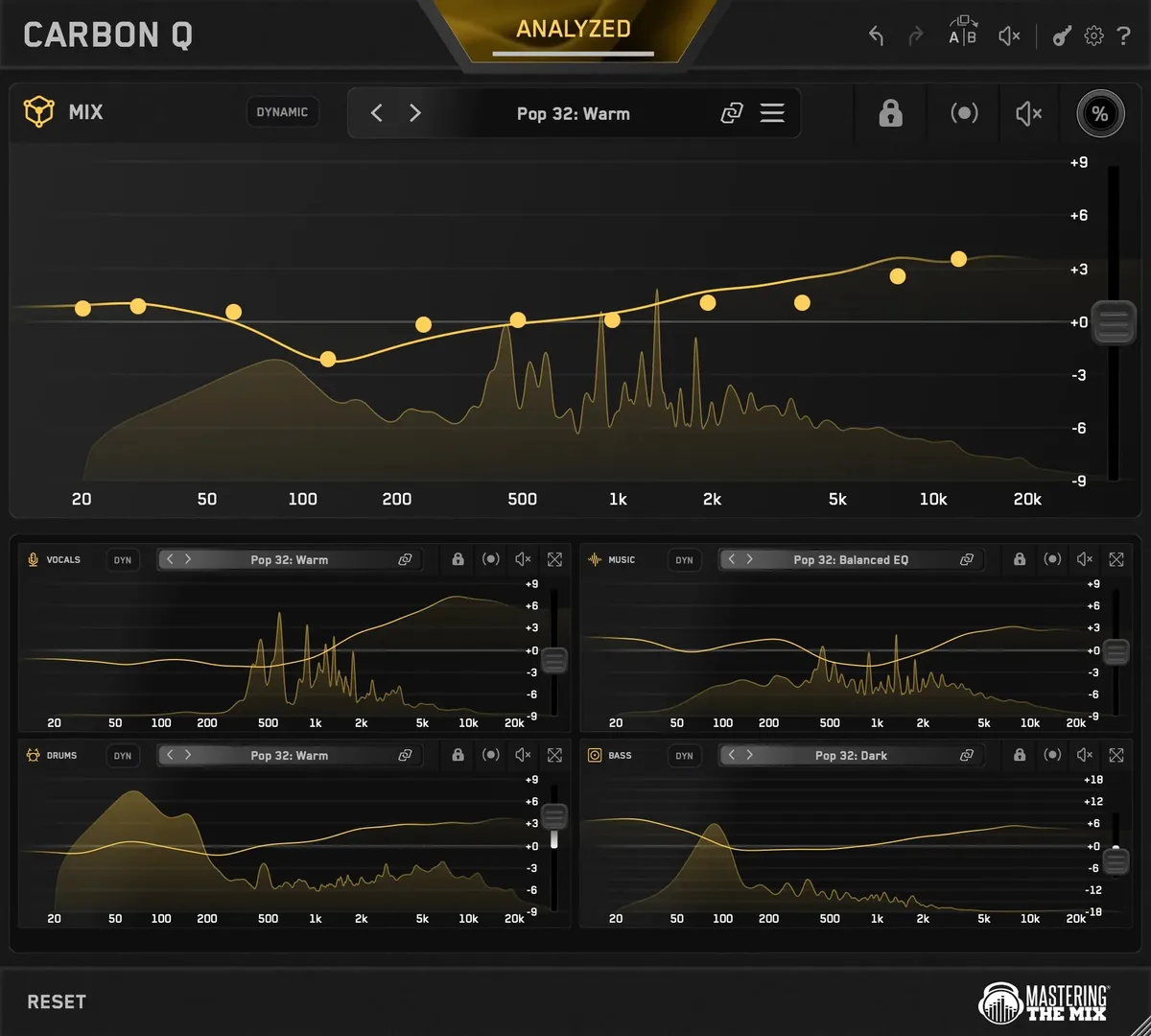
Matching your mix to a reference track by comparing the two full spectrums has a basic flaw. The reference has a different arrangement. If its low mids are fuller because it has a cello and you have a synth bass, an EQ match will push your synth bass to fill a gap that was never about the bass.
Mastering The Mix’s answer in CARBON Q, which went on sale on 1 October, is to compare parts instead of whole mixes.
Four instances and one reference
CARBON Q goes on five places: the output, plus the vocals, music, drums and bass buses. The instances find each other when they load, and any one window controls the EQ, level and preset of all of them. Together they form an eleven-band EQ spread across the session, with the instance on the output calculating presets from the whole mix and sharing them with the others.
Drop a reference track in and CARBON Q separates it into vocals, music, drums and bass. It measures each part’s tonal balance and its loudness relative to the others, and turns that into a target for the matching bus in your session. The bus instances can also be unlinked, so the vocal target can come from one reference and the drums from another. The analysis and the separation run on your own machine, and the developer says nothing is uploaded.
Linear phase, at a shorter delay
The filters are linear phase, with 41 ms of latency reported to the DAW. Mastering The Mix says the response matches a leading linear-phase EQ at maximum resolution to within 0.13 dB, at 41 ms instead of 1,509 ms. The page does not name the competitor, so that comparison is the developer’s claim.
Every EQ move and preset change is level matched in real time, which keeps louder from passing for better. Dynamic Mode holds each bus to its tonal-balance target by controlling peaks rather than applying a static curve.
Price and formats
£41.30, down from £59, with no end date given. macOS 13.3 or later (AU, VST3, AAX, native on Apple Silicon) and Windows 10 or later (VST3, AAX).
Producer’s note
Take the instances off the vocal and drum buses before recording overdubs. Delay compensation lines up playback, but anything you monitor live through a 41 ms plug-in arrives 41 ms late in your headphones, which is plenty to throw a performance.
Read more at Mastering The Mixhttps://www.masteringthemix.com/products/carbon-q
Buy atPlugin Boutique