Inharmonic partials: why a bar or a drum has a less certain pitch than a string
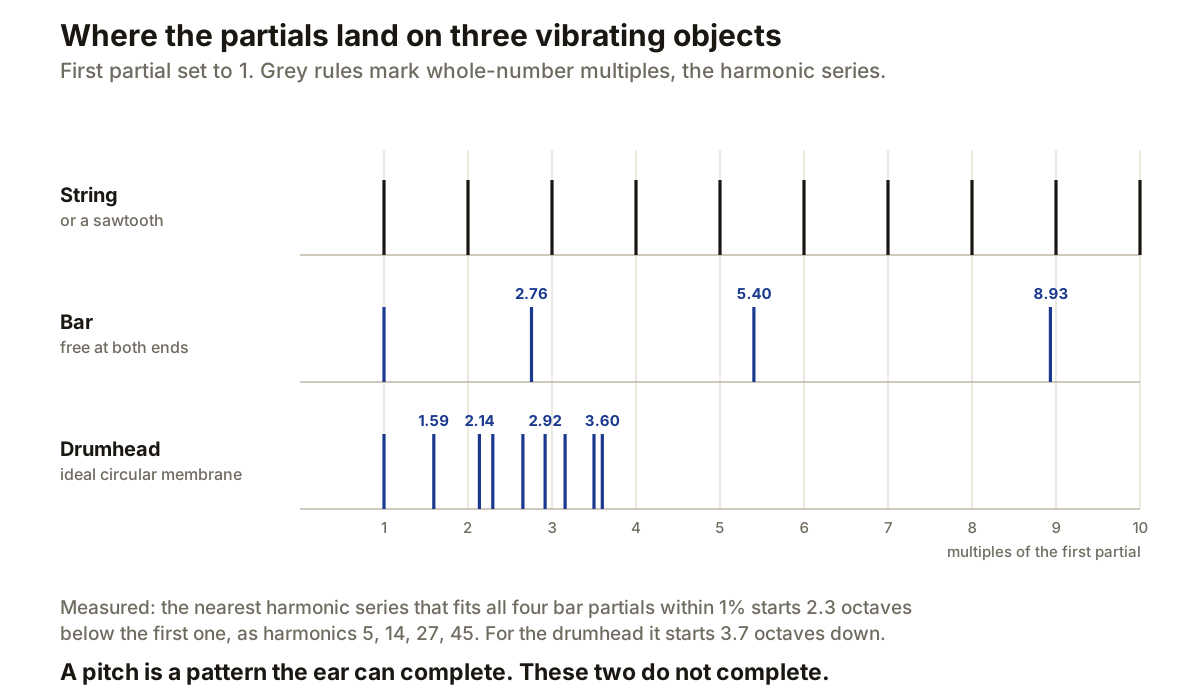
The pitch you hear is not stored in any single partial. It is a conclusion the ear draws from how the partials are arranged, and some arrangements lead to a clear answer while others do not.
The pattern a pitch comes from
A vibrating string produces its fundamental plus partials at whole-number multiples of it: twice, three times, four times, and on up. A sawtooth does the same, which is why it sounds like a note rather than a noise, and which multiples are present is what separates one waveform from another.
The useful property of that arrangement is that the gap between neighbouring partials always equals the fundamental. Every partial points to the same note. That is why you can hear the pitch of a bass line on a phone speaker that cannot reproduce the fundamental at all: the upper partials still sit at the spacing the missing note would have, and the ear fills it in.
Bars and drumheads break the pattern
Other objects vibrate in modes that are not whole-number multiples of anything simple.
A thin bar free at both ends, the basic shape of a glockenspiel bar, has mode frequencies that Daniel Russell’s Penn State demonstrations give as rising approximately with the square of an odd number, so they are not integer multiples of a fundamental. Worked out exactly, the first four sit at 1, 2.76, 5.40 and 8.93 times the first.
An ideal circular drumhead is further out still. Russell lists its modes at 1.593, 2.135, 2.295, 2.917 and 3.598 times the fundamental, among others, so nine partials crowd in below four times the first, and none after the first lands on a whole number.
The diagram puts all three on one axis. To put a number on how far each set is from a harmonic series, we searched for the highest fundamental that all of a set’s partials fit within 1%, about a sixth of a semitone. For the string, that is the string’s own fundamental. For the bar, it is 2.3 octaves below the first partial, with the four partials landing on harmonics 5, 14, 27 and 45. For the drumhead it is 3.7 octaves down. A pattern that sparse, starting that high up its own series, is not one the ear completes into a single note.
How a drum gets a pitch back anyway
The modes are not all equal in practice. Russell’s drumhead page notes that a timpani struck at the centre mostly excites modes that radiate sound efficiently and die away fast, giving a “thump” with no definite pitch. Struck between the centre and the edge, it excites modes that ring on longer, and the result has a definite pitch that lasts several seconds.
So the pitch of a real drum or bar depends on which partials are excited and which survive longest. That is a matter of where it is struck and what it is made of, and the arithmetic alone does not decide it.
The same thing inside a synth
A synth can produce inharmonic partials on purpose. FM with a non-integer ratio does it, and so does frequency shifting, which adds the same number of hertz to every partial and breaks the whole-number ratios between them.
Additive synths give direct control. COLAPSO takes its partials from atomic emission lines, which follow the physics of the atom rather than a harmonic series. Materia lets you change each partial’s frequency ratio, so you can start from a harmonic sample and pull individual partials off their whole numbers.
Chords are where this costs you. Consonant intervals work partly because the harmonics of the two notes coincide: in a pure fifth, every third harmonic of the lower note lands exactly on every second harmonic of the upper one. Inharmonic partials do not line up like that, so a chord built from them has more partials sitting close together without matching, and sounds rougher than the same chord on a harmonic sound.
Producer’s note
When an inharmonic patch has to sit in a key, tune it by ear against a plain sine at the root, not with a tuner. A tuner locks onto the strongest partial, which may not be the one you hear as the note. If the pitch still wanders, layer a quiet sine at the root an octave or two below. It gives the ear the fundamental the sound itself does not supply, and the inharmonic partials then read as colour on top of a note.