FM ratios: why one number decides whether the harmonics follow the note
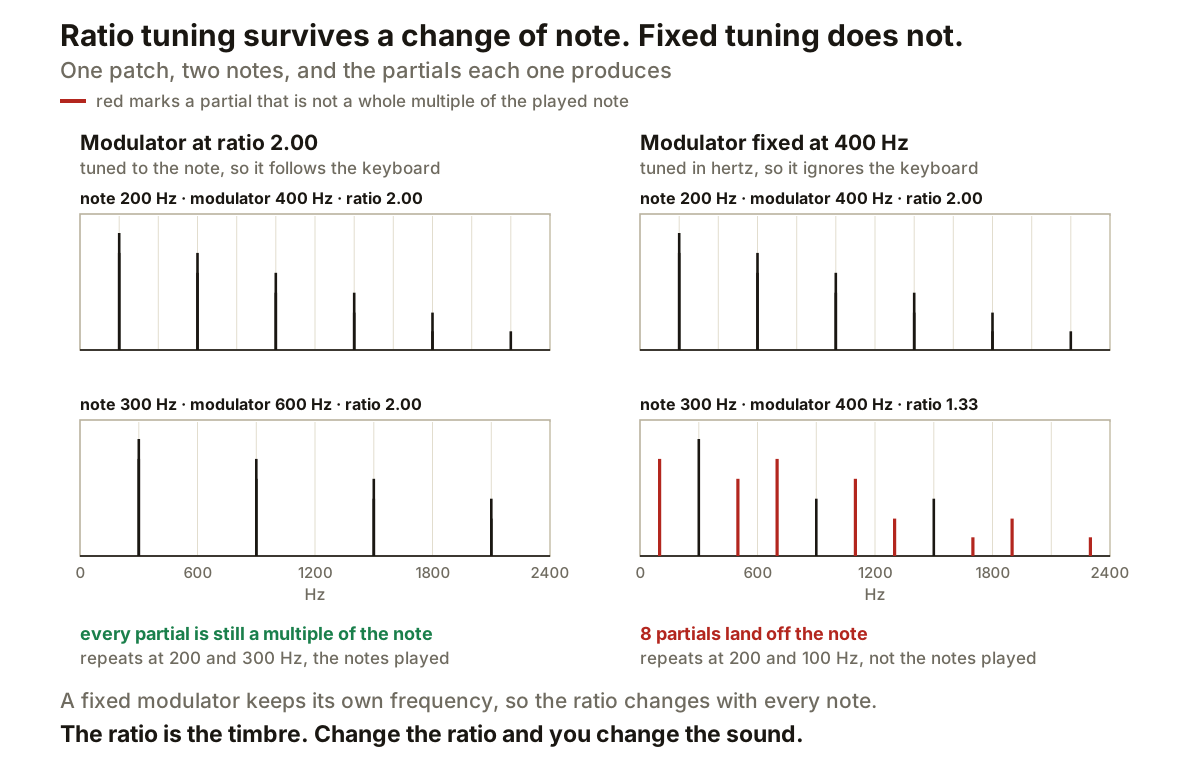
Every FM patch contains at least two frequencies: the one you played, and the one modulating it. Neither number decides the timbre on its own. Their ratio does.
That is why FM synths put a control called Ratio where you would expect a frequency, and why a patch can sound exactly right on one key and wrong on the next.
What modulation actually adds
Modulating one sine with another does not blur the carrier. It replaces it with a set of separate partials, spaced by the modulator frequency on both sides of the carrier: carrier plus the modulator, carrier minus the modulator, carrier plus twice the modulator, and outwards from there.
Two things follow from that spacing.
The lower sidebands can be pushed past zero, and when they are they fold back as positive frequencies. That is why FM puts energy in places nothing was asked to go.
The second consequence is the one worth building a habit around. Where the partials land relative to the note you played is decided entirely by the modulator’s frequency relative to the carrier’s, and by nothing else.
Whole numbers keep everything on the note
Set the modulator to a whole multiple of the carrier and every sideband lands on a whole multiple of the note. The result has a definite pitch.
Surge XT’s manual states the design decision plainly for its FM2 oscillator: the ratios of its two modulators to the carrier are always integer, so the resulting waveform is always cyclic. Both ratio controls run from 1 to 32 with nothing in between. That constraint is the point rather than a limitation, because an oscillator that cannot make a non-repeating waveform cannot make an unpitched one either.
The left column of the diagram is that case. At a 200 Hz note with the modulator at 400 Hz, the partials land on 200, 600, 1000 and so on upwards. Play 300 Hz and the modulator moves to 600 Hz with it, so the partials land on multiples of 300 instead. Same pattern, moved. Same timbre.
Notice which multiples survive: at a ratio of 2 the partials are the odd multiples of the note only, 1, 3, 5, 7 and up. That is the same harmonic content odd-order saturation produces, arrived at from a completely different direction.
Fixed frequency breaks the relationship
Most synths will also let an oscillator ignore the keyboard. Surge’s per-oscillator Keytrack does exactly that: switch it off and the oscillator plays a fixed pitch that is the same for all notes. Its FM3 oscillator goes further, allowing non-integer ratios and adding a third modulator whose rate is set as an absolute frequency instead of a ratio.
Do that to a modulator and the ratio stops being a setting you chose. It becomes a result of which key you pressed.
The right column shows it happening. A modulator fixed at 400 Hz gives a ratio of 2.00 at a 200 Hz note, which is the same sound as the left column. Play 300 Hz and the ratio is 1.33, and eight of the eleven partials no longer sit on a multiple of the note.
What “no longer harmonic” actually means
The usual description of this is not quite right, and the precise version is more useful.
400 over 300 is still a ratio of whole numbers, 4 to 3, so the sound has not turned into noise. Carrier and modulator both sit on multiples of 100 Hz, so every partial does too, and the pattern still repeats.
It repeats at 100 Hz, an octave and a fifth below the note you played.
That is why fixed-frequency modulation goes wrong in a specific way rather than a vague one. The sound stays pitched. The pitch it implies just drifts away from the pitch you asked for, by a different amount at every note. Chords fall apart before single notes do.
Ratios chosen to be non-integer on purpose do not have this problem, because they are not pretending to track anything. Bells, mallets and struck metal have inharmonic spectra to begin with, and FM3’s wider non-integer range exists for that. The manual is honest about the register it lives in, describing it as the algorithm for “scraping paint off the walls”.
The other control is how much, not where
Ratio decides where the partials go. Modulation amount decides how many there are and how far out they reach.
Turn the amount up and energy spreads outwards from the carrier into higher-order sidebands. That is where FM’s brightness comes from, and also where its oldest problem comes from: sidebands can be pushed above half the sample rate, at which point they come back as aliasing at frequencies with no relationship to the note.
High ratios make that more likely, since a ratio of 12 puts even the first sideband pair a long way from the carrier. A high ratio, a high note and a lot of modulation is the combination to be suspicious of.
Producer’s note
Set the ratio while playing at least two notes an octave apart. A patch that sounds right on one key has told you nothing yet.
If something sounds correct low and wrong high, or in tune alone and out of tune in a chord, look for a modulator with keytracking off or a frequency entered in hertz before you touch anything else. That single check explains most FM patches that will not behave across the keyboard.
And when you want something metallic, move the ratio rather than the modulation amount. More modulation on a whole-number ratio gives a brighter version of the same note. A ratio like 1.41 gives something that is not really a note any more, which is what a bell is.