Bass distortion: what changes when the sub goes through it too
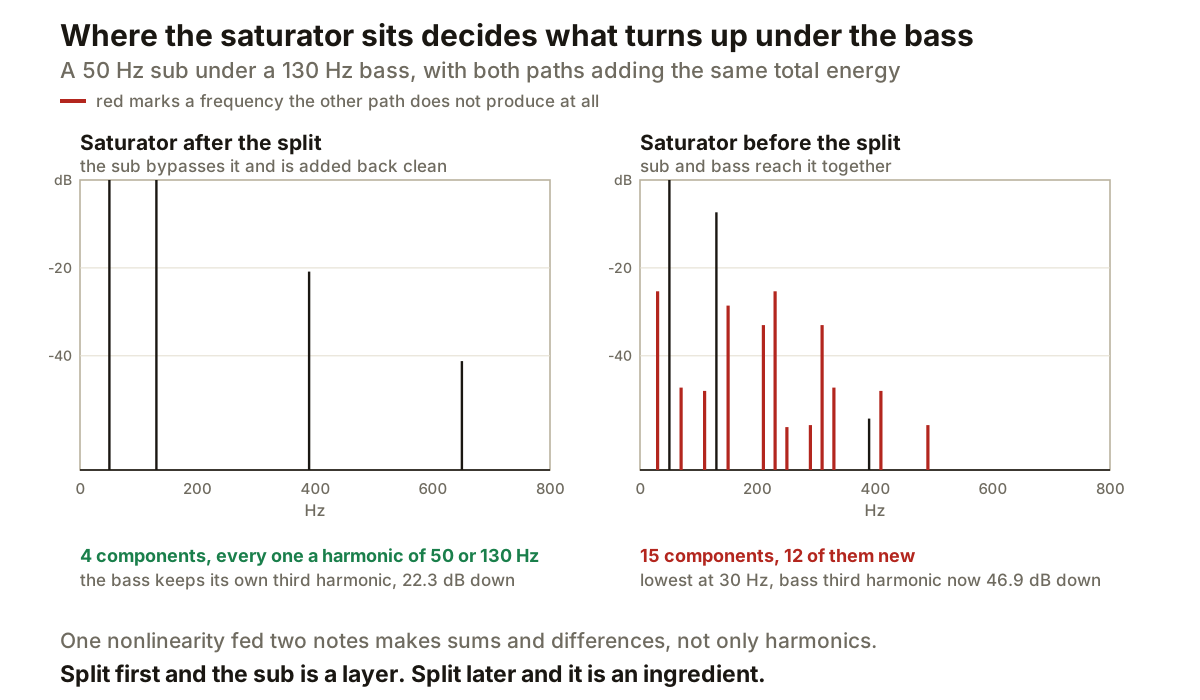
Put a saturator on a bass track and there is a decision hiding in the routing that almost nobody makes on purpose: does the sub layer go through it, or around it?
The answer changes what comes out, and not by a little.
One nonlinearity, two different jobs
A nonlinearity applied to a single sine produces harmonics of that sine. Multiples of the note, all of them above it.
Feed the same nonlinearity two frequencies at once and it produces something else as well: sums and differences of the two, and sums and differences of their multiples. That is intermodulation, and the property that matters here is direction. Harmonics can only go up. Difference tones can go down, below both of the frequencies you put in.
A sub layer under a bass layer is two frequencies at once.
The measurement
Both panels are a 50 Hz sub under a 130 Hz bass, through the same tanh saturator. The only difference is where the saturator sits. The drive on the shared path was solved for until both paths add exactly the same total energy relative to the sub, so neither panel is simply distorted harder than the other. The question is only where that energy landed.
Distortion after the split gives four components below 800 Hz: the sub at 50, the bass at 130, and the bass’s third and fifth harmonics at 390 and 650. Every one of them is a harmonic of something that was played.
Distortion before the split gives fifteen, and twelve of them do not exist in the other panel at all.
The lowest sits at 30 Hz, 25.3 dB under the sub. It is twice the sub minus the bass: 100 minus 130 is minus 30, which comes back as 30 Hz. Its partner at twice the sub plus the bass, 230 Hz, arrives at exactly the same level. There is also energy at 150 Hz, which is the sub’s own third harmonic and cannot exist at all while the sub stays out of the distortion.
The part that is genuinely surprising
Compare the one component you were actually after: the bass’s third harmonic at 390 Hz.
With the sub kept out, it sits 22.3 dB below the bass. With the sub included, matched for total added energy, it sits 46.9 dB below. That is 24.6 dB less of the distortion you reached for.
The sub is the bigger signal, so it does most of the bending of the transfer curve. The bass rides that curve rather than bending it, which leaves it gain-modulated by the sub’s waveform instead of distorted in its own right, and gain modulation is exactly what produces those sum and difference pairs.
That inverts the usual assumption, so it is worth saying flatly. Running the sub through the saturator does not give you more distortion on the bass. It gives you less of it, and a lot of intermodulation instead.
When it does not matter
If the sub is an exact sub-octave of the bass, the arithmetic protects you.
Move the bass to 150 Hz, three times the sub, and every product of the shared saturator lands on a multiple of 50 Hz. Sums and differences of multiples of 50 are still multiples of 50, so nothing falls between the harmonics. Not one stray component.
That is the case where distorting the whole thing together is fine, and it explains why some bass patches survive the treatment and others come apart. A sub locked to the same note as the bass is safe. A sub that is a separate voice, or a patch playing more than one note at a time, is not.
It is the same arithmetic that decides whether an FM patch stays on the note, arrived at from the other end.
Two more things the shared path does
tanh is symmetric, so everything measured above is odd-order only. An asymmetric distortion, which is most of the ones modelled on hardware, adds even-order products as well, including the plain difference between the two notes.
And the products reach upwards too. Intermodulation spreads further than harmonic distortion does for the same amount of drive, so this is also the signal path that asks more of the oversampling. FabFilter puts oversampling of Saturn 2’s distortion algorithms behind a High Quality control with Good and Superb modes, which is the knob this eventually lands on.
What to do instead
Split before the distortion. That is the entire technique, and it is why so many bass patches are built the same way: one clean layer carrying the fundamental, one distorted layer carrying everything above it, summed afterwards.
Saturators do it internally now. Saturn 2’s display lets you create frequency bands directly, and each band gets its own distortion type, drive, feedback, dynamics, tone, level and mix, so a low band can sit at no drive while the band above it is pushed hard. Instruments do it too: Arturia’s Pure SUB is built around keeping the fundamental out of the distortion path.
The crossover is not free either. Saturn 2 has a Linear Phase mode that applies linear phase filtering to both the multi-band crossover and the internal oversampling, and it exists because ordinary crossover filters shift phase around the split point. A phase shift between a sub layer and the layer directly above it is its own problem.
Producer’s note
Put an analyser on the bass bus and look below the sub rather than above it. Harmonic distortion cannot put anything down there. If there is energy under the fundamental, something in the chain is being fed two notes at once.
When you want more distortion and turning the drive up is not giving it to you, check whether the sub is in the path before you turn it up again. On a shared saturator, most of what more drive buys is intermodulation.
And when you layer a sub under a separate bass patch, tune it to an exact octave below wherever the arrangement allows. It costs nothing and it removes the whole problem.