Arturia's Pure SUB keeps the fundamental out of the distortion path
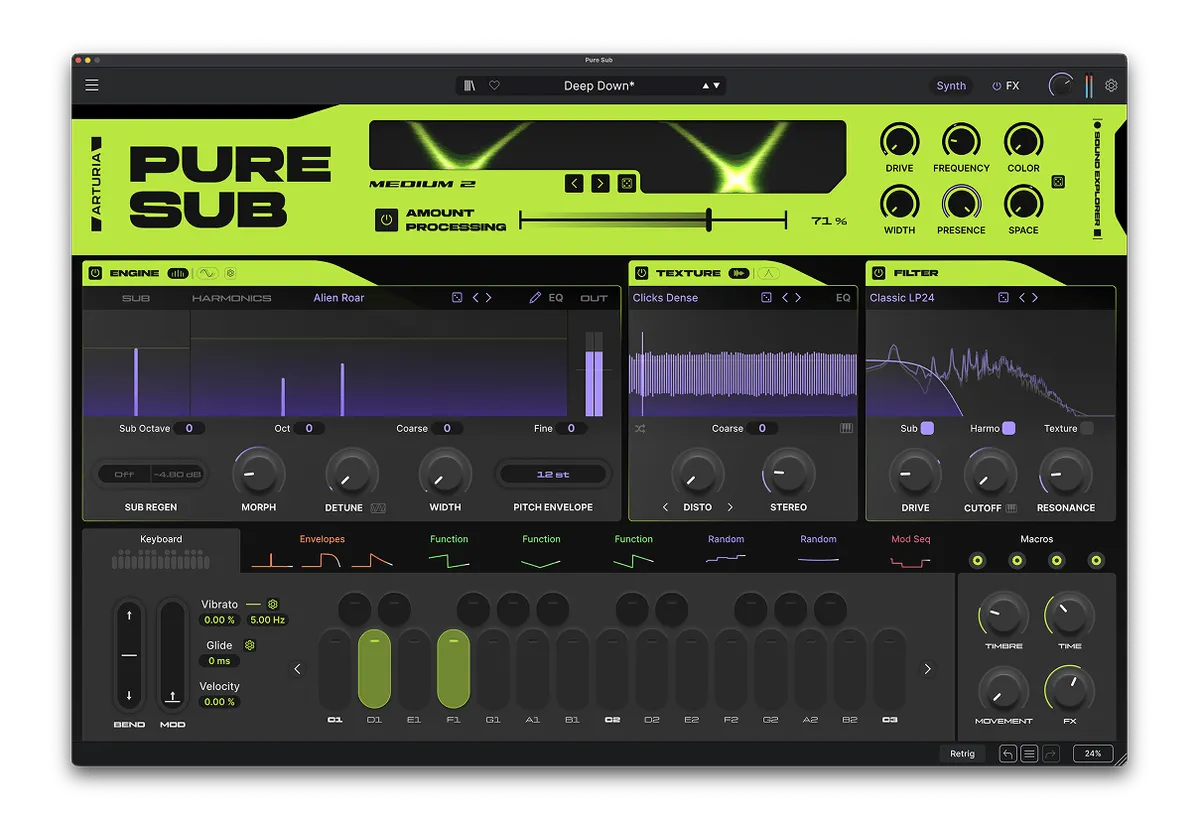
Arturia has released Pure SUB, a bass instrument built around one structural decision: the fundamental is kept separate from everything happening above it. A patch splits into Sub, Harmonics and Texture sections, and each can be routed into the filters and effects independently.
That is a more useful idea than it sounds, because it addresses the single most common failure in bass design.
The problem it is built around
Drive a bass sound hard and the low end usually suffers. Distortion is a non-linear process, so it does not simply add harmonics above the note: it reshapes the whole waveform, including the fundamental. Push far enough and the lowest component becomes unstable, loses level, or wanders in a way that will not sit still in a mix.
The usual workaround is to build the sound twice. One layer stays clean and carries the sub, another gets distorted for character, and the two are summed. Anyone who has made a hard dance or drum and bass patch has done this by hand with two instruments and a crossover.
Pure SUB moves that arrangement inside the instrument. Sub controls level and pitch independently of the harmonic layers, and Sub Regen exists specifically to restore a clean, stable fundamental after the signal has been pushed through filters, distortion and effects.
What is in each section
The Harmonics section switches between Pressure and Reese modes, covering waveforms from clean 808s to the moving, detuned shapes the Reese name implies. Texture completes the core with Noise or Corroder modes and can shape noise against the fundamental using ring modulation or AM.
Downstream there are more than 40 filter modes and a Sub Processor with 33 modes at varying degrees of distortion and tonal reshaping. The effects rack holds 18 effects across 12 slots, with saveable rack presets and soft and hard maximiser modes.
Modulation is three envelopes including a dedicated pitch envelope for kick-like attacks and gliding 808s, six flexible modulator slots taking function, random, envelope, step sequencer or voice modulator sources, and four assignable macros. There is also a Modulation Sidechain, which lets one modulation source control another rather than routing audio.
Where it sits
Arturia lists 300 presets, MPE support including Slide, NKS compatibility and MTS-ESP microtuning.
It runs as VST, Audio Unit and AAX on 64-bit hosts, Windows 10 or later and macOS 11 or later. One specification is worth reading before buying: ARM processors are not supported. That rules out Windows on ARM machines, and it is the kind of line that is easy to miss under a list of features.
The introductory price is 49 dollars or euros until 15 September, after which it is 79.
Producer’s note
The idea is worth stealing even if you do not buy the instrument.
If a bass patch needs heavy distortion but its lowest octave falls apart, stop trying to find a distortion setting that spares the fundamental. There usually is not one. Split the signal instead: low-pass a clean copy below roughly 100 Hz, distort the rest, and sum them. Check the result in mono, because two paths recombining is exactly the situation where phase relationships decide the low end.
That is the same routing Pure SUB is selling. Building it by hand costs a crossover and five minutes, and it tells you whether the idea is worth 49 to you before you spend it.
Read more at Arturiahttps://www.arturia.com/products/software-instruments/pure-sub/overview