Comb filtering: why a 1 ms delay cuts every other kilohertz
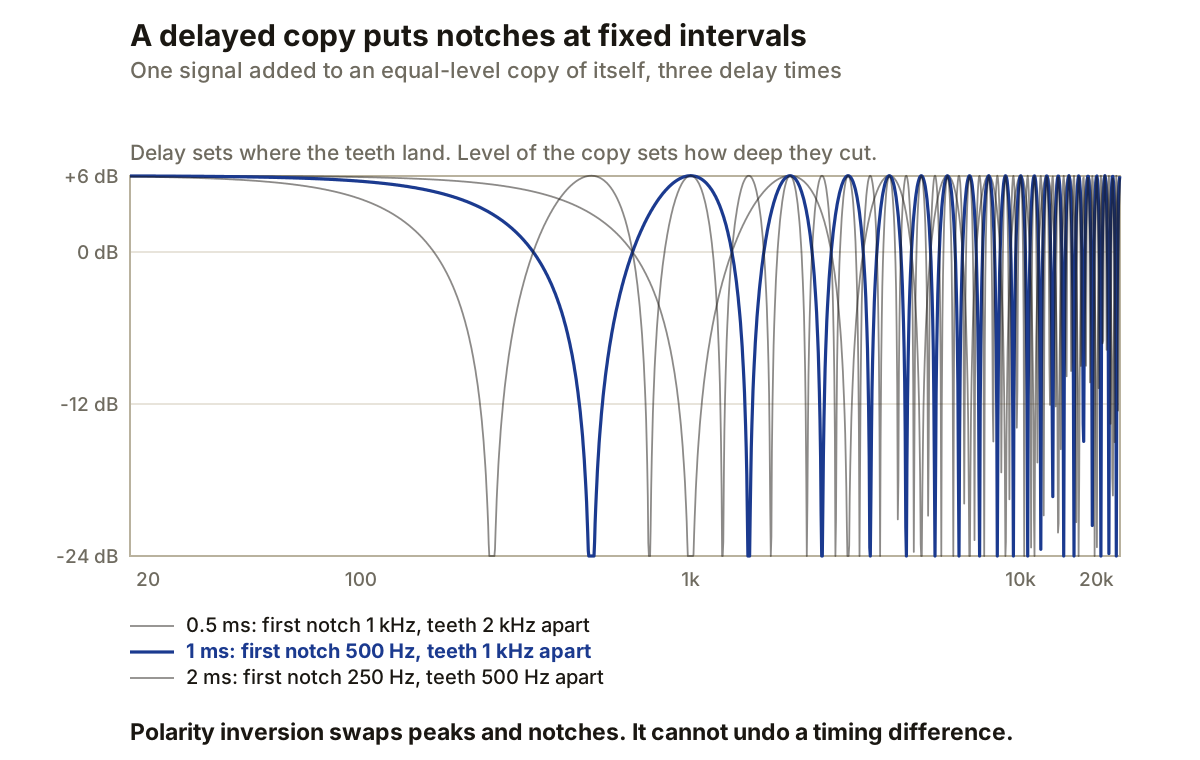
Comb filtering starts when a signal is mixed with a delayed copy of itself. Some frequencies add, others cancel, and the frequency response develops a regular row of peaks and notches. The delay decides where those teeth land. The level of the copy decides how deep they become.
This happens acoustically when one microphone receives direct sound plus a reflection, or when two microphones capture the same source from different distances. It also happens electrically when a dry track meets a delayed parallel path. With equal levels and polarity, a single millisecond puts the first cancellation at 500 Hz.
One delay creates many phase relationships
A delay is a different phase shift at every frequency. One cycle of a 1 kHz sine lasts 1 ms, so delaying it by 1 ms returns it to the same point in its cycle and the two copies add.
A 500 Hz sine takes 2 ms to complete one cycle. A 1 ms delay moves it by half a cycle, or 180 degrees. With equal level and polarity, one copy is positive whenever the other is negative, so they cancel.
At 1.5 kHz, 1 ms equals one and a half cycles, which also leaves the delayed copy 180 degrees away. The pattern repeats at 2.5 kHz, 3.5 kHz and onward.
For a direct signal added to an equal-level delayed copy, the spacing between adjacent notches is 1 / delay_seconds, and the first notch sits halfway to that spacing:
1 ms      notches 1000 Hz apart      first at 500 Hz
2 ms      notches 500 Hz apart       first at 250 Hz
0.5 ms    notches 2000 Hz apart      first at 1000 Hz
Longer delays crowd more teeth into the same frequency range. Peaks sit between the notches, reaching +6.02 dB where the two copies add in phase.
Level sets the notch depth
Perfect cancellation requires equal levels. If the delayed copy is quieter, its negative half-cycle cannot erase the direct signal completely.
A copy reduced by 6 dB has a linear gain of about 0.501. At a notch the two amplitudes subtract, leaving 1 - 0.501 = 0.499, which is about -6.04 dB relative to the direct signal alone. At a peak they add to 1.501, about +3.53 dB.
The response is still uneven, but it no longer falls to silence. DPA recommends attenuating delayed pickup by at least 10 dB when several microphones hear the same source. Their 3:1 placement rule aims for that: a neighbouring microphone should be at least three times farther from the source than the primary one, assuming equal sensitivity and gain. The arithmetic is 20 * log10(1/3), which is about -9.54 dB.
Polarity changes which frequencies cancel
Invert the delayed copy and the peaks and notches trade places. With equal levels, zero frequency now cancels, followed by notches at every whole multiple of 1 / delay_seconds. For a 1 ms delay those notches fall at 0, 1000, 2000 and 3000 Hz, with peaks at 500, 1500 and 2500 Hz.
This is why a polarity button cannot correct an arbitrary timing difference. It swaps one comb pattern for another. Polarity inversion fixes a signal that is reversed at all frequencies. A delay creates phase rotation that changes with frequency, so timing must be corrected with placement or delay.
Where it appears in a session
Two microphones on one source are the obvious case. A reflection from a nearby surface can create the same delayed copy inside a single microphone signal, which means track alignment cannot remove it later.
Parallel processing is another source. Plugin delay compensation should align paths inside the mixer, but routing through external hardware or an uncompensated bus can leave a short offset. Duplicate tracks can also drift by a few samples after editing. At 48 kHz, 1 ms equals 48 samples; at 96 kHz it equals 96.
Stereo widening by delaying one channel creates a left-right timing difference. Each channel can seem acceptable alone, yet summing to mono mixes the direct and delayed information and exposes the comb response. Check mono before committing that route.
Flanging uses the mechanism deliberately. A flanger varies a short delay over time, so the evenly spaced notches move. A fixed delay gives a fixed row of teeth; modulation turns that static response into the moving pattern associated with the effect.
Not every short offset is a problem, and moving a part deliberately off the grid is a separate technique with different arithmetic behind it.
Diagnose it before reaching for EQ
Start by finding two paths carrying the same performance. Mute one. If the remaining track recovers frequencies that seemed absent in the combined signal, timing is a likely cause.
Zoom to a clean transient and compare arrival times. Nudge one track by the measured sample offset, or enter that amount in a sample-delay plugin, and judge the sum after every move. Waveform peaks are useful landmarks, but two microphones may have different shapes because of placement and direction, so the best-looking alignment is not automatically the best sum.
For microphones, move the microphone before recording if you can. DPA gives 2 ms as roughly 66 cm of path-length difference, and Apple states that one sample at 44.1 kHz corresponds to 7.76 mm of acoustic travel. Small position changes therefore move every notch, rather than repairing one frequency with EQ.
If the unwanted copy is a room reflection, reduce its level by changing microphone position or reflection angle, or by absorption. An EQ boost at a notch cannot restore information that has cancelled, and the notch locations move the moment the source or microphone moves.
Producer’s note
Build one in a minute and watch the two controls separate cleanly.
Duplicate a mono track, delay the copy by 48 samples in a 48 kHz session, and leave both at equal level. Insert a spectrum analyser after the sum. The first notch should sit near 500 Hz with further notches 1 kHz apart. Now lower the copy by 10 dB and watch the notches become shallower without moving.
That is the whole mechanism in one test: delay sets the spacing, level sets the depth. Once you have seen it, a hollow-sounding pair of microphones stops being a mystery and becomes a measurement.