Nudging tracks off the grid: what moving a part 10 ms actually changes
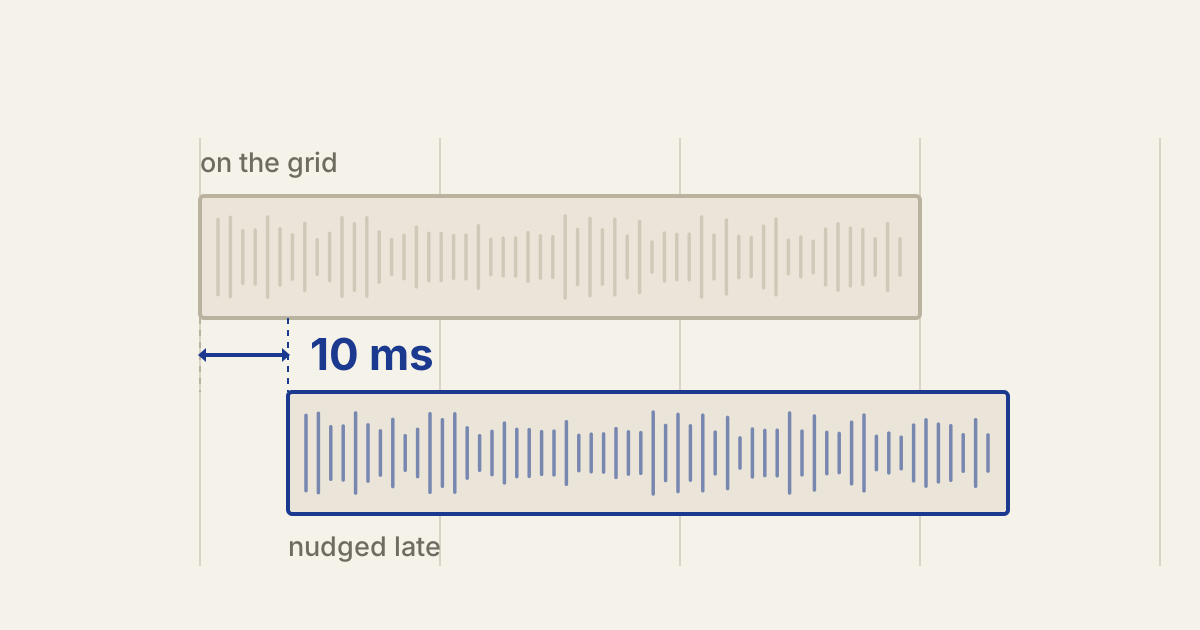
The advice turns up in every mixing thread. Slide the guitars back five to fifteen milliseconds and the low end clears up. Move the vocal off the snare and it stops fighting the drums. The technique works. The explanation that travels with it usually does not, because three separate things happen when you move a part in time, and only one of them has anything to do with frequency.
Knowing which one you are using is what decides whether the right answer is five milliseconds or fifty.
One: comb filtering, which needs two copies of the same sound
Sum two versions of one signal with a delay between them and they reinforce at some frequencies and cancel at others. The pattern is set by the offset alone. Cancellations land at (2n+1)/2T and reinforcements at n/T, where T is the delay in seconds.
At a 10 ms offset that means deep notches at 50, 150 and 250 Hz, with boosts at 100, 200 and 300 Hz. Change the offset and the whole comb slides.
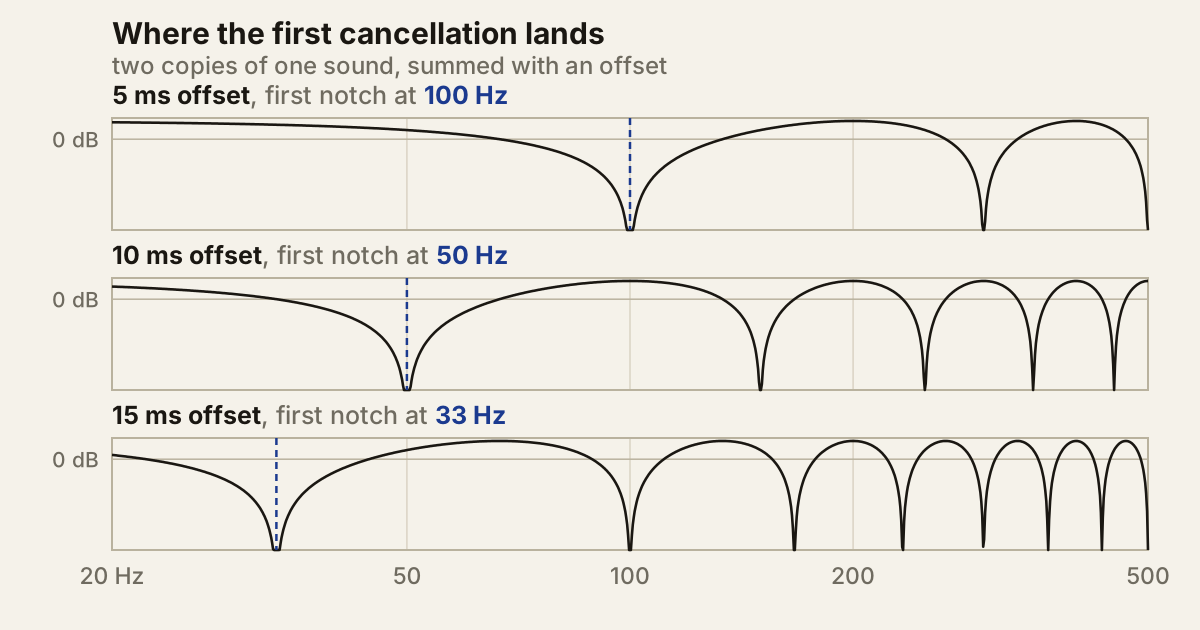
This is the part of the folklore that holds up, and it is also why the useful range is five to fifteen milliseconds rather than any number at all. Across that span the first notch walks from 100 Hz down to 33 Hz, which is exactly the region where a bass and a kick compete. You are not clearing the low end in some general sense. You are dragging a cancellation through it until it lands somewhere that helps.
The catch is the word same. Comb filtering needs correlated signals: a doubled take against its twin, a DI against the mic’d cab, two mics on one source, a kick and a bass holding the same note. Two parts playing different notes share no coherent content, so there is nothing to comb, and the summed spectrum barely moves however far you slide them.
The test takes ten seconds. Solo the pair, find one sustained low note, and sweep the offset. If the level of that note swings, the comb is real and this section is what you are hearing. If nothing happens, it is one of the next two.
Two: transients arriving in the same instant
Between parts that share no coherent content, a vocal against a snare or rhythm guitars against a lead, moving one in time changes almost nothing about the frequency content of the mix. Put an analyser on the sum before and after and the curve is the same.
What changes is when the attacks land. A snare hit and a hard consonant on the same millisecond are two loud transients competing for one instant, and the ear resolves that badly. Separate them by ten or twenty milliseconds and each gets its own moment. Nothing was equalised. The parts simply stopped colliding.
That is why the trick works on a vocal against drums, where the spectral explanation predicts no effect whatsoever.
Three: feel, which has no acoustics in it at all
A part sitting slightly late reads as relaxed. Slightly early reads as pushing. Drummers and bass players do this without a DAW, and quantising everything to the grid is what removed it in the first place.
Worth separating from the other two, because it scales differently. Comb filtering is set by arithmetic and does not care about tempo. Feel is a proportion of the beat: 10 ms is a far smaller slice of a sixteenth note at 90 BPM than at 170. The same nudge that fixes a collision on a slow track is a groove change on a fast one.
Why it never sounds like an echo
Below roughly 30 ms the hearing system stops treating two arrivals as two events. It fuses them into one and places the result at whichever came first. This is the same mechanism that keeps a room’s early reflections from sounding like a run of slapbacks, and it is what makes pre-delay work.
So the change registers without the ear reporting a delay. It has a name, precedence, and it is the reason the technique feels like a mystery from the inside. Push past about 40 ms and fusion breaks down, the offset starts to be heard as a separate hit, and the ceiling on the whole technique is reached.
The move that will cost you
Nudging a stem or a whole performance is safe. Nudging one microphone of a multi-mic’d source is not.
If you have already aligned an overhead pair, a DI against a cab, or the top and bottom of a snare, that alignment is a phase relationship you set deliberately. Sliding one member of the group by 10 ms does not improve it gently, it replaces it with a different comb filter you did not choose. Move the group, never a member of it.
A smaller cost worth knowing: moving a part earlier needs audio in front of its start. On the first bar of a song there may be none, and the region will just clip at the front.
Producer’s note
Ten milliseconds is 441 samples at 44.1 kHz and 480 at 48 kHz, so if your DAW nudges in samples those are the numbers to type.
It is also 3.4 metres of air. Pushing a guitar 10 ms late puts it in the timing position of an amp three and a half metres further back, while the level and the top end stay exactly where they were. That is the genuinely useful part: the distance cue without the tone of distance, which is not something an EQ or a reverb can hand you.