Pre-delay: how to add reverb without pushing a vocal backwards
The usual complaint about reverb is that adding enough of it to hear makes the part sound distant. You want the space, you do not want the vocal to retreat three metres. Pre-delay is the control that separates those two things, and it is often left at zero because it looks like a technical setting rather than a creative one.
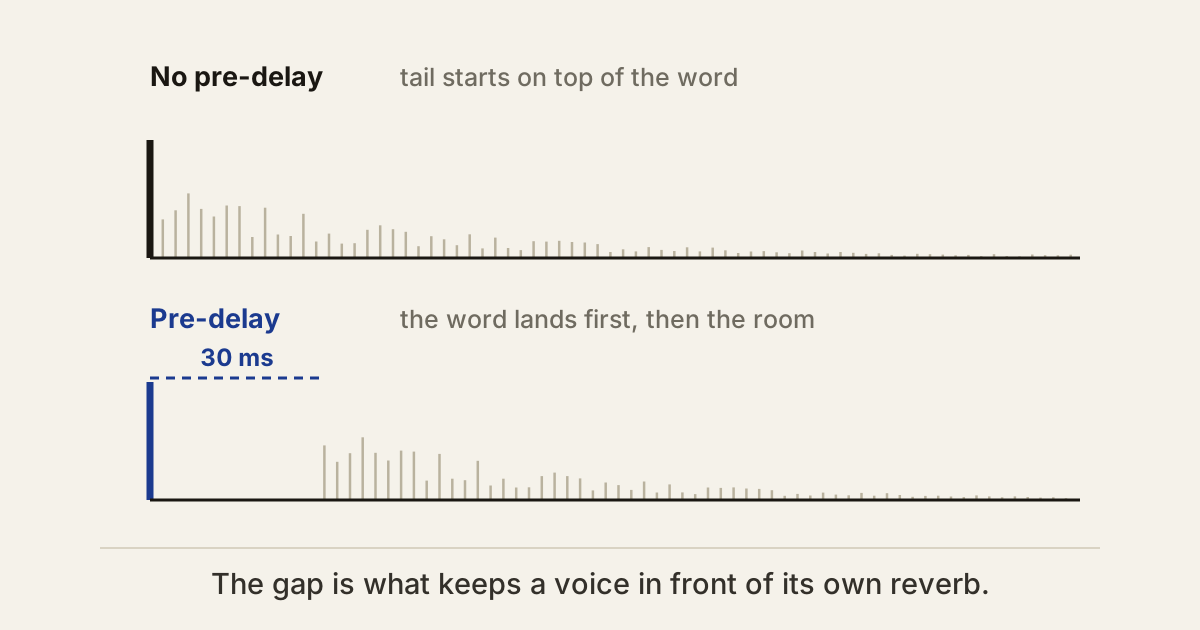
Pre-delay is the gap between the dry sound and the moment the reverb starts. That is all it is.
Why a few milliseconds change so much
Your ear works out where a sound came from using what arrives first. Once it has decided, later reflections of the same sound get folded into the impression of the room rather than moving the source. The decision window is short, in the region of a few tens of milliseconds.
That is the whole trick. With no pre-delay, the reverb starts at the same instant as the voice, so the two arrive as one event and the ear places the source somewhere inside the reverb. Put 30 ms between them and the voice arrives alone, gets located up front, and the reverb that follows is heard as the room the voice is standing in.
More reverb, same position. That is not a compromise, it is how the hearing system works.
Rough starting points
0 to 10 ms glues the reverb to the source. Right for a small room sound, a plate that is meant to feel like part of the instrument, or anything you want sitting further back on purpose.
20 to 40 ms is the vocal range. Enough separation to keep the words in front, not so much that the reverb reads as a distinct echo.
50 ms and beyond starts to be heard as a separate event. That can be a deliberate effect, especially on slow material, but it stops sounding like a room.
There is a physical reading of these numbers too. Sound covers roughly a third of a metre per millisecond, and a reflection has to travel to the wall and back, so 30 ms of pre-delay is close to standing five metres from the nearest surface. Zero pre-delay is standing with your face against it.
Pre-delay and decay are not the same control
These two get swapped for each other constantly, because both of them make a space sound bigger.
Decay is how long the tail lasts once it has started. Pre-delay is how long it waits before starting. One is the length of the reverb, the other is the gap in front of it, and they can be set independently.
FabFilter’s Pro-R 2 keeps them on separate controls and is explicit about what each covers. Its Space knob combines the room model and the decay time together, running from a 200 ms ambience up to a ten-second cathedral, and its Decay Rate then scales whatever that gives you between 25% and 400%. Pre-delay is a knob of its own that does not touch either.
The reason they feel interchangeable is that FabFilter is right about both: higher pre-delay settings tend to increase the perceived room size, and so does a longer decay. Turn up either one and the space grows.
What separates them is the cost. A longer decay is still sounding when the next word arrives, so it buys size by spending clarity. Pre-delay buys size by spending nothing, because the tail it delays is the same length it always was.
FabFilter puts the same conclusion in its own manual: increasing pre-delay instead of the overall decay time can work well in achieving a less intrusive, more natural reverb that sits better in a mix.
That gives you a diagnostic with two branches. If the reverb is blurring into whatever comes next, the decay is too long, and no amount of pre-delay will fix it. If the source itself sounds distant, the decay is not the problem and pre-delay is.
Setting it to the tempo
Pre-delay is a delay, so it can be musical. Many reverbs let you sync it to note values, and matching it to a 32nd or 64th note lands the reverb entry on the grid instead of between the beats. On a dense track that is the difference between a tail that reinforces the rhythm and one that blurs it.
If your reverb has no sync, the arithmetic is quick: a beat at 120 BPM is 500 ms, so a 32nd note is about 62 ms and a 64th about 31 ms.
The order that matters
Pre-delay only helps if the dry signal actually reaches the listener first, which means the reverb has to be on a send rather than inserted across the channel. On an insert with a wet-heavy mix, there is no untouched dry path to arrive early, and the effect disappears.
Producer’s note
If a vocal still feels far away after setting pre-delay, the reverb is probably too bright rather than too loud. Distant sounds lose their top end on the way to you, so a tail with plenty of high frequency reads as close and expensive, while the same reverb with the highs rolled off reads as far away. Try lifting the pre-delay and cutting the tail above 6 or 7 kHz, and judge the two changes separately.