Transient shapers: how attack and sustain controls find events
A transient shaper changes the level envelope around detected events. Its Attack control works on the beginning of an event, while Sustain or Release works on what follows. This resembles compression, because both processes apply changing gain, but the detector logic is different.
A compressor normally compares level with a threshold and follows a ratio above or below it. A classic transient shaper compares envelopes moving at different speeds. Their difference indicates that the signal is rising quickly, settling or decaying.
Two followers describe one event
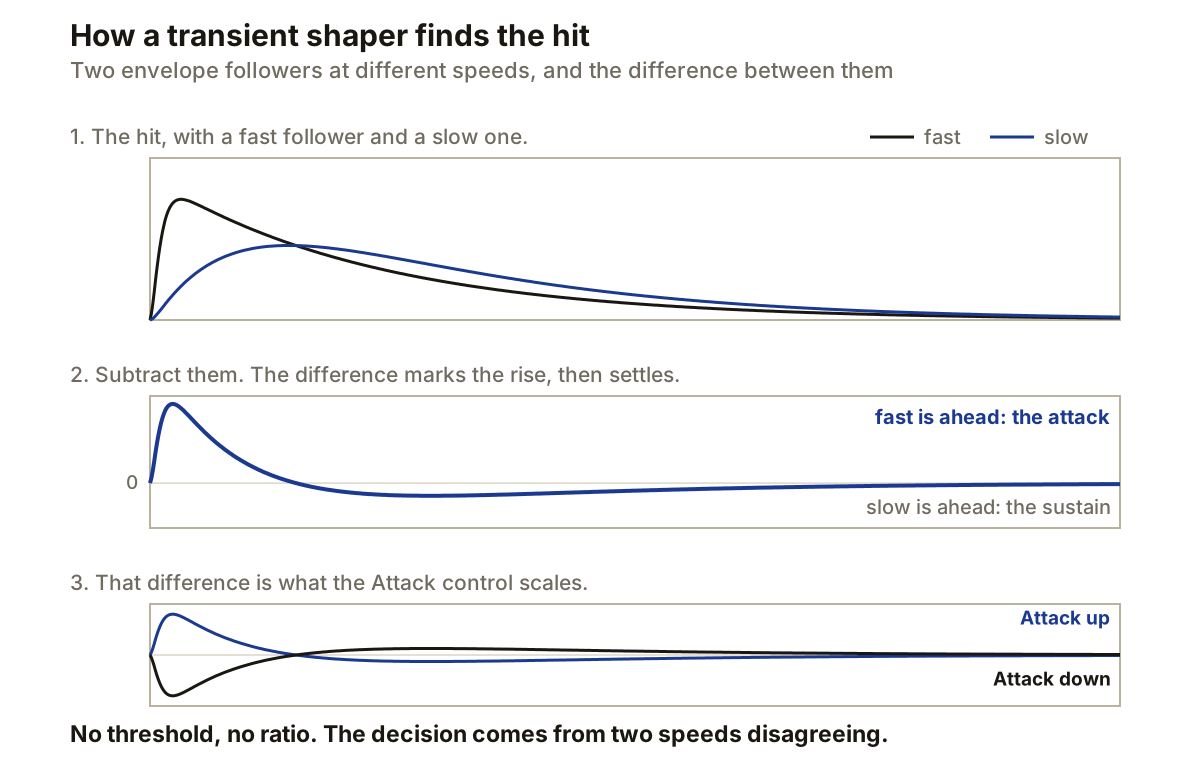
SPL explains its Differential Envelope Technology as the difference between envelope followers. One follower tracks the input closely. Another responds more slowly. Subtracting one from the other produces a control signal tied to changes in the envelope rather than its absolute level.
During a fast rise the quick follower moves ahead of the slower one and their difference becomes positive. The processor uses that difference to raise or lower gain around the transient. Once both followers catch up, the difference crosses zero and goes slightly negative while the slow one is still coming down, which is the region a Sustain control acts on.
The simplified path is input, then envelope followers, then their difference, then attack and sustain control signals, then a changing gain, then output.
This is why many transient shapers need no ratio and no manually placed threshold. SPL describes its design as level-independent because the decision comes from envelope differences. Apple’s Enveloper can also work independently of absolute input level, although Apple notes this requires its Threshold control at the lowest value.
Level independence is a design choice, not a rule for everything called a transient shaper. If the processor has Threshold or Sensitivity controls, those settings decide which events enter the process at all.
Attack gain is not attack time
An Attack knob on a transient shaper usually sets the amount of gain applied to the detected beginning. Positive values increase it, negative values attenuate it.
This differs from a compressor’s attack time, which describes how quickly gain reduction develops after detection. Turning down transient-shaper Attack directly reduces the detected initial portion. Lengthening a compressor’s attack instead allows more of that portion through before reduction develops.
Some transient shapers expose a separate length control. Steinberg’s EnvelopeShaper provides an Attack range of -20 to +20 dB and an attack Length range of 5 to 200 ms. There the two controls have separate jobs: Attack sets the gain change, Length sets how much of the event counts as the attack phase.
A processor supplying only an Attack amount is choosing its timing internally. SPL states that its time constants adapt to the characteristics of the input signal, so the knob cannot be translated into a fixed number of milliseconds.
Sustain changes what happens after detection
Sustain, Release or Tail controls act on the later portion of an event. The terminology varies, but the operation is another time-varying gain change.
Positive Sustain holds the gain envelope above its neutral position for longer. Negative Sustain reduces the detected decay. This alters room pickup, cymbal decay or the body following a picked note without placing a gate threshold between wanted material and noise.
It does not rewrite the source envelope. The processor keeps applying gain while the event runs, so a large positive setting raises spill and background noise along with the wanted decay, and a large negative setting removes quiet detail between the transient and the end of the event.
Attack and Sustain also interact. Increasing Attack while reducing Sustain enlarges the level difference between beginning and decay, which is a crest factor change as much as a tonal one. Set one control at a time before deciding both need to move.
Detection depends on context
A single isolated hit gives the detector a clear rise followed by a decay. A drum bus is harder. One instrument’s decay may still be active when another transient arrives, so the envelope followers are analysing their sum.
This is why the same setting acts differently on a solo snare and on a full loop. A sustained bass note or cymbal wash keeps the slower envelope raised, and the next event then produces a different envelope difference from the one it generated in isolation.
Side-chain filtering can narrow the detector’s attention. SPL provides a side-chain filter for preventing selected frequency regions from controlling its transient process, and Steinberg’s EnvelopeShaper accepts an external side-chain signal, which can trigger processing from another source.
Multiband designs split the signal before detection and processing, so they can raise the attack in one frequency region while leaving another unchanged. The trade is more setup: crossover positions and separate detectors affect which part of a broadband event each band identifies as its beginning.
Output level still needs attention
Transient shaping can raise sample peaks. Steinberg warns that positive gain settings may clip the output and provides an Output control for compensation.
Do the first comparison with the output reduced enough to preserve headroom, and match the processed and bypassed passages by overall level before judging the envelope change. A pass with increased Attack will otherwise win, because its peaks and short-term level are higher.
Peak meters reveal whether the attack adjustment created a new ceiling problem. An RMS or loudness meter shows whether Sustain changed the longer-term level. Use both, because a short attack boost can move the peak meter far more than the programme average.
Set the detector before the amount
Begin with Attack and Sustain at zero. If the processor supplies Sensitivity or Threshold, move it until wanted events produce consistent activity while spill does not dominate the detector.
Raise Attack by a small amount and watch the output peak. Return it to zero, then reduce Attack by the same amount. That establishes which part of the event the processor has classified as its beginning.
Repeat with Sustain, using a section containing both isolated events and overlaps. A setting that works only on the isolated hit is not ready for the full performance.
Finish by matching output level and checking bypass. If attack timing needs to change rather than its level, use an envelope editor, a sample start control or a dynamics processor with explicit timing. A transient shaper modifies the detected beginning; it does not move that beginning earlier or later on the timeline.
Producer’s note
Find out what the processor has decided is the attack before you set an amount.
Send four identical drum hits through it with 500 ms between them. Set Attack and Sustain to zero, then render three passes at Attack -6 dB, 0 and +6 dB with Sustain untouched. Compare the first 20 ms against the following 200 ms in a waveform editor.
The attack region should change substantially more than the later section. If it does not, the detector is classifying more of the event as the beginning than you assumed, and every setting after that will be working on the wrong part of the hit. Reduce output gain before the positive pass if its peak approaches 0 dBFS.