Compressor ratio: what 2:1, 4:1 and 10:1 actually mean
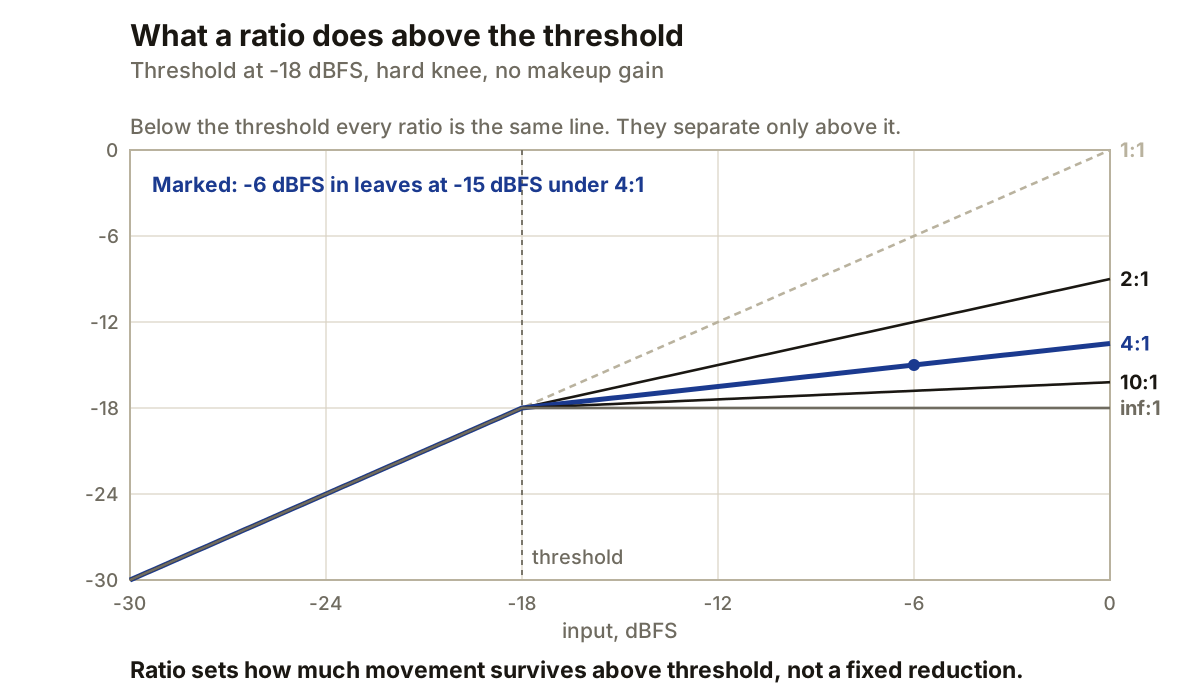
A compressor ratio describes how far a signal may continue above the threshold after gain reduction. It does not specify a fixed number of decibels to remove. The result depends on the threshold and on how far the detected input crosses it.
This is easiest to understand as arithmetic. With a hard knee and a steady signal, the amount above threshold is divided by the ratio. A 4:1 ratio leaves 1 dB at the output for every 4 dB that entered above threshold.
Read the ratio from left to right
The first number is the input movement above threshold. The second is the remaining output movement. At 2:1, every 2 dB above threshold becomes 1 dB. At 10:1, every 10 dB becomes 1 dB. A 1:1 setting leaves the level unchanged. At infinity:1 the static curve becomes horizontal above threshold, so additional input level produces no additional output level.
For a hard-knee downward compressor, write the relationship as:
output = threshold + (input - threshold) / ratio
The expression in parentheses is the amount above threshold. Dividing that by the ratio gives the permitted output overshoot. Adding the threshold places the answer back on the dBFS scale.
Suppose the threshold is -18 dBFS and the detected input is -6 dBFS. The signal is 12 dB above threshold:
2:1         leaves 6 dB above      output -12 dBFS      6 dB of reduction
4:1         leaves 3 dB above      output -15 dBFS      9 dB of reduction
10:1        leaves 1.2 dB above    output -16.8 dBFS    10.8 dB of reduction
infinity:1  leaves nothing above   output -18 dBFS      12 dB of reduction
These figures are before makeup gain. They describe the static transfer curve rather than the moment-by-moment reading from programme material.
Ratio does not work alone
Moving the threshold changes how much signal enters the calculation. Keep the ratio at 4:1 but raise the threshold from -18 to -12 dBFS. The same -6 dBFS input is now only 6 dB above threshold. Dividing by four leaves 1.5 dB above it, so the output is -10.5 dBFS and the gain reduction is 4.5 dB.
This is why comparing ratio settings while an automatic threshold is moving is confusing. Two passes may show similar gain reduction even though the ratios differ. For a controlled comparison, disable automatic threshold and automatic makeup, then hold the threshold and input level still.
The knee also changes the simple calculation near threshold. A hard knee joins the uncompressed and compressed lines at one point. A soft knee bends between them across a range of levels, so compression begins progressively around the nominal threshold. The hard-knee equation becomes exact only once the signal is beyond that transition.
Range imposes another limit. Ratio determines the slope above threshold, while range caps the available gain change. If a 4:1 setting calls for 9 dB of reduction but the range is limited to 6 dB, reduction stops at 6 dB. The output then rises one-for-one with any further input increase, because the compressor has reached its gain-reduction ceiling.
Attack and release make it dynamic
The transfer equation assumes the compressor has settled. Real material rarely holds one level long enough for that to happen. Attack controls how gain reduction develops after the detector responds. Release controls how it returns after the level falls.
A short peak can therefore receive less reduction than the static ratio predicts. At 4:1, a peak 12 dB above threshold does not guarantee 9 dB on the gain-reduction meter. If the peak ends before the attack envelope reaches its target, the compressor never arrives at the calculated value.
The detector matters as well. Peak and average-sensitive detection produce different control signals from the same waveform, and side-chain filtering can keep selected frequencies from driving the detector as strongly. Ratio still scales the level presented by that detector, but the detector decides what level enters the calculation.
Makeup gain does not change the ratio
Makeup gain is applied after gain reduction. Add 6 dB of makeup and a calculated -15 dBFS output becomes -9 dBFS. The curve shifts upward, but its slope above threshold remains 4:1.
This can make a higher ratio appear preferable in a bypass comparison, because the processed version is louder. Set makeup to zero while learning the control. Once threshold and ratio are doing the intended job, match the processed output to the bypassed level before judging the result.
Choose a ratio by retained movement
Think about how much level movement should remain after the threshold crossing. If a source moves 8 dB above threshold, 2:1 retains 4 dB of that movement, 4:1 retains 2 dB, and 8:1 retains 1 dB.
Start at 2:1 when much of the original movement should remain. Move toward 4:1 or 8:1 when peaks need to occupy a narrower output range. Then set attack and release for the timing of the gain change, and use range if the reduction needs a firm ceiling.
Producer’s note
Feed the compressor a steady tone and set the threshold to -18 dBFS, hard knee, 4:1 ratio and zero makeup gain.
After the envelope settles, inputs of -24, -18, -12 and -6 dBFS should produce static outputs of -24, -18, -16.5 and -15 dBFS. A different result tells you something else is active: knee, range, detector behaviour or another gain stage in the path. That is a two-minute test that turns an abstract control into a number you can predict.