HoRNet SpectraDuck does spectral ducking at 5 ms, which is the interesting number
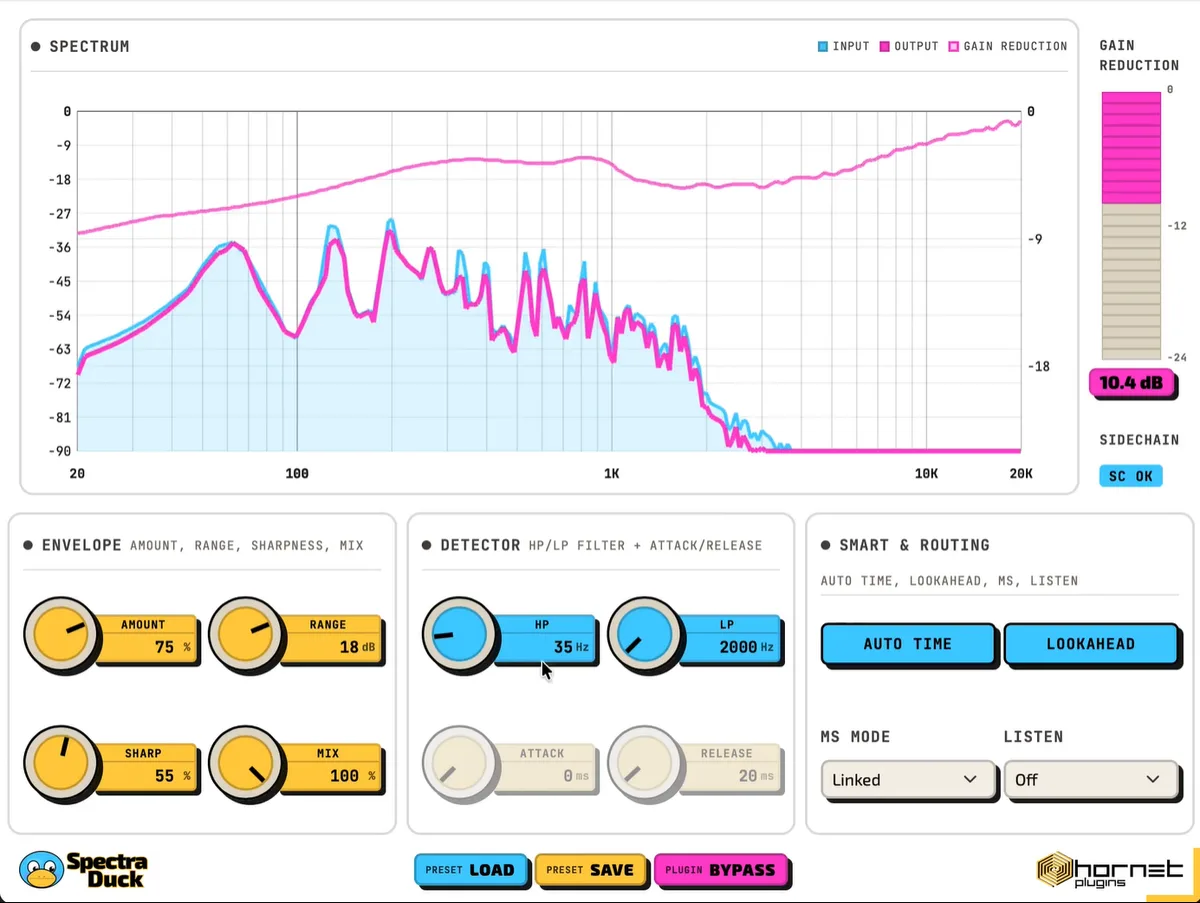
HoRNet have released SpectraDuck, a sidechain ducker that works in the frequency domain. Instead of pulling the whole signal down when the trigger is loud, it compares the two spectra and takes gain off only where the trigger actually has energy.
This is the second plugin in a fortnight doing that, after ZL Spectrum Equalizer, which suggests it is becoming a category rather than a curiosity. The two are worth reading against each other, because they have made opposite choices about the one trade that governs this kind of processing.
Why the latency figure is the headline
Frequency resolution is bought with time. An FFT’s bin width is the sample rate divided by the window size, so a longer window resolves finer detail and delays the audio by more.
ZL publishes its bill openly: seven settings from roughly 12 ms to roughly 743 ms. HoRNet states approximately 5 ms, DAW-compensated.
Run the arithmetic on what 5 ms buys at 48 kHz and you get 240 samples, which is a bin width of 200 Hz, and nearer 400 Hz once a window function widens each bin’s response. Down where a ducker earns its living that is very coarse indeed:
a 200 Hz bin at  50 Hz spans 27.9 semitones
a 200 Hz bin at 100 Hz spans 19.0 semitones
a 200 Hz bin at 200 Hz spans 12.0 semitones
a 200 Hz bin at 1 kHz spans  3.2 semitones
A kick and a bass note living inside one bin cannot be separated by anything downstream of that analysis, which is the exact job people buy a spectral ducker to do.
Two caveats before treating that as a verdict. HoRNet do not publish their window size, and a plugin’s reported latency is not necessarily its analysis window: the 5 ms could be the lookahead, with a longer window running behind it. There are also ways to get frequency resolution other than a plain long-window FFT.
So the honest position is that 5 ms is either a genuinely clever piece of engineering or a coarse analysis, and the specification as published does not say which. The demo settles it, and it is free with no time limit.
The controls
Three knobs do the work. Amount sets how hard it pushes, from 0 to 100 percent. Range caps the ducking at up to 24 dB. Sharpness moves it between surgical and broad, which in practice means how closely the gain-reduction curve follows the sidechain’s spectral shape.
An HP/LP detector filter restricts which part of the sidechain the plugin listens to, so a kick trigger can be told to ignore everything above a couple of hundred hertz rather than ducking your target’s top end on every hit.
Auto Time estimates attack and release from the sidechain material. Lookahead is switchable for percussive triggers, and it is worth knowing that this is where a chunk of that latency will come from, and that it belongs off on anything record-enabled.
MS mode runs Linked, Mid Only or Side Only, which is the useful one for bus work: ducking only the middle leaves a wide pad intact while the kick still gets its space.
Listen lets you monitor the sidechain, the reduction alone, or normal output. The display overlays the input spectrum in cyan against the output in magenta, with the gain-reduction curve tracked above and a numeric readout beside it.
Price and formats
VST3, AU and AAX, 64-bit. macOS 10.15 and up including Apple Silicon through M4, and Windows 10 and 11.
29.99 euros, one-time, with lifetime updates and a 15-day money-back guarantee. The demo is fully functional with no time limit, which given the open question above is the sensible place to start.
Producer’s note
Set the amount with both sources playing at their final levels, never with either soloed. Masking is relational: an amount that looks correct against a soloed kick is almost always too much once the arrangement is in.
Then test the thing the specification cannot tell you. Feed it a kick and a bass line playing in the same octave, and listen to whether the bass survives the kick’s fundamental or gets pulled down with it. That single test separates a ducker with real resolution at the bottom from one that is effectively a fast broadband compressor with a nicer display, and it takes about a minute.
Read more at HoRNet Pluginshttps://www.hornetplugins.com/plugins/hornet-spectraduck/