Hard sync: why it changes the harmonics without changing the note
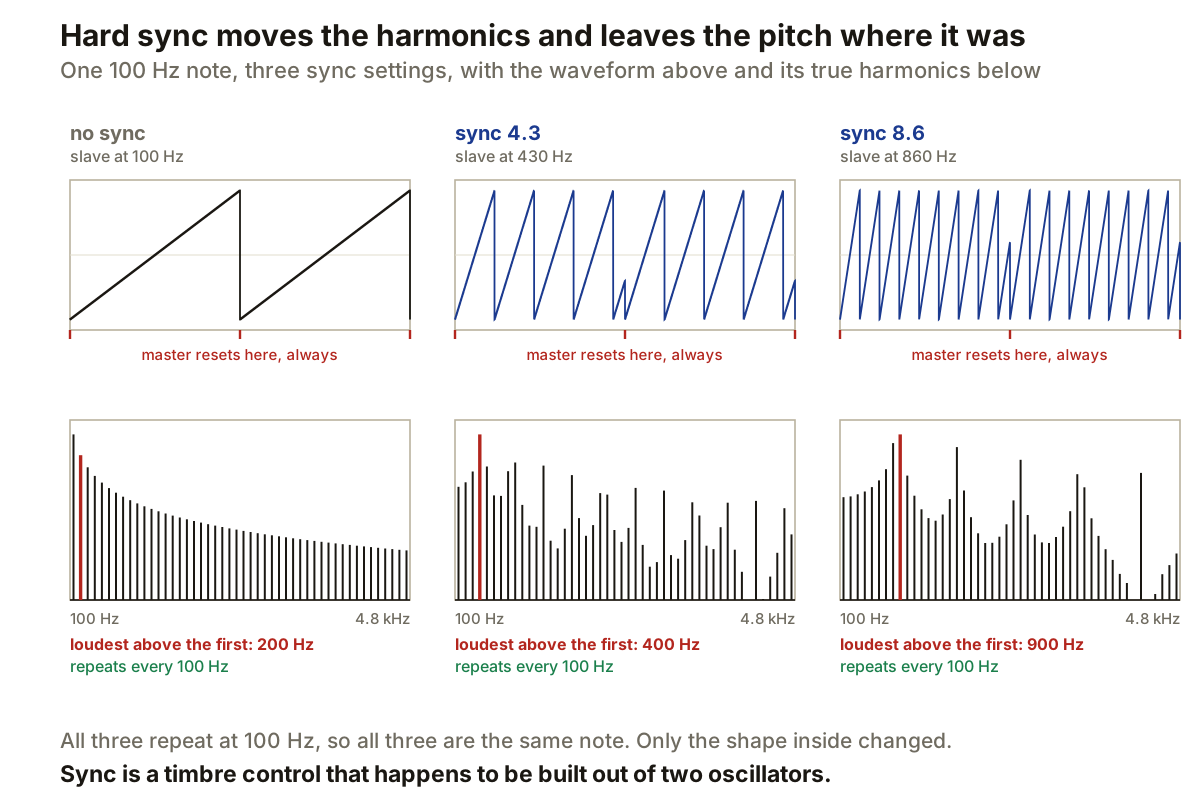
Hard sync uses two oscillators to make one sound, and only one of them is audible. The second is there to interrupt the first.
That arrangement is unusual enough that the control does not behave like the other controls around it. Turning it up does not add a second voice, does not detune anything, and does not move the pitch. It changes the timbre and leaves everything else alone.
What the reset actually does
One oscillator is the master. It is tuned to the note you played, and it is not heard. The other is the slave, it runs at its own frequency, and it is the one that reaches the output.
Every time the master completes a cycle it forces the slave’s phase back to zero. The slave is cut off wherever it happens to be and starts again.
FabFilter puts it in terms of what the knob does to the waveform: raising Sync makes the oscillator squeeze more phases into one audible phase, which they say drastically changes the harmonics and gives a metallic-sounding effect. Surge XT scales the same control in musical terms instead, offering hard sync over a range of 60 semitones.
The waveform panels above are that description made literal. The red ticks mark where the master resets, and they sit in the same two places in all three columns. At no sync the slave completes exactly one cycle between resets. At 4.3 it gets through four and is cut off part way through a fifth. At 8.6 it manages eight and a bit.
The pitch does not move, and the reason is mechanical
The output repeats when the master repeats. That is forced, because the reset happens on the master’s schedule, so whatever shape the slave produces between two resets is the same shape it produces between the next two.
A waveform that repeats 100 times a second is a 100 Hz note. It does not matter what is happening inside the period.
All three columns measure the same way: every one of them repeats at 100 Hz, so every one of them is the same note. That is not an assertion about how it sounds, it is a property of the waveform that the diagram checks before it draws anything.
The harmonics move, and they follow the slave
The other half is equally measurable. With no sync, the loudest partial above the fundamental is the second harmonic at 200 Hz, and the weight of the spectrum sits at 275 Hz. At sync 4.3 the loudest is at 400 Hz and the weight has moved to 773 Hz. At sync 8.6 the loudest is at 900 Hz and the weight is up at 1316 Hz.
Notice where those peaks land. The slave is at 430 Hz and the peak is at 400. The slave is at 860 Hz and the peak is at 900. The bright spot in the spectrum sits on the slave’s own frequency, within one harmonic of it, at every setting.
Which means a sync sweep is a moving peak in a spectrum whose fundamental never moves. That is the same shape of thing as a formant, and it is why sweeping sync sounds vocal rather than melodic.
Whole numbers are the dead spots
Here is the part worth knowing before you spend an hour on a patch that will not do anything.
Set the ratio to exactly 2 and the slave completes precisely two cycles between resets. Nothing is cut off, because the reset arrives at the moment the slave was going to restart anyway. The result is a plain sawtooth at twice the frequency: its harmonics are 2, 4, 6, 8 and up, with the odd ones absent entirely.
An octave, in other words. Not a timbre change. Exactly 3 gives you a twelfth, exactly 4 gives two octaves, and in each case the interruption never happens.
Sync lives between the integers. The further from a whole number the ratio sits, the more of the slave’s cycle gets cut off, and the more the waveform differs from a plain one.
This is the mirror image of what ratios do in FM, where whole numbers are the safe setting and everything else drifts off the note. Here whole numbers are the setting that does nothing.
Two controls with similar names
FabFilter’s oscillator panel has a Sync knob and a Phase Sync button, and they are unrelated.
Sync is what this article is about. Phase Sync resets the oscillator’s phase to the middle of the waveform once per note-on, so every note starts identically. FabFilter recommends it for short percussive sounds, where it makes the attack consistent, and recommends leaving it off otherwise because it can introduce clicks.
One happens thousands of times a second and shapes the tone. The other happens once per note and shapes the attack.
The cost
A forced reset leaves a step in the waveform, and a step contains energy at every frequency. That is the source of the brightness, and it is also why hard sync is one of the classic ways to make an oscillator alias.
A well-written oscillator handles this and a careless one does not. If a sync sweep develops tones that move downward while you are moving the control upward, that is aliasing rather than the effect, and oversampling is the setting to look for.
Producer’s note
Put sync on a modulation source rather than setting it and leaving it. FabFilter makes Sync a modulation target for exactly this reason, and an envelope on it gives the swept vowel sound the technique is known for.
Set the master to the note you want and use the slave purely as a tone control. Nothing you do to it will change the pitch, so there is no reason to be careful with it.
And if a sync setting sounds like a clean interval rather than a change of character, you have landed on a whole number. Move it a fraction and the effect comes back.