Envelope followers: the modulation source that has no shape of its own
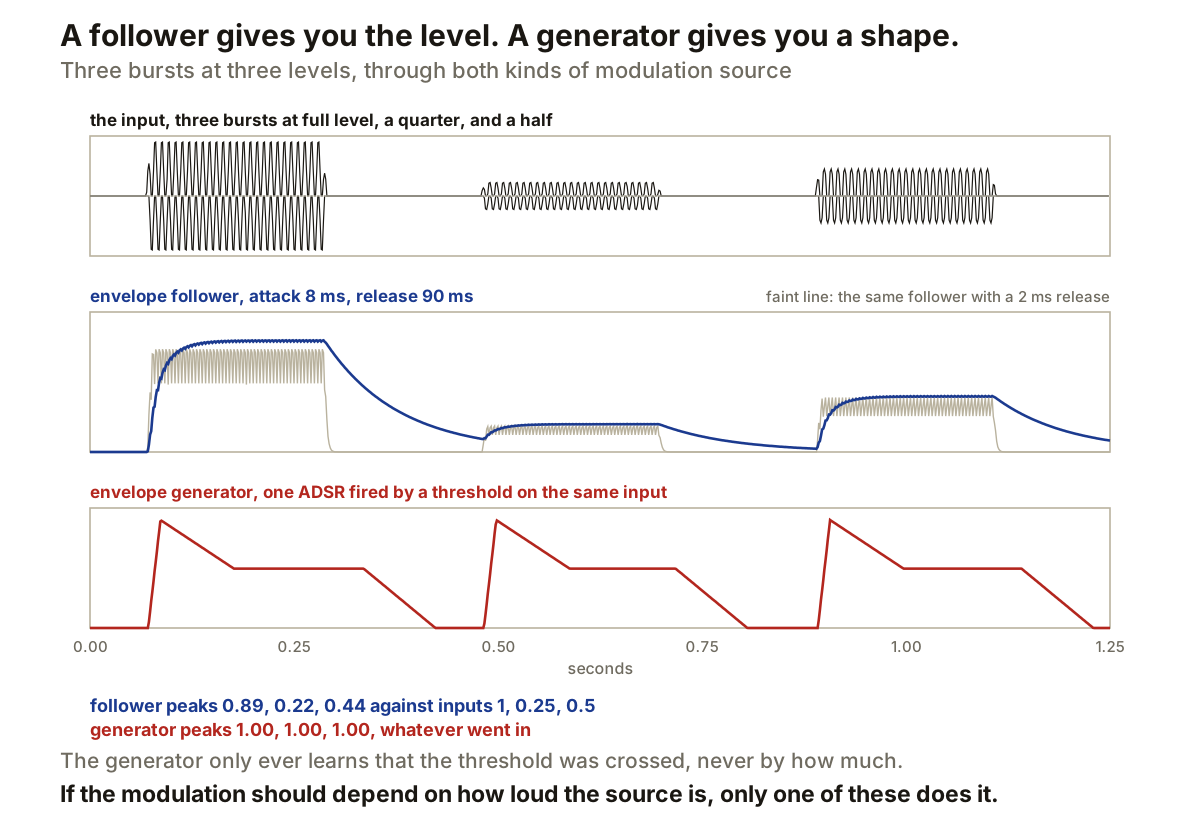
An LFO invents a shape and repeats it on its own clock. An envelope generator invents a shape and plays it when something triggers it. Both decide in advance what the modulation will look like.
An envelope follower decides nothing. It has no shape stored anywhere. What comes out is whatever is going in, measured.
What it actually does
Two steps, and that is the whole processor.
Rectify the incoming audio, so the negative half of every cycle is folded upwards and the signal only ever moves in one direction. Then smooth the result, so it stops jumping around on individual cycles of the waveform and starts describing the general level instead.
FabFilter’s description of its own is precise about the difference: unlike the envelope generator, which produces its own envelope, the follower tracks the envelope of the trigger signal and smooths it out to produce a modulation signal. Its output is based on the side-chain input audio level.
That last word is the one to hold on to. Level. Not timing, not a trigger, not an event. A number that goes up when the input gets louder.
What that difference looks like
The three panels above are one input through both kinds of source. Three bursts of the same tone, the same length, at full level, a quarter and a half.
The follower’s output ends up at 0.89, 0.22 and 0.44. Divide each by the input that produced it and you get 0.889 every time, to three decimals. It is a proportional measurement of the input, and nothing else.
The generator’s output is 1.00, 1.00 and 1.00.
That is not a flaw in the generator. It is what a generator is for. It is fired by a threshold, so the only thing it ever learns about the input is that the level crossed a line. Whether it crossed by 1 dB or 20 makes no difference to what comes out, and the envelope it produces is the one you drew.
So the question that picks between them is not which sounds better. It is whether the modulation should depend on how loud the source is. If the answer is yes, only one of the two can do it at all.
Attack and release mean something different here
On a generator, attack is part of the shape being drawn. On a follower, there is no shape, so attack and release are not drawing anything. FabFilter describes them plainly as controlling how the signal is smoothed.
Make the release short enough and the smoothing stops working, which is the faint line in the middle panel above. At a 2 ms release the follower stops describing the level and starts following the waveform itself, dropping back towards zero between the peaks of every cycle of a 120 Hz tone. The output becomes a ripple at twice the input frequency rather than a control signal.
This is the practical failure mode. If a follower-driven filter buzzes or sounds rough on low material, the release is too short for the frequencies involved, and the modulation is picking up the waveform rather than the envelope. Low sources need longer releases than high ones for exactly this reason.
Its output is not a peak meter
Worth knowing before you try to match numbers to something else on screen: that 0.889 figure is not the input’s peak, which was 1.0.
A rectified sine averages about 0.64 of its peak. A follower with real attack and release times lands somewhere between that average and the peak, depending on the times you set. Shorten the attack and it climbs closer to the peak, lengthen it and it settles closer to the average.
So a follower’s output depends on its own settings as well as the input. Two followers on the same signal with different times will hand you different numbers, and neither is wrong.
The transient mode
FabFilter’s follower has a second mode. In Transient mode it stops reporting level at all and works as a transient detector, producing output only for short-term bursts of energy such as drum hits.
That is a genuinely different tool sitting under the same name. Ordinary mode says how loud it is now. Transient mode says something just happened. A sustained pad will drive the first continuously and the second almost not at all.
You have been using one all along
The reason this concept is worth having a name for is that it is already inside most of the processors you own.
A compressor’s detector is an envelope follower with its output wired to a gain stage. Its attack and release are the same two smoothing controls doing the same job. That is also why filtering a compressor’s sidechain works at all: you are changing what the follower is measuring without changing what the gain stage acts on.
A dynamic EQ band is the same thing again, with the follower listening to a band-limited version of the input rather than the whole of it.
Once you have seen it in one place you start seeing it everywhere, and a modulation slot labelled envelope follower stops looking exotic. It is the detector, made available as a patch point.
Producer’s note
Set the release by ear on the lowest material the follower will ever see. That is where the ripple appears first, and a setting that behaves on a vocal can fall apart on a bass.
When you want a filter to open further on louder hits, a follower is the only source that will do it. When you want every hit treated identically, use a generator on a threshold instead, and stop trying to make the follower behave consistently. They are answers to different questions.
And if the modulation feels late, check the attack before you blame the plugin. A follower cannot report a level it has not finished measuring yet, so every millisecond of attack is a millisecond of delay on the modulation.