Clipping and limiting: same peak, different waveform
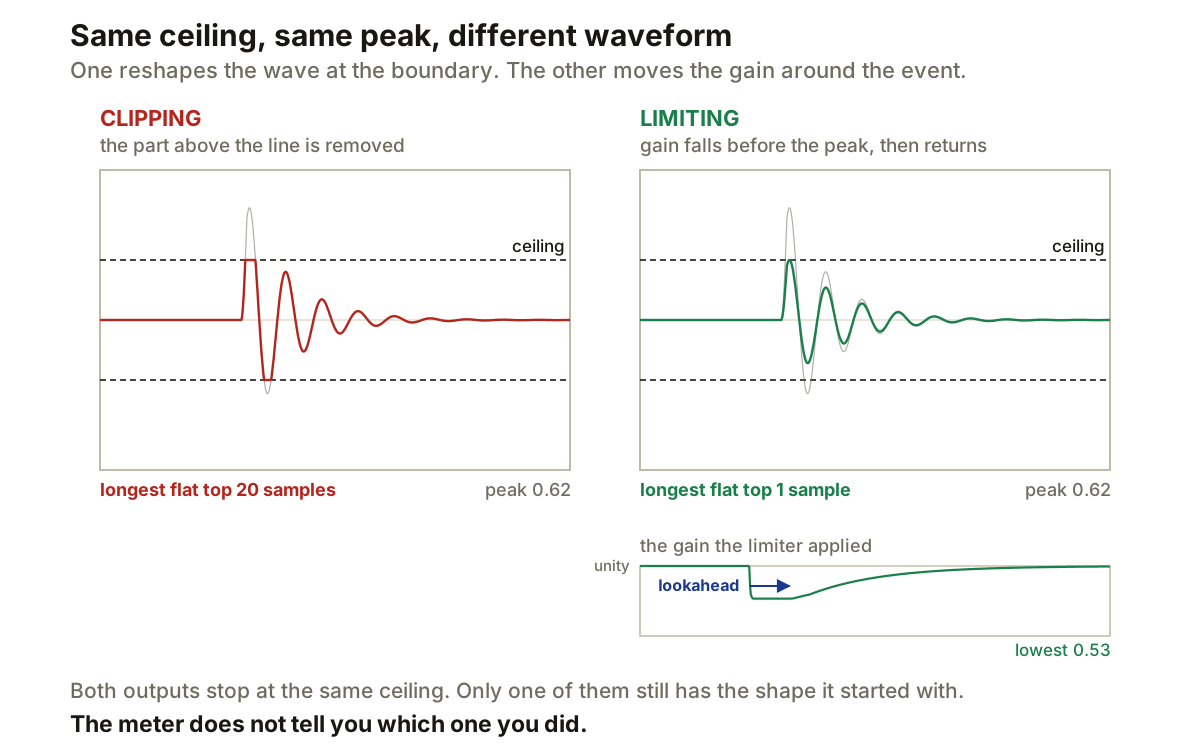
A clipper and a limiter can both stop a peak reaching its original height, and both can leave the meter at the same number. They get there by different mechanisms, and the difference is visible in the waveform rather than in the reading.
A clipper reshapes the wave where it crosses a boundary. A limiter changes gain over time so the signal stays under a target. One is a transfer function with no memory. The other is an envelope with a past and a future.
The same transient, both ways
Both outputs in that diagram peak at exactly the same value. The clipped one has a flat top twenty samples long. The limited one has a flat top one sample long, which is just the peak touching the ceiling on its way past.
That is the whole distinction. A peak meter cannot tell you which one you did.
Clipping has no memory
Hard clipping evaluates one sample against a curve and constrains it. The next sample is evaluated against the same curve, with no reference to what came before. There is no attack, because nothing has to move. There is no release, because nothing was moved.
Reshaping a waveform that directly generates new frequency content, and some of it lands above Nyquist, where it folds back into the audible range rather than disappearing. FabFilter’s answer is oversampling, which runs the internal process at a multiple of the host rate so those products have somewhere to go before being filtered off. They recommend 4x, or 8x, and note the CPU cost of going further.
A limiter can act before the peak arrives
The thing a clipper cannot do is see what is coming. Lookahead delays the audio path while the detector examines the incoming signal, so the gain can already be moving by the time the peak reaches the gain stage.
In the diagram the gain starts falling 77 samples before the peak and bottoms out at 0.535. The waveform is scaled rather than truncated, which is why its shape survives.
That is also why a limiter needs release and a clipper does not. Gain that came down has to go back up, and how it does that is audible.
The two meet at very short lookahead
The interesting part is what happens when you take the time away.
FabFilter states it plainly: lookahead below 0.1 ms “will approximate ‘hard clipping’, introducing distortion and aliasing”. As the time available for gain control approaches zero, a limiter stops being a limiter and becomes a clipper with extra steps.
So these are not two unrelated tools. They are the same axis, and lookahead is the control that moves along it. That reframes the usual question. Asking whether to clip or limit is really asking how much time to give the gain stage.
Neither one guarantees the ceiling you set
There is a peak a sample meter does not show. Samples are discrete measurements, and the waveform a converter reconstructs between them can go higher than any stored sample. Those are inter-sample peaks, and FabFilter notes that ultra-fast limiting and hard clipping are two of the things that create them.
This is the trap. A clipper can hold every single stored sample at your ceiling and still produce a file whose reconstructed waveform goes over it. The sample meter will show you a clean result that is not clean.
True-peak limiting handles this in two stages: it reduces true peaks already present in the input, then attenuates overshoot its own limiting introduced. FabFilter gives a figure worth remembering, that 4x oversampling with at least 0.1 ms of lookahead keeps inter-sample peaks within about 0.1 dB in most cases.
Two costs come with it. True-peak limiting adds roughly 5 ms of latency, and lookahead changes transient behaviour, so buying safety here spends something elsewhere.
Why clipping into a limiter is not redundant
Because they do different jobs, running both is a real technique rather than belt and braces.
A clipper ahead of a limiter removes a small number of unusually tall peaks by reshaping them. The limiter then receives a signal with a different peak structure and has less work to do, so its gain envelope moves less and the crest factor of what reaches it is already lower.
Order changes what each one sees. Limiter first, and the clipper meets an already-enveloped signal. Clipper first, and the limiter responds to a waveform that has been reshaped. Neither order is correct in general.
Producer’s note
Diagnose before choosing, because the two answer different questions.
If a handful of very short peaks are eating your headroom, that is a waveform problem and a clipper addresses it directly. If the level has to stay under a ceiling while the gain around larger events stays controlled, that is an envelope problem and a limiter has the timing controls for it.
Then check the result on a true-peak meter, not a sample meter. If you find yourself pushing lookahead below 0.1 ms to get the transient you want, you have stopped limiting and started clipping, so decide whether that is what you meant. Try slightly more lookahead before assuming a lower ceiling is the fix.