ADSR: three of the four controls are times and one is not
Four letters in a row suggests four of the same kind of thing. They are not.
Attack, decay and release are durations. Sustain is a height. FabFilter says so directly in its own documentation, and puts it in a note rather than burying it in the paragraph: sustain specifies a volume level rather than a time period.
Almost every confusion about envelopes comes from missing that one sentence.
What each one does
An envelope generator produces a control signal that changes over time. FabFilter describes its job as modulating a parameter over time, triggered either by MIDI or by the level of an audio signal crossing a threshold.
Attack is the time taken to reach maximum after the trigger. Decay is the time taken to fall from that maximum to the sustain level. Sustain is the level it falls to, and it holds there for as long as the key is held. Release is what happens after the key is let go.
Read that back and the odd one out is obvious. Three of them answer “how long”. One answers “how far down”.
What the panels measure
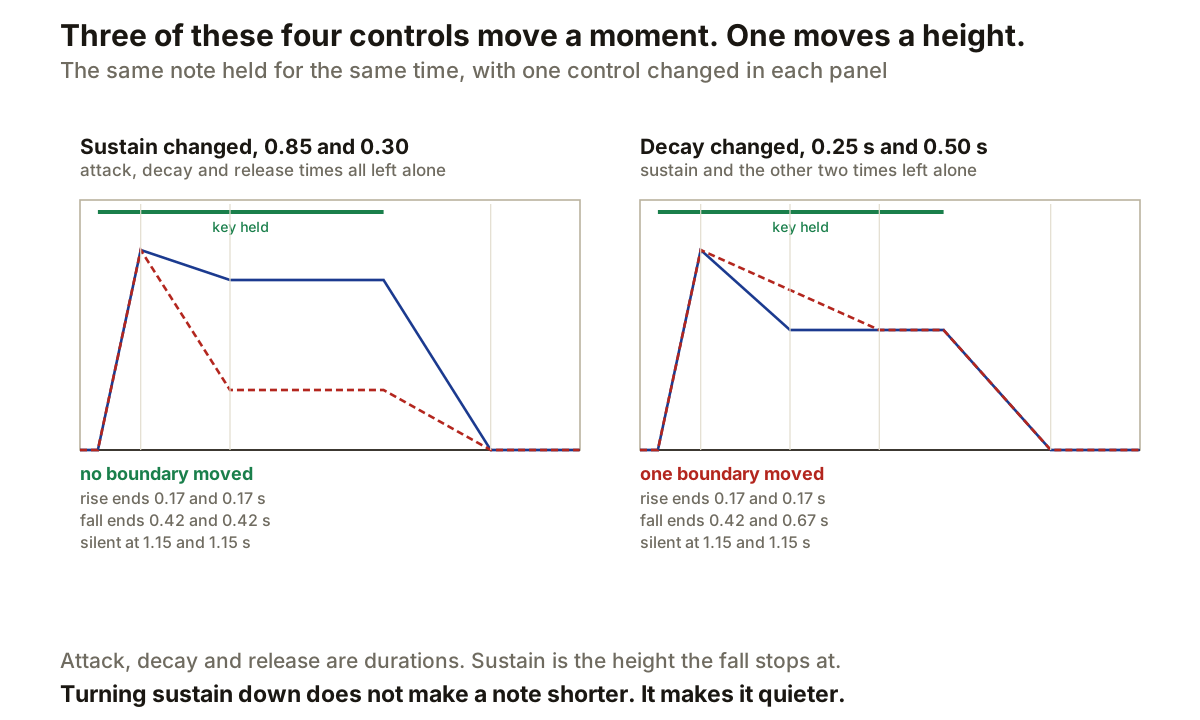
Both panels above hold the same note for the same length of time. The vertical lines are not drawn in; the script finds them by looking at the finished envelope and asking where it stops rising, where it stops falling and where it reaches zero.
In the left panel the sustain level goes from 0.85 to 0.30 and nothing else changes. The rise ends at 0.17 s in both. The fall ends at 0.42 s in both. Both go silent at 1.15 s. Three boundaries, none of them moved.
In the right panel the decay time doubles from 0.25 s to 0.50 s. The fall now ends at 0.67 s instead of 0.42 s, and the other two boundaries stay exactly where they were. One control, one boundary.
The mistake this prevents
Turning sustain down to make a sound shorter.
It does not make it shorter. It makes it quieter for the same length of time. The note runs just as long, the release starts at the same moment and finishes at the same moment, and all you have changed is the level it was sitting at while it waited.
If you want a shorter sound, decay and release are the controls that move the end of it. Sustain decides how loud the middle is.
The inverse mistake is subtler and just as common: reaching for decay when sustain is already at maximum. With sustain at 1.0 there is nothing for the decay stage to fall to, so the segment has no distance to cover. Decay at 0.1 s and decay at 0.9 s produce an identical envelope, both settling at 0.17 s, which is the moment the attack finished.
So a decay control that appears to be doing nothing is usually not broken. It is being asked to travel from maximum to maximum.
It is a modulator, not a volume shape
The default assumption is that an envelope controls loudness, because that is where most people meet one first. FabFilter’s description does not mention loudness at all. It says the envelope modulates a parameter.
The same shape on a filter cutoff gives you a filter sweep with every note. On pitch it gives you a bend. On an oscillator’s sync amount it gives you a swept vowel sound without touching the note being played.
FabFilter also offers a range setting where the envelope outputs zero during its sustain phase rather than during silence, attacking from a negative value up through zero and releasing back down below it. That is useless for volume and genuinely useful for modulation, because it lets a note push a parameter in both directions around a resting value.
Four letters is a simplification
Real envelope generators have more stages than the name admits. FabFilter’s has a Delay before the attack begins and a Hold after the key is released, during which the value stays at the sustain level before the release starts.
That is five times and one level, not three and one. The four-letter name survives because it describes the shape people usually want, not because it describes what the generator can do.
The curves between the stages are adjustable too. Each of the attack, decay and release segments has a slope control that moves it between linear, logarithmic and exponential. A linear attack and an exponential attack of identical length do not behave the same way, even though both take the same time to arrive.
The other kind of envelope
Worth naming the boundary while we are here. An envelope generator invents a shape and plays it when triggered. An envelope follower invents nothing and reports the level of whatever is going in.
They are used in the same modulation slots and they answer different questions. The generator gives you the same shape however loud the trigger was. The follower gives you a shape that is the trigger.
Producer’s note
Set the release before the decay. The release is what decides whether notes overlap, and a decay set against the wrong tail length has to be set again anyway.
When a synth part will not sit still in a busy arrangement, shorten the release before reaching for a gate. Most of what a gate would remove is envelope you asked for.
And if a decay knob feels dead, look at sustain. At maximum, decay has nowhere to go.