Release time: why the same fast release distorts the bass and leaves the mids clean
Set a bus compressor’s release to a few milliseconds and the hi-hats come through untouched while the bass picks up a fuzz it did not have before. Same compressor, same setting. The difference is the note, and the reason is arithmetic.
The detector follows the waveform
A compressor decides how much to turn down by following the level of the signal. For a sine wave, the level the detector sees peaks twice per cycle, once on the positive half and once on the negative half, and falls towards zero in between.
If the release is fast enough, the detector falls with it. The gain comes back up between the peaks, then clamps down again at the next one. At that point the compressor is no longer turning the note down. It is reshaping every cycle of it.
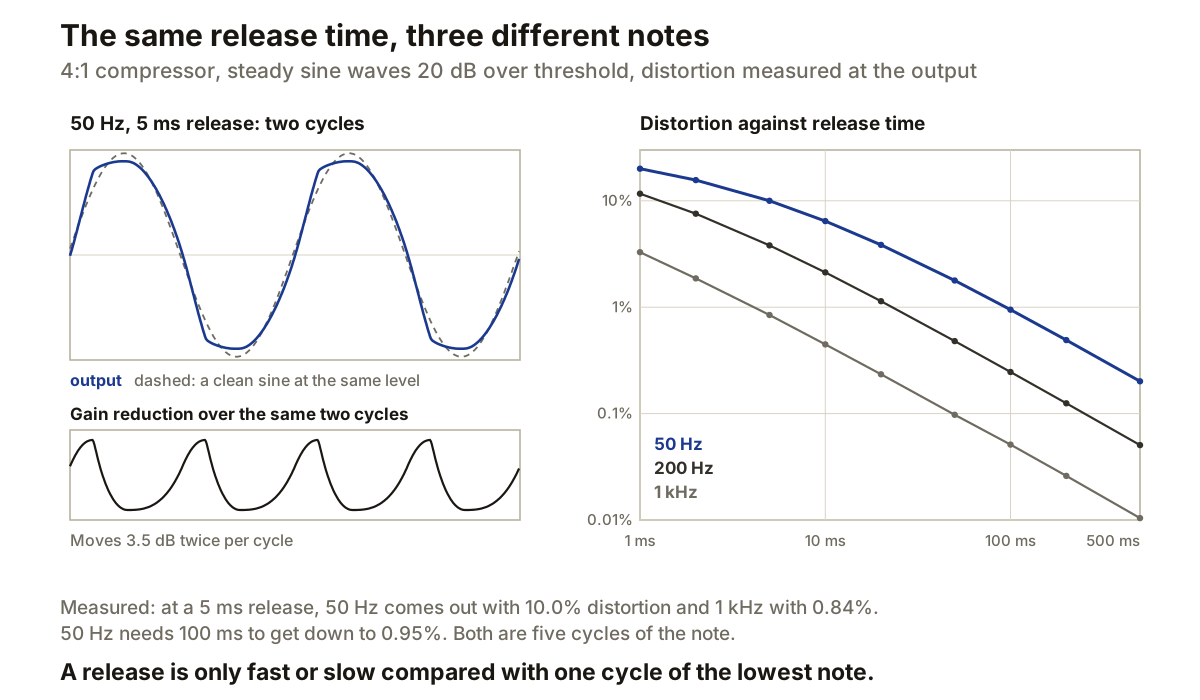
The diagram shows exactly that. A 50 Hz sine through a 4:1 compressor with a 5 ms release: the gain reduction moves 3.5 dB, twice per cycle, and the output’s peaks are flattened against a clean sine at the same level. A changed waveform is harmonic distortion, and in this simple model it comes out almost entirely as the third harmonic, because the gain moves the same way on both halves of the wave.
Fast compared with what
One cycle of 50 Hz lasts 20 ms. One cycle of 1 kHz lasts 1 ms. A 5 ms release is four times shorter than the bass cycle and five times longer than the 1 kHz one, so it is fast for one note and slow for the other.
Measured off the same model at a 5 ms release:
- 50 Hz: 10% distortion
- 200 Hz: 3.8%
- 1 kHz: 0.84%
To bring 50 Hz down to roughly the 1 kHz figure, the release has to go to 100 ms, where it measures 0.95%. Both of those settings are five cycles of their note. What decides the distortion is the release measured in cycles of the note, not in milliseconds, and on a full mix that means the lowest note sets the limit. A 40 Hz bass repeats every 25 ms, which is where the release entry in our glossary draws the line.
The milliseconds in the diagram come from a plain one-pole release, and plugins define their release times in different ways, so the exact figures will not carry over to your compressor. The scaling will.
Why anyone sets it fast anyway
The short answer is loudness. FabFilter’s Pro-L 2 manual is direct about the trade: short attack and long release are “safer and cleaner” but can cause pumping, while long attack and short release can increase apparent loudness and presence “at the expense of possible distortion”. The fast release is buying level, and the distortion is the price, paid mostly in the low end.
Ways round it
- A longer release. The simplest fix, and it costs some of the loudness the short one was buying.
- Program-dependent release. FabFilter describes Pro-C 3 as recovering quickly after a transient and slowly after longer periods of gain reduction. A sustained bass note is a long period of gain reduction, so it gets the slow behaviour.
- Hold. Hold keeps the gain reduction at its peak for a set time before release starts. The two detector peaks of a cycle are half a cycle apart, 10 ms at 50 Hz, so a hold at least that long stops the gain recovering between them.
- Keep the detector off the bass. A high-pass filter on the sidechain stops the detector following the low cycles at all, at the cost of the compressor responding less to the bass level.
- Split by frequency. A multiband compressor gives the low band its own longer release. Some limiters now do this internally: Softube’s Limit Pro can make its release frequency dependent, and has a separate mode that takes over limiting of the sub-bass.
One thing that does not fix it is oversampling. FabFilter recommends oversampling for aggressive settings because fast gain changes cause aliasing, and that is real, but the distortion here is a third harmonic at 150 Hz, well inside the audio band. Oversampling leaves it exactly where it is.
Producer’s note
Test your bus chain with a sine at 40 or 50 Hz, pushed into the compressor as hard as your mix pushes it, and put a spectrum analyser after it. Shorten the release until a peak appears at three times the test frequency, then back off until it drops away. That is the shortest release your low end will take on that compressor, whatever the knob says in milliseconds.