Pan law: why a centred channel changes level while moving
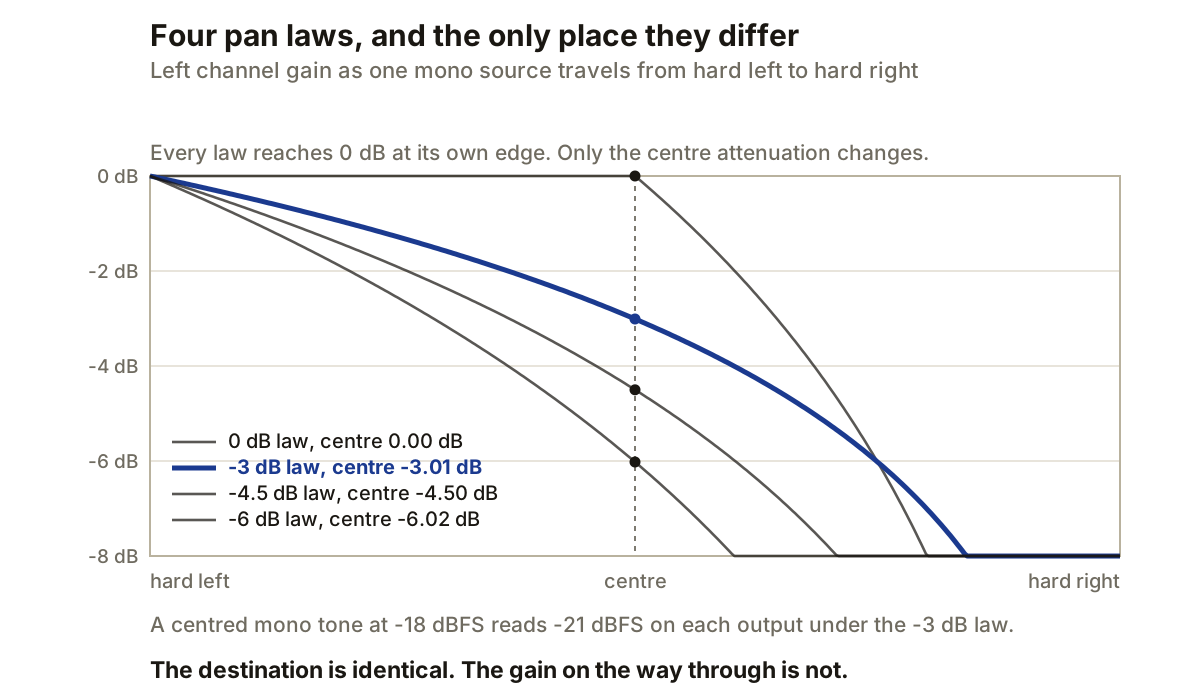
A pan knob does more than move a channel between two speakers. It also changes the channel’s gain according to a pan law, which is why the same mono signal can meter differently at the centre and at either edge.
The law is a compromise. Sending a mono signal to both output channels without attenuation increases the combined level. Reducing the centre gain prevents that jump, but the required reduction depends on whether the design is trying to keep electrical amplitude, channel power or perceived level steady.
What the pan knob controls
A mono panner creates left and right output gains from one input. At hard left, the left gain is 1 and the right gain is 0. At hard right those values swap. The question is what should happen halfway between them.
With a 0 dB law, both centre gains are 1. Each output channel receives the mono signal at its original level. Apple notes that this can make a centred signal seem louder than the same signal panned to one side.
A pan law lowers one or both channel gains while the control travels through the middle. The name normally states the attenuation applied to each channel at the centre. A -3 dB law therefore sends the centred signal to the left at -3 dB and to the right at -3 dB.
Where -3 dB comes from
An equal-power panner keeps the sum of the squared channel gains constant. At the centre the left and right gains are equal, so each must be:
centre_gain = 1 / sqrt(2)
            = 0.7071

20 * log10(0.7071) = -3.01 dB

check:  0.7071^2 + 0.7071^2 = 1
That is the basis of the familiar -3 dB pan law. It keeps the mathematical power sum constant across the pan, but it cannot guarantee constant perceived level in every room. Speaker placement, listening position, reflections and the source itself still affect the result.
Why -6 dB also exists
A -6 dB law uses a centre gain of 0.5 on each channel:
20 * log10(0.5) = -6.02 dB

mono sum:  0.5 + 0.5 = 1
This law keeps a coherent mono sum level rather than a squared-power sum. It can produce a level dip during a stereo pan, because the centre receives more attenuation than an equal-power law.
A -4.5 dB law sits between those behaviours. Apple provides 0, -3, -4.5 and -6 dB choices, along with compensated versions. In a compensated law the centre stays at its original level and the edges are raised by the chosen amount instead. The relative movement is the same, but the gain is placed at a different point.
A panner is not a balance control
A mono panner distributes one signal between two outputs. A stereo balance control starts with separate left and right inputs. Turning it left reduces the existing right channel rather than moving every part of the stereo recording towards the left.
That difference matters on stereo piano recordings, drum overheads, room microphones and effect returns. A balance control can remove one side of the recording at an extreme setting. A true stereo panner can reposition the left and right inputs independently.
Logic uses a Pan control on mono channel strips and a Balance control on stereo strips by default. It also provides a setting that applies pan-law compensation to stereo balancers. Other DAWs expose split-stereo panning or a separate dual-panner mode. Check the control type before treating a stereo track like a mono source, and see what the centre and sides really contain before assuming a balance move does what a pan move would.
What changes in mono
Pan law becomes easy to see when the stereo output is summed. Two identical channels combine by amplitude. If a centred signal uses -3 dB on each side, each channel has a linear gain of about 0.707. Adding them gives 1.414:
20 * log10(0.7071 + 0.7071) = +3.01 dB
With a -6 dB law the two 0.5 gains add back to 1, producing no level change in the digital mono sum. With a 0 dB law two full-level copies add to 2, which is +6.02 dB.
This does not make one law universally correct. A stereo playback system and a mono fold-down reward different gain relationships. The choice should stay fixed once balance decisions and pan automation have been written.
Why projects change between mixers
Move a session between DAWs with different pan laws and centred mono channels may change level even when every fader and pan position appears identical. Pan automation can also follow a different gain curve between the centre and edges.
The safest transfer is rendered audio when the existing balance must remain exact. If editable tracks are required, match the destination pan law before comparing the mix. Do this before adjusting faders, since compensating by ear first makes the later correction harder to identify.
Producer’s note
A simple test reveals the setting. Place a mono 1 kHz sine at -18 dBFS on a channel. At hard left the left output should read -18 dBFS. Now centre the panner and read either output meter:
-18 dBFS      0 dB law
-21 dBFS      -3 dB law
-22.5 dBFS    -4.5 dB law
-24 dBFS      -6 dB law
Run it with monitoring low. The meter readings are the point and there is no reason to audition a steady test tone at working level. Print that tone before moving a mix between DAWs, match the law in the destination, and only then touch a fader.