Manley's Dual EQ series is passive, which is exactly why it is full of tubes
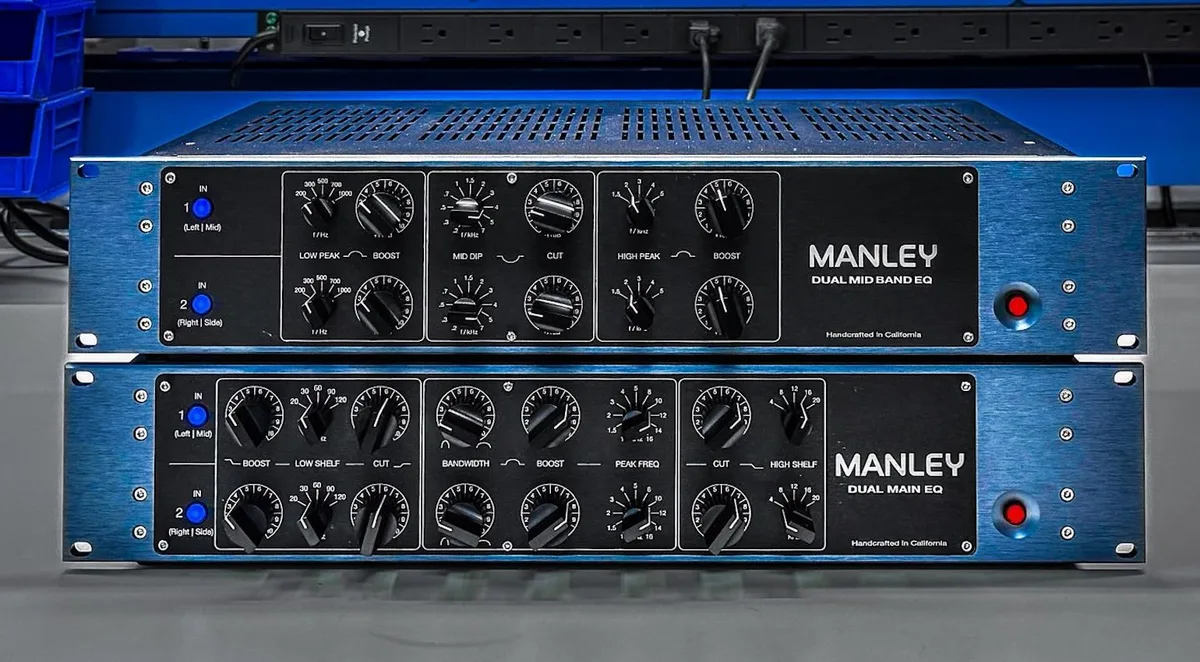
Manley have released two two-channel passive tube equalizers, the Dual Main EQ and the Dual Mid Band EQ. Both are inductor-based, both run a 5751 input tube into a 12BH7 output stage, and both sit in 2U with Manley’s own transformers on each end.
The word doing the most work in that description is passive, and it explains the tubes rather than sitting alongside them.
Passive means it can only take away
A passive filter network is inductors, capacitors and resistors. There is no active device in it, so there is no gain in it either. Every band you set is a matter of attenuating something, and the whole signal comes out quieter than it went in, often by a lot.
Which means a passive equalizer cannot exist without an amplifier after it to put the level back. That makeup stage is not an accessory bolted onto the EQ. It is a mandatory part of the design, it handles the entire signal, and it is where most of what people call the character actually comes from.
So when Manley specify a 5751 at the input and a 12BH7 at the output with custom-wound Manley Iron transformers on both ends, that is not tubes added for flavour. It is the gain the filters made necessary, and the choice of how to provide it is the sound.
It also explains why passive designs stay expensive. You are paying for a filter network that loses level and a tube amplifier good enough to give it back without anyone noticing.
Two boxes, one frequency plan
The Dual Main EQ is the broad one: a low shelf with separate boost and cut, a boost band with variable Q, and a high shelf cut.
The Dual Mid Band EQ works the midrange, with Low Peak, Central Dip and High Peak bands, each on a fixed Q chosen so the bands interact without producing artefacts where they overlap.
Both follow the same frequency layout, and it is worth reading what it says. Five selectable frequencies on each outer band, eleven on the central one. Manley are telling you where they expect the work to happen: you get coarse choices at the extremes and fine ones through the middle, where boxiness and boom actually live.
Bands overlap, so a frequency can be boosted and cut at once. That is the move we covered in the Softube piece: on a passive design the boost and cut curves are not mirror images, so running both leaves a shape neither control produces alone.
Manley have been at this since 1990, when their first Enhanced Pultec took the 3U EQP-1A layout, added frequency choices and fitted it into 1U. Pultec-style is the shorthand, but the frequency plan is Manley’s rather than a copy of anyone’s.
The caveat at this price
Both units are true two-channel designs and both can run left/right or mid/side.
Then Manley’s own FAQ is refreshingly direct about the limit: there is no internal mid/side encoder or decoder. The channels can process a mid/side pair perfectly well, but you have to supply the matrix yourself at both ends.
At this money that is a real thing to plan for. If mid/side is why you are looking, budget an external encoder and decoder alongside, and remember that both boxes will be in the path.
Connections are two combo XLR and 6.3 mm inputs, with two balanced XLR and two unbalanced 6.3 mm outputs. Frequency response is quoted at 20 Hz to 22 kHz within 0.1 dB, with the full range running 10 Hz to 70 kHz. Each unit is 2U, 482.6 by 88.9 by 177.8 mm, and 5 kg.
Price
Manley list an MSRP of 5,499 dollars each.
European figures need care. One report gives 5,999 euros while the affiliate widget in the same article shows 5,599 at a retailer, and those cannot both be the price you pay. Check with a dealer in your own country rather than trusting either number.
Producer’s note
If you are comparing a passive EQ against an active one, match levels before deciding, and be aware you are not only comparing filters.
The passive box has a mandatory tube gain stage in circuit whether or not you touch a control. Set every band flat and it is still colouring the signal. That is usually the point, but it makes the comparison unfair in a way people rarely account for: a null test between the two at flat settings will show a difference, and the difference is the amplifier, not the equalization.
Read more at Manleyhttps://www.manley.com/products/pro-audio/eqs/dual-main-eq