Softube's Reference 1998 and 1956 are a Massive Passive and a Pultec, and cannot say so
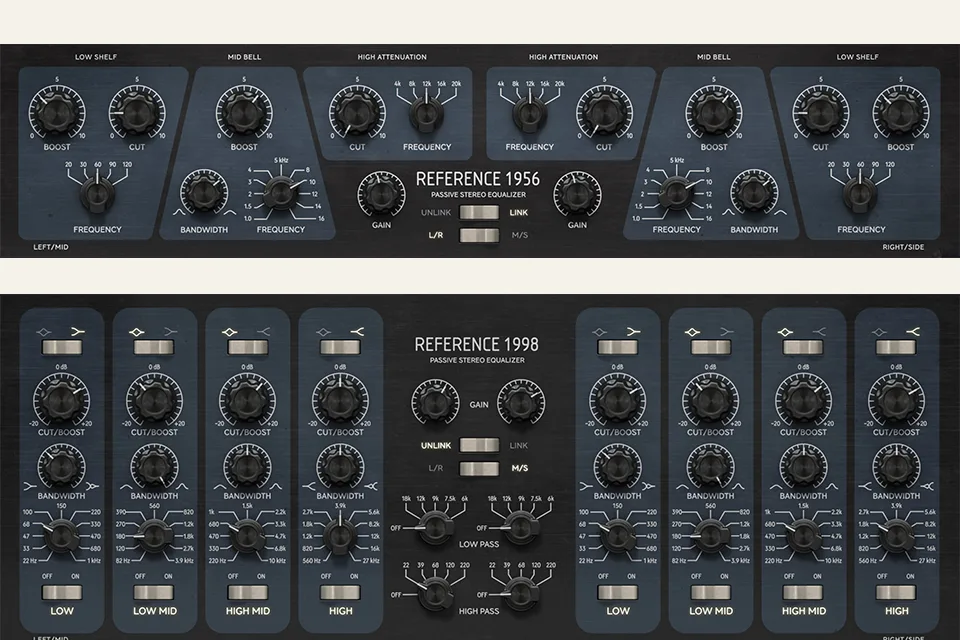
Softube have released two passive tube equalizers, Reference 1998 Equalizer and Reference 1956 Equalizer. Neither one says what it is a model of.
That is worth stopping on, because Softube are the company that always says. They are the official developer for Tube-Tech, for the Chandler Limited Curve Bender, for Trident’s A-Range and for Empirical Labs, and the licence is normally the first thing in the headline. Their own product page for Reference 1998 names Tube-Tech, Chandler and Empirical Labs as partners, in a paragraph about their history, and then refers to this plugin’s subject only as “the inspiration for this plug-in” and “a modern classic”.
Calling a product Reference 1998 is what you do when you cannot call it by its name.
What they will tell you
The descriptions are specific enough to be useful even without a badge on them.
Reference 1998 is a four-band passive equalizer with the bands in parallel, each contributing warmth and light saturation, followed by a tube stage for make-up gain and headroom. Softube single out the shelving filters as the design’s masterstroke, running from wide and smooth to a shape they describe as unique and colourful.
Reference 1956 is a minimum-phase passive design of a type Softube say has been in studios for about seventy years. Their version is based not on the original but on later hardware that added stereo operation and extra frequency selections while keeping the original circuit’s behaviour.
That is specific enough to identify both, and German publication Bonedo, who have tested them, name them outright: Reference 1998 as the Manley Massive Passive, which was introduced in 1998 with exactly that four-band parallel passive layout and tube stage, and Reference 1956 as the Pultec EQP-1A.
Why the names are missing
There is a straightforward explanation, and it does not require a falling out.
Universal Audio already hold the officially licensed emulations of both units. Their Manley Massive Passive EQ has been in the UAD catalogue for years, and their Pultec Passive EQ Collection covers the EQP-1A along with the MEQ-5 and HLF-3C.
An exclusive licence is exclusive. Softube can model a circuit, because circuits are not what licensing protects, but they cannot put another company’s trademark on the box while someone else holds the right to do exactly that. Hence Reference 1998 and Reference 1956, and hence a product page that describes a design in loving detail while never once naming it.
Worth knowing what that does and does not tell you about the plugins. It says nothing about how they sound. It does mean Softube worked without access to the manufacturers, so where an official emulation can hand over schematics and factory-calibrated units, this pair was measured from the outside.
The low end trick, built in
The Reference 1998 feature list includes “low end trick” shelving curves, and that phrase refers to the most famous move in passive equalization.
On a classic passive design, boosting and attenuating the same low frequency at once does not cancel out. The boost and cut curves are not mirror images: the attenuation is centred a little higher up, so running both together leaves a lift at the very bottom with a shallow dip just above it. The result is weight without the mud that usually comes with it, and engineers have been doing it by hand for decades on a control layout that was never designed for it.
Baking the resulting shape into the shelf, which is what Softube describe, removes the dance. Whether that is a feature or a loss depends on whether you liked having the two controls to balance against each other.
What Softube added
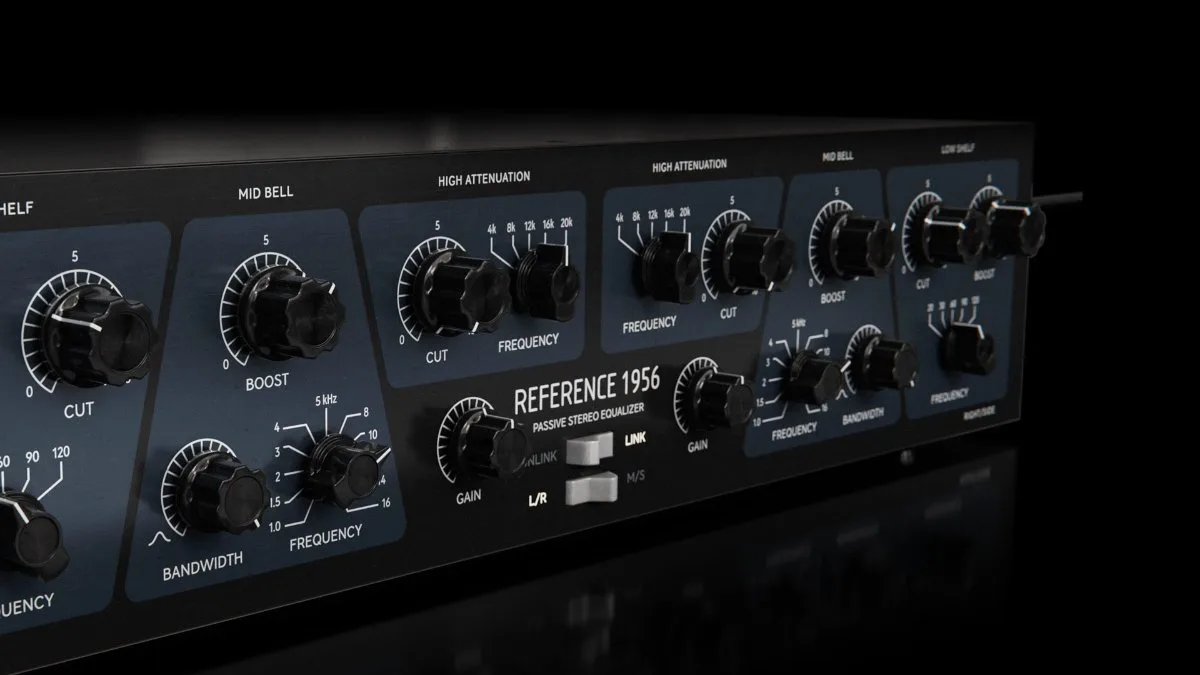
Reference 1956 gets a Headroom control in its Extended Features panel, which Softube say exaggerates the low-end character of the transformers rather than cleaning it up. It also gains mid/side operation and separate gain per channel, neither of which the hardware type is known for.
Both plugins load into the vintage slot of Softube’s own Equalizers plugin, which puts the passive curves alongside up to 20 bands of modern EQ, spectrum display and dynamic EQ. That is the actual pitch here: a coloured passive front end with a surgical modern one stacked on it, in one window.
Both are Console 1 ready. Reference 1998 is included in Flow Mastering and Complete subscriptions, Reference 1956 in Flow Mixing and Complete.
An unusually blunt comparison
Softube’s own page sets Reference 1998 against their licensed Curve Bender and does not flatter the new one into the lead. The Curve Bender is described as always transparent and always smooth; Reference 1998 as more colourful, more extreme and more distorted.
Marketing copy that tells you its new product is the dirtier option, and names the company’s own licensed emulation as the clean one, is rare enough to note. It is also useful: it tells you which of the two to reach for.
Price and requirements
Reference 1998 is listed at 79 euros against a 99 euro full price, with a 20-day trial, 14-day returns and three activations. There are two bundles, one pairing the Reference equalizers and one adding the Equalizers plugin, both described as time-limited.
AU, VST, VST3 and AAX. macOS Sonoma 14 through Tahoe 26, Windows 10 64-bit and 11. An iLok account is required, which for some people is the whole decision, and the 20-day trial is long enough to find out whether the rest of it earns its place.
Both are at Plugin Boutique: Reference 1998 and Reference 1956.
Read more at Softubehttps://www.softube.com/plug-ins/mastering/reference-1998-equalizer