Karno's SEPIA keeps the analogue and adds the recall, which is the other way round
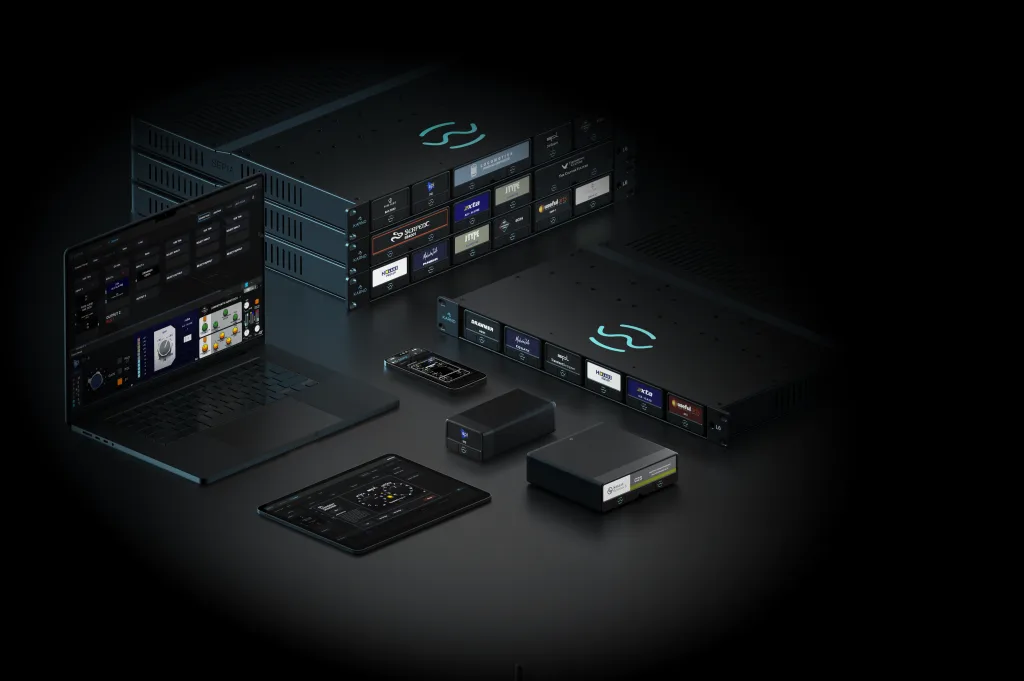
Almost every plugin worth writing about this month has been software chasing hardware. Acustica sampling a Pultec, Softube modelling a Massive Passive, AIR multisampling an Alesis polysynth. The reason is always the same underneath: outboard sounds like outboard, and outboard cannot be recalled.
Karno’s SEPIA goes at the same problem from the opposite end. Keep the transformers, valves, optical cells and FETs, and put the recall in instead.
A format, not a box
SEPIA is a module standard with hosts to put the modules in, which puts it in the 500 series’ territory rather than alongside any single product.
The modules are 60 percent smaller than a 500 series card, and the first host, the L6, fits six of them into one rack unit. There are no controls on the hardware at all. Every parameter is set from a desktop, tablet, phone or plugin application, or from a console over HUI, EUCON, MIDI or OSC.
That last part is the whole idea. A 500 series module has knobs, so its settings live in a photograph and a notebook. A SEPIA module has none, so its settings live in the session file.
The signal path stays analogue throughout. Sound on Sound’s preview of the platform noted there is no latency and no conversion in the audio path: the digital side sets the analogue circuit rather than processing the audio.
The routing matrix is the second idea
Each host carries a routing matrix, so the order of the chain is set in software rather than by patching. Compressor before EQ becomes a drag rather than two cables.
There is passive audio bypass, which matters more than it sounds: it means the path survives the control system failing. Power is redundant, with six separate supplies per unit and voltages tailored per module, since a valve module and a FET module do not want the same rails.
Real analogue in every slot also means real channel-to-channel variation, which is the thing software has to synthesise rather than simply have.
Three things fall out of the control layer
Recall is the headline, but it is not the only consequence of moving the knobs into software.
Ganging. Analogue equalizers are mostly mono, so a stereo pass means setting two units by hand and trusting your eyes that they match. Two SEPIA modules can be ganged under one set of controls. That removes a class of error rather than a chore.
Hot swapping. A module releases on two catches and another goes in. Set against unracking a unit, pulling it off the patchbay and hunting for the right loom, that is a different order of effort.
Chain order. Modules are placed into a path in software and the host updates, so putting the compressor after the equalizer is a drag rather than a repatch.
Connections are XLR in and D-sub out with Ethernet for control, which lines up with the assignable analogue output card the retailers list. Karno have also said a plugin version of the control application is coming, which matters: at the moment the controls live in a separate app rather than in the session alongside everything else.
Solving recall creates a different problem
Nothing on the module moves. That is exactly what makes recall possible, and it is exactly what you give up.
A knob on a console stays where your hand left it, and over months your hands learn the panel. A control in a window is somewhere else every time the layout changes, and a hardware controller only partly helps, because the same physical knob is assigned to a different parameter each time you select a different module. You get the sound of the circuit and the convenience of software, and you lose the part of analogue that is muscle memory rather than electronics.
Whether that is a fair trade depends entirely on the work. For anyone recalling client sessions weeks later it is not close. For anyone who mixes by reaching without looking, it is a real loss and not a nostalgic one.
The partner list is the strong part
Twelve manufacturers are named as platform partners: API, SPL, XTA, Pope Audio, Locomotive, H-Labs, Langstrath Audio, Serpent Audio, J Type, Malcolm Toft, Drawmer and Smart Research. Sound on Sound reported a further nine in discussion at the time of the preview.
API, SPL, Drawmer, Smart Research and Malcolm Toft are not names that lend themselves to a format speculatively. That list is the best evidence the platform is real.
What you cannot find out from Karno
The company’s own site is the weakest part of the story.
There is no price anywhere on it. The store subdomain returns a 404. The modules page names its twelve partners without saying which modules exist, which are shipping, or which are planned, and a line about a routing feature “due for announcement 2024” is still sitting there in the middle of 2026. The buttons on that page still read “Pre-order the first Host”.
The product is a good deal further along than pre-order. Vintage King, Sweetwater and Studiocare all stock L6 hosts, in variants with an assignable analogue D-sub card, a Dante card and a MADI SFP card. Modules from API, SPL, Locomotive Audio, J-Type and Lunar Electronics are in working systems now, not renderings. Karno also publish field documentation for recovering a host stuck on an unreachable fixed IP, which references firmware 0.3.22, and nobody writes that document before units are in the wild.
Worth noting the version number, though. Firmware 0.3.x on a platform previewed in October 2023 is not a finished software story.
Price, and a claim that needs revisiting
Retailers put the L6 host at 2,499 dollars in the US and 2,499 pounds including VAT in the UK, which is 2,082.50 before tax.
That is for the host on its own, with no modules in it.
It is worth holding that against what was said at announcement. Karno’s stated expectation, reported in 2023 before pricing was settled, was that a SEPIA system would work out roughly the same as a 500 series chassis containing equivalent modules. A six-slot 500 chassis is a few hundred to about a thousand, so the empty SEPIA host alone costs more than most loaded ones.
The comparison is not quite fair, because the L6 is a chassis plus a digital interface plus a control system plus redundant power, and a 500 rack is a box with a power supply. But anyone who remembers the parity line should price a full system before assuming it still holds.
Producer’s note
The question to ask about any recall system attached to analogue hardware is what happens to a recall in five years.
A saved session is only useful if the same physical module reads the same values later, and analogue components drift with age and temperature. Ask what the recall actually stores: a control position, or a measured result. Position-based recall gets you back to the same knob setting, not the same sound, and on a valve module a decade apart those are different things. It is the one question a specification sheet never answers and the one that decides whether the promise holds.
Read more at Karnohttps://karno.com/sepia/