Gate hysteresis: how separate thresholds stop trigger chatter
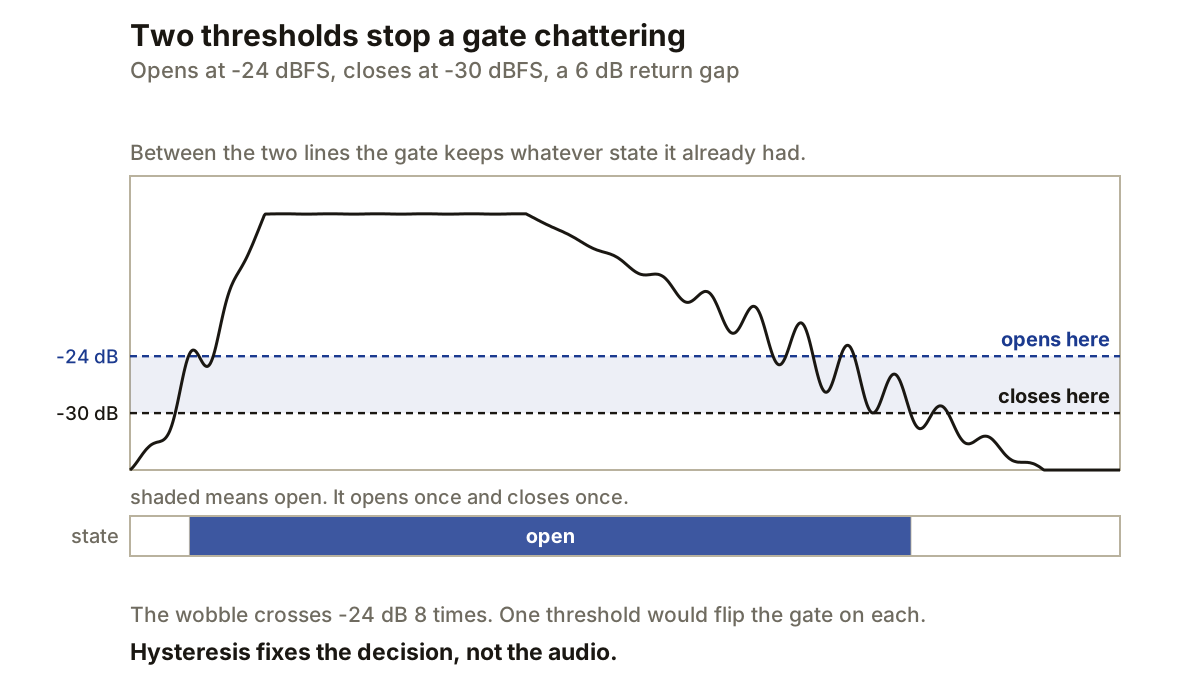
A gate can misbehave even when its threshold appears correctly placed. The detector hovers around that level, the gate opens, the signal falls by a fraction, and the gate closes again. Leakage or room noise then pushes it back across the same line. The result is chatter: repeated switching near the end of a note or between drum hits.
Hysteresis fixes the decision rather than the audio. It gives the gate one threshold for opening and a lower threshold for closing. Once open, the gate stays open while the detector moves through the gap between them.
One threshold creates an unstable decision
Imagine an opening threshold at -24 dBFS. Without hysteresis the gate opens when the detector rises above -24 dBFS and closes when it falls below -24 dBFS.
A decaying snare may move between -23 and -25 dBFS as cymbal spill changes the detector level. Every crossing reverses the gate state. Attack and release soften those changes, but they do not remove the indecisive trigger condition.
The issue resembles a thermostat that turns heating on and off at exactly the same temperature. A small fluctuation causes another switch. Separating the two switching points gives the system a stable state between them.
Hysteresis creates separate opening and closing levels
Ableton labels its hysteresis control Return. It sets the difference between the level that opens the gate and the level that closes it:
close_threshold = open_threshold - return
                = -24 dBFS - 6 dB
                = -30 dBFS
On the rising edge the detector must cross -24 dBFS to open the gate. After that crossing, a level of -26 or -28 dBFS does not close it. The detector must fall below -30 dBFS before the closing sequence starts.
In the diagram above the trace crosses -24 dBFS eight times during its decay. With one threshold, each of those crossings would flip the gate. With a 6 dB return gap the gate opens once and closes once.
The gap does not attenuate anything by itself. It changes the gate’s memory. Between -30 and -24 dBFS, a closed gate stays closed and an open gate stays open. The previous state decides what happens.
More hysteresis is not automatically better. A large gap can hold the gate open through spill that should have started the closing sequence. Too little brings the chatter back. Set the opening threshold for reliable detection first, then widen the return gap only far enough to stop repeated crossings during the decay.
Hold and release solve different problems
Hysteresis decides when closing may begin. Hold decides how long the gate remains open after that condition is reached. Release controls the transition from open to the selected closed level.
These are often mistaken for substitutes. A long hold can mask chatter by preventing the gate from closing for a while, but it does not create separate trigger levels. Once hold expires, a detector sitting near a shared threshold can still reopen the gate.
Release cannot repair the decision either. A slower release makes each closing movement less abrupt, but if the detector crosses the threshold again during that movement, the gate can reverse direction before it reaches the floor.
Set hysteresis while watching the detector trace. Add hold when the source contains short internal dips that should remain part of one event. Set release for the wanted decay after the event has genuinely ended.
A gate does not have to mute
The closed state can mean attenuation rather than silence. Ableton calls this control Floor, FabFilter calls it Range. At a floor of negative infinity a closed gate mutes the signal. At 0 dB, closing changes nothing. Values between reduce the signal without removing it.
FabFilter gives 20 dB as an example of a limited expansion range. That retains some room tone and bleed, which makes imperfect triggering less conspicuous than a complete mute, and lets the decay remain while lowering what happens between events.
This changes the practical cost of a false decision. A gate moving between unity and silence exposes every timing error. A gate moving between unity and 20 dB of attenuation still reduces spill, but a late opening or early closing is far less abrupt.
Filter the detector before moving the threshold
The gate responds to its detector signal, which need not match the audio sent to the output. A side-chain high-pass or low-pass filter can restrict which frequencies trigger the state change, acting on detection rather than removing those frequencies from the audible track.
On a close snare microphone, low-frequency kick spill may open a broadband detector before the snare arrives. Raising the opening threshold may reject the kick, but it can also miss quieter snare hits. Filtering low frequencies from the detector addresses the cause more directly. The same logic applies when a compressor is doing the ducking instead of a gate.
Audition the side chain when the processor allows it. Set its filters until the wanted event dominates the detector, then return to the opening threshold and hysteresis. Moving all three at once makes it impossible to tell which change fixed the trigger.
Set the controls in decision order
Begin with the range or floor set for enough attenuation to reveal mistakes without forcing silence. Filter the side chain so the intended source controls the detector. Raise the opening threshold until unwanted events stop opening the gate, then confirm the quietest wanted events still cross it.
Add hysteresis next. Watch several decays and increase the difference until the gate stops changing state inside one event. Add hold only if brief dips still cause premature closing. Set release last, because its job is to control the closing movement once the trigger logic is dependable.
Check the quietest and busiest sections of the recording. A setting made on one isolated hit may fail when bleed rises later. If no threshold separates wanted hits from spill, automation, editing or a cleaner trigger signal is a better answer than a larger hysteresis gap.
Producer’s note
Confirm the control does what its label says before trusting it.
Set the opening threshold to -24 dBFS and hysteresis to 6 dB, then feed the gate a slowly rising and falling test signal. It should open while rising through -24 dBFS and close while falling through -30 dBFS.
If both changes happen around -24 dBFS, hysteresis is either disabled or the control uses a different convention. Some processors express the gap as a ratio or as a percentage of the threshold rather than as decibels below it, and a control that reads 6 does not always mean 6 dB.