BLEASS and KERN both shipped reverbs that listen to the dry signal
A long reverb tail and the sound that made it compete for the same frequencies. The usual fixes are blunt: pre-delay to buy a gap, an EQ on the return, or a compressor on the return keyed from the dry track so the whole tail dips while the source plays.
Two reverbs released this week do that ducking frequency by frequency instead, and they go about it differently.
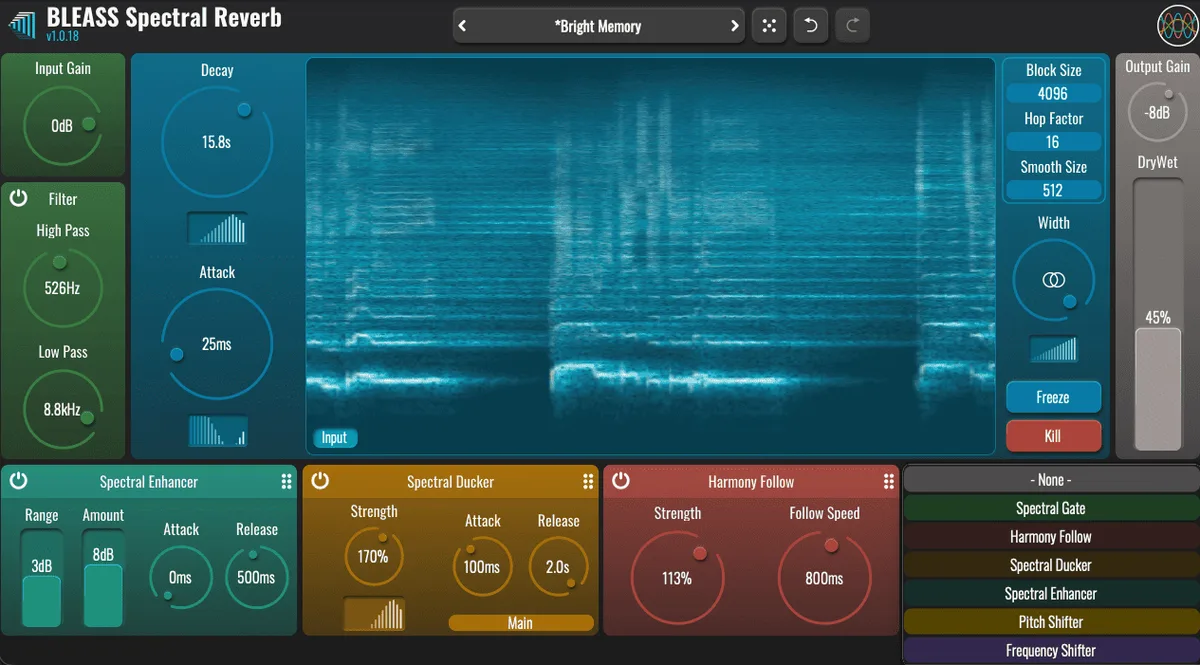
BLEASS Spectral Reverb lowers the tail where the source is
BLEASS released Spectral Reverb on 24 September. It is an FFT reverb with four processing slots, each able to host one of six spectral processors. Two of them address masking directly.
Spectral Ducker analyses the input and removes that spectrum from the reverb, using either the main input or an external sidechain. Harmony Follow is the more unusual one: it compresses every frequency in the reverb, then boosts the frequencies that match what is coming in. On a series of sustained notes, the tails of earlier notes recede and the tail of the current note stays up.
The core controls also vary with frequency. Attack, Decay and Width each have a Spectral Map, where one drag sets the focus frequency and the shape of a ramp, peak or trough, so decay can run short in the lows and long in the highs. FFT Block Size and Hop Factor are exposed too. Larger blocks resolve frequency more finely and cost more processing, and BLEASS pitches turning the engine down as a way to get a dirtier, glitchier reverb on purpose.
€39 for desktop: VST3, CLAP, AU and AAX on Windows and macOS, plus VST3 and CLAP on Linux (Ubuntu 24.04 or later). The iOS version is an AUv3 at $12.99.
KERN OPEN shortens the tail where the source is loud
KERN Audio released OPEN on 22 September. It analyses the dry signal in 40 ERB bands, a scale modelled on the ear’s own frequency resolution, and changes the decay time of each band rather than its level.
One control, BLOOM, runs the whole idea. At low settings, loud bands get shorter reverb, so the tail carves itself out of the source. At the centre OPEN is a plain reverb with no spectral awareness. At high settings the logic reverses: loud bands ring longer, up to an effectively infinite drone made from the source’s own spectrum. FOCUS sets how hard it reacts.
OPEN is $29 with no iLok, no account and a lifetime licence covering Mac and Windows. Formats are VST3, AU, AAX and standalone, with AAX added in version 1.1.0 on 25 September. KERN gives the latency as 256 samples, about 5.8 ms at 44.1 kHz.
Producer’s note
Lowering a tail’s level and shortening its decay sound alike while the source is playing, and differ once it stops. A ducked tail comes back up when the note ends, which is what you want on a vocal that should bloom into the gaps between phrases. A shortened tail has already decayed, which suits a busy part where the space between notes should stay drier.
Read more at BLEASShttps://www.bleass.com/spectral-reverb/
Buy atPlugin Boutique