AudioThing's Orbita runs eight rhythmic cycles that refuse to line up
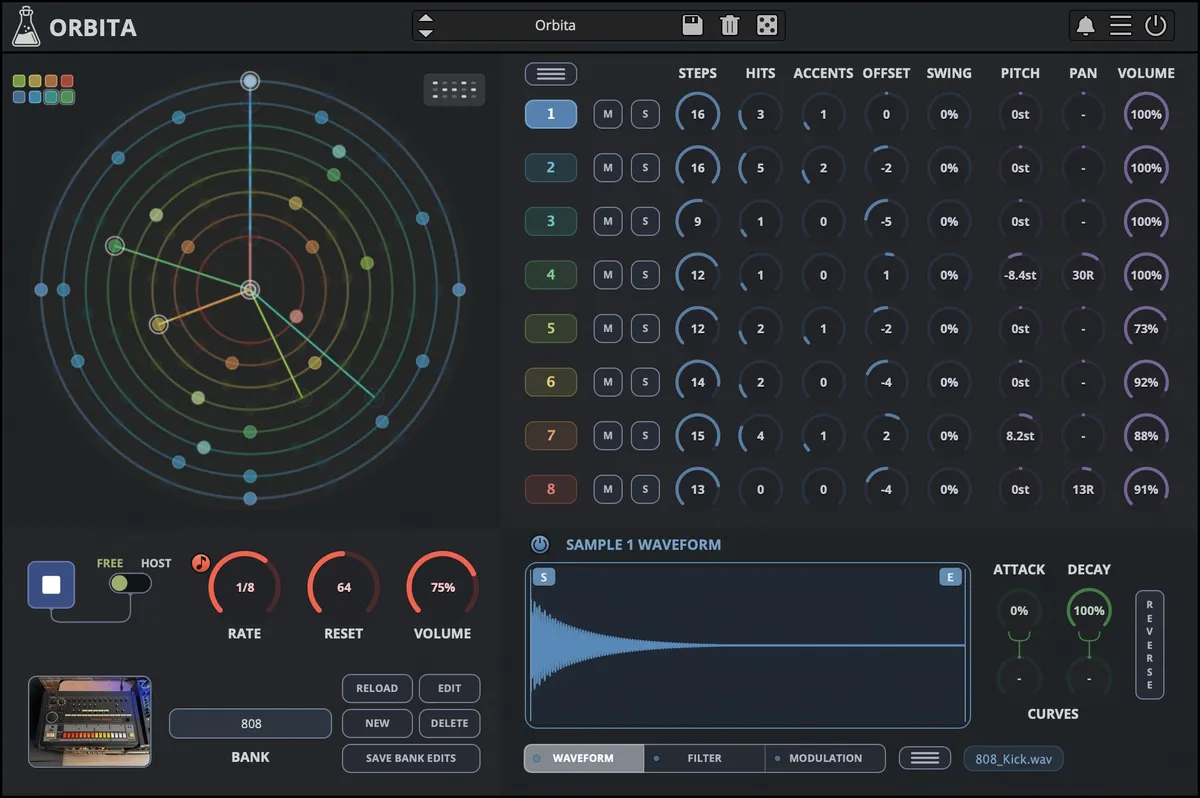
AudioThing released Orbita on 28 August, a sample-based drum machine whose sequencer works by distribution rather than by drawing. Eight tracks each get their own cycle, and the useful part is that those cycles do not have to be the same length.
You give a track a number of Steps and a number of Hits. The hits are spread as evenly as the arithmetic allows, and Offset rotates the result without changing either figure.
Why unequal cycles are the point
AudioThing’s own example is the clearest way in: a 16-step kick against percussion on 11 or 13 steps.
Those lengths share no useful factor, so the parts meet in a different relationship every bar and take a long time to return to where they started. The pattern is not random and nothing is being humanised. Every hit is exactly where the arithmetic puts it. What changes is which hits coincide.
That is a different kind of variation from anything a 16-step grid produces, and it is difficult to program by hand precisely because it takes so long to repeat.
Reset puts a boundary on it. It sets the number of beats after which the sequencer returns to the start, which is how you use unequal cycles inside a normal-length phrase instead of waiting for them to realign on their own.
What each track has
Each of the eight tracks carries a sample, a filter and an LFO. The filter offers low-pass, high-pass, band-pass and notch, in two-pole and four-pole versions. The LFO can be sent to pitch, pan, volume, cutoff or resonance.
There are 36 factory banks plus a Custom Bank Editor for loading your own samples, so the sequencer is not tied to the supplied material. Accents and Swing sit alongside the cycle controls, handling emphasis and timing separately from where the triggers fall.
Practical details
Orbita is $39, down from $69, and AudioThing does not put an end date on that. Desktop formats are VST2, VST3, AU, AAX and CLAP, with AU on macOS. It covers Windows 7 through 11, macOS 10.13 through 26, and Ubuntu 20.04 LTS, and there is an iOS version.
One line on the specification page is worth more than it looks: no internet connection is required to activate it. That is increasingly rare and it is the difference between a plugin that still opens in five years and one that depends on a company still running an authorisation server.
Producer’s note
The trap with Euclidean sequencing is treating it as a randomiser. It is the opposite: everything is deterministic, and the movement comes from arithmetic between cycles.
Start with one track anchored to the bar, then give a secondary percussion part an uneven length rather than reaching for randomisation. If the combined phrase takes too long to come round, that is what Reset is for. If the interaction is right but starts in the wrong place, rotate with Offset instead of changing the hit count, because Offset is the only control that moves a pattern without altering its density.
Working out how long two cycles take to realign is ordinary arithmetic you can do before touching the plugin.
Read more at AudioThinghttps://www.audiothing.net/instruments/orbita/
Buy atPlugin Boutique