Euclidean sequencing: steps, hits and rotation do three different jobs
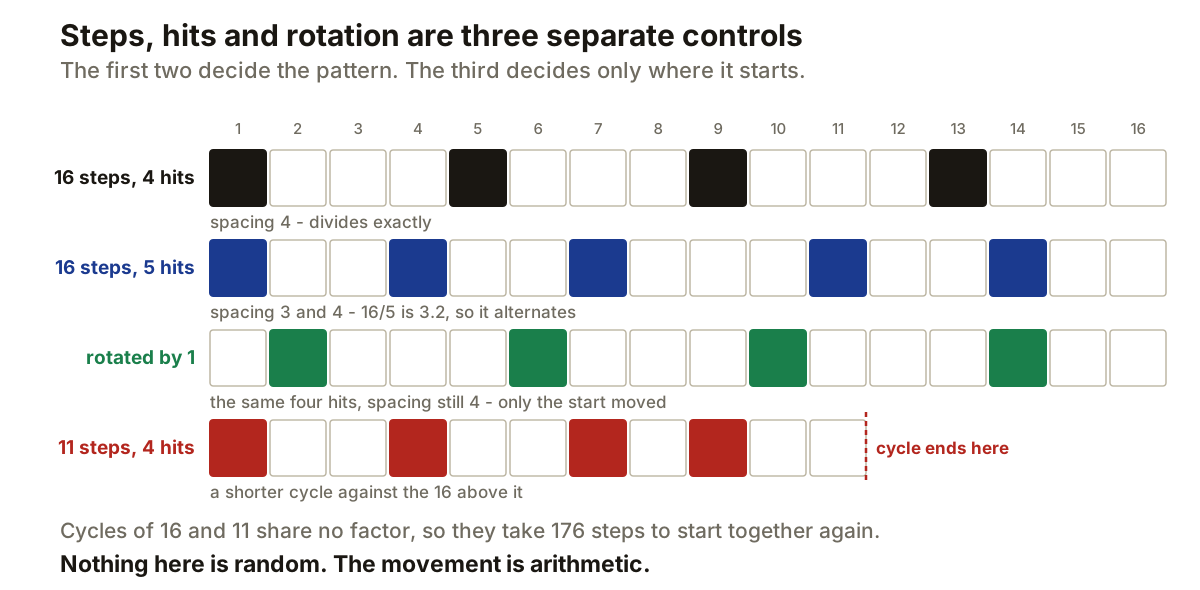
A step sequencer asks which steps should play. A Euclidean sequencer asks a different question: how many hits should fit into a cycle of this length, and then works out where they go.
Give it a number of steps and a smaller number of hits, and it spreads those hits as evenly as the arithmetic allows. That last clause is where the interesting behaviour comes from.
When the division is not exact
Sixteen steps and four hits is the easy case:
16 / 4 = 4 steps between hits
One trigger every four steps, and nothing unusual is required.
Five hits into sixteen steps is not so tidy:
16 / 5 = 3.2 steps between hits
No sequencer can place a trigger 3.2 steps after the last one. So the distribution alternates between the two neighbouring integer spacings, keeping the hits spread through the whole cycle rather than letting them bunch at one end.
The second row of the diagram above is the pattern generated by that arithmetic, gaps of 3, 3, 4, 3, 3. That is what “as evenly as possible” produces when exactly even is unavailable, and it is the shape most people recognise from these sequencers without knowing where it comes from.
Rotation is not density
Steps sets the length. Hits sets how many events occupy it. A third control decides where the pattern starts.
AudioThing calls it Offset, Ableton calls it Rotation, and both do the same thing: turn the cycle without changing the number of steps or hits. In the diagram, the rotated row has the same spacing as the row it came from. Every gap is still four. Only the alignment against the bar moved.
That distinction is worth holding on to, because rotation is the control people reach for last and it is often the one they actually want. If the density is right but the pattern lands awkwardly, rotating it fixes the problem without touching the density that was already correct.
Unequal cycles, and how long they take to come round
The mechanism gets useful when several tracks run at different lengths.
AudioThing’s example is a 16-step kick against percussion on 11 or 13 steps. The parts meet in a different relationship each time round, and the arrangement only returns to its starting alignment after both cycles complete a whole number of repetitions.
That length is the least common multiple, assuming the same step duration and nothing resetting early:
LCM(16, 11) = 176 steps
LCM(16, 12) =  48 steps
Eleven is prime and shares no factor with sixteen, so those two take 176 steps. Twelve shares a factor of four with sixteen, so those two are back together in 48.
This is why changing a cycle by one step can transform how long a phrase takes to repeat. You are not making a part slightly longer, you are changing the arithmetic relationship between two parts.
Reset puts a boundary on it
Left alone, unequal cycles run until they naturally realign, which at 176 steps is eleven bars of 4/4 at sixteenth-note resolution.
A Reset control forces them back to the start after a set number of beats. That is how you use unequal lengths inside a normal phrase length rather than committing to the full mathematical cycle. The relationships still move, but within a boundary you chose.
Four controls, four jobs
The reason these sequencers feel confusing at first is that four controls all appear to make the pattern “different”, and they are not interchangeable.
Adding hits increases density. Changing steps changes the cycle length, and therefore how this part relates to every other part. Rotation moves an existing pattern against the bar. Reset decides when unequal cycles are forced back into line.
Accent and swing sit outside all of that. Accent changes which hits are emphasised without moving any trigger. Swing shifts timing without changing the count. Both can alter the perceived rhythm while the underlying distribution stays exactly where it was.
Producer’s note
The mistake is treating this as a randomiser. Nothing here is random: every trigger is where the arithmetic puts it, and the same settings give the same pattern every time.
So when a part is not working, ask which of the four questions you actually need answered. Too sparse or too busy, change hits. Lands wrong against the bar, rotate. Not enough movement across a phrase, change the cycle length on one track only. Takes too long to come round, set a reset rather than replacing the pattern with something random.
Work out the least common multiple before you start editing. If two cycles need 176 steps to realign and your phrase is eight bars, you were never going to hear the relationship resolve, and that is a decision to make deliberately rather than discover.