Xils Lab MemoryTone joins a crowded field of Memorymoog emulations
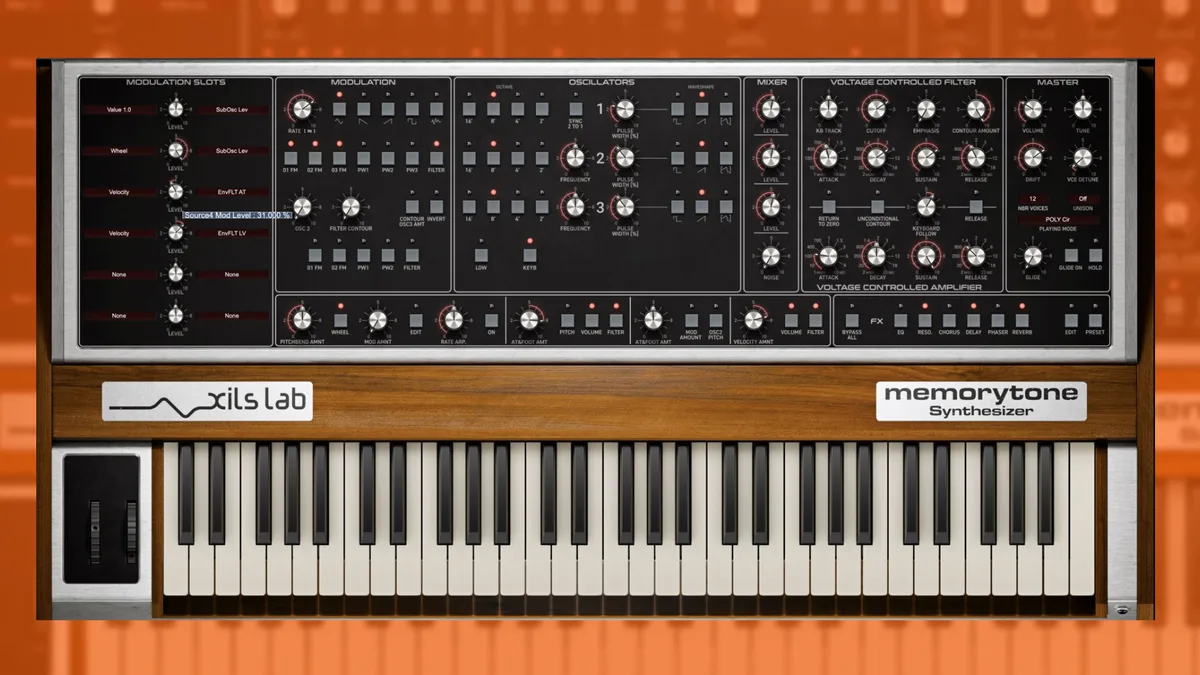
Emulating a specific vintage flagship synth usually goes one of two ways. Either the developer expands on the original with extra layers, unison modes and modern routing (Cherry Audio’s approach with Memorymode 2), or they aim for a faithful single-layer recreation and let the original circuit design do the talking. Xils Lab has picked the second path with MemoryTone, an emulation of the 1982 Moog Memorymoog.
That puts it in direct competition with Arturia and Cherry Audio, both of which released Memorymoog emulations this year, plus Akai’s sample-based take. Three or four versions of the same vintage synth landing in one year is unusual, and it means the deciding factor for most buyers won’t be “does it sound like a Memorymoog” but which implementation gives you the workflow you want.
MemoryTone’s spec reads like a straight port of the original: three multi-wave oscillators with PWM, a sub-oscillator that doubles as an LFO, a four-channel mixer with noise, and a 24dB self-oscillating ladder filter with cutoff, resonance, contour and key tracking. No bass compensation is visible in the filter section, which on the hardware mattered at high resonance settings. Modulation is two ADSR envelopes, a main multi-wave LFO with FM and PWM routing to all three oscillators and the filter, and a 6-slot matrix for everything else. MPE is supported.
None of this is new ground for the category. If you already own a Memorymoog emulation, there’s nothing here that should make you switch. If you don’t and want the single-layer, close-to-hardware version rather than an expanded one, this is worth a look. The plugin has appeared at JRR Shop but Xils Lab hasn’t formally announced it, so pricing and format details aren’t confirmed yet.
Read more at Xils Labhttps://www.xils-lab.com/store/xils-store/