Vermona's drumDING samples its own analog voice into six tracks
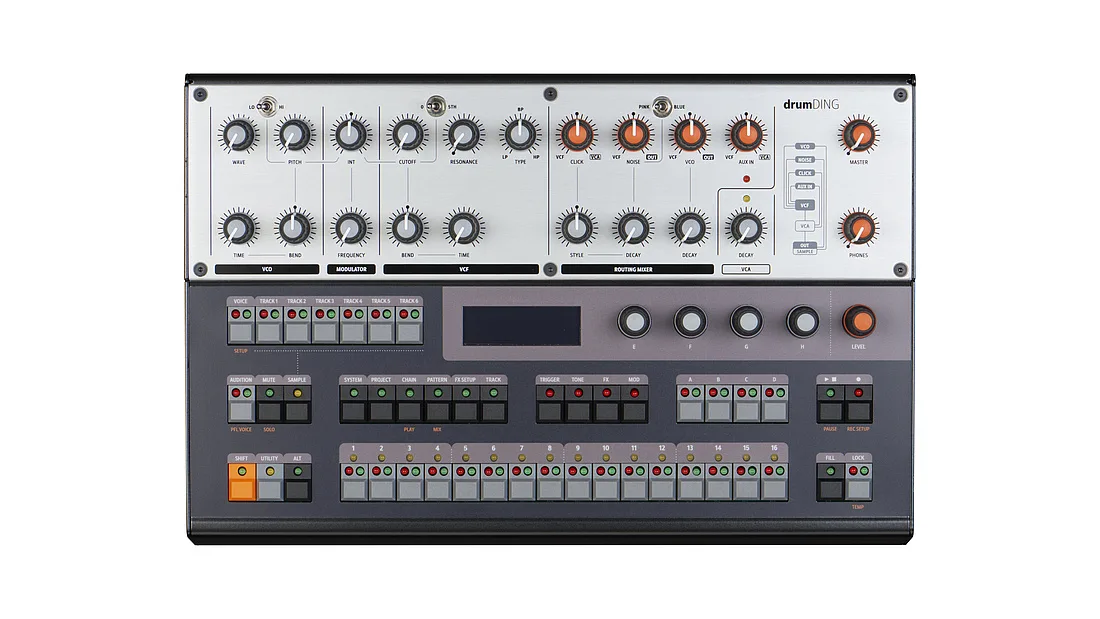
Most drum machines hand you a fixed set of voices: a kick circuit, a snare circuit, a hat circuit, and whatever else the designer decided you needed. Ask for a second kick tuned a fourth up, or a metallic hit nobody built a circuit for, and you either borrow a voice that was not meant for it or record the machine into a sampler and lose every knob.
Vermona put both halves in one box. The drumDING has a single analog percussion voice and six tracks that play samples. Press a button and the analog sound is written to the SD card, ready to sequence on one of those tracks. Vermona previewed it at Superbooth 2025, so this is no reveal; what changed on 3 August is that pre-orders opened.
The spec line that closes the loop is AUX IN, which routes either an external audio signal or an internal track or sample into the analog voice. A sample can go back through the filter and envelopes and be captured again.
The voice runs a VCO with a sine-to-square blend, pink and blue noise, an impulse generator and a 12 dB/octave filter that blends low-pass, band-pass and high-pass. Vermona says the analog voice is built around circuitry inspired by its DRM1. Samples are 48 kHz, 16-bit and up to six seconds, stored as WAV, and your own WAVs play too. Each of the six tracks gets its own output, with a seventh for the analog voice.
Vermona’s page carries the full specification but no price, no pre-order link and no date; the company sells through dealers, not direct. Thomann lists it at €1,499 including VAT in Germany, £1,299 in the UK and $1,439 in the US, and its first batch has sold out and been re-ordered, with the retailer saying its supplier cannot promise delivery inside three months.
Producer’s note
Record hot and record long. A 16-bit sample sets its noise floor a fixed distance below full scale, so a quiet capture that you raise afterwards raises the hiss with it; get the level as close to clipping as the source allows on the way in. Give yourself more decay than the part needs, too, because an AHD envelope can shorten a tail but nothing can add one that was never recorded.
If one capture is going to cover several tracks at different pitches, sample it brighter and higher than the finished part wants. Transposing a sample down stretches it and drags its top end down with it, so the take that works at its original pitch will be dull an octave lower.
Read more at Vermonahttps://www.vermona.com/en/products/drums-percussion/product/drumding/