UDO DMNO lets two four-voice synths pass notes and audio between them
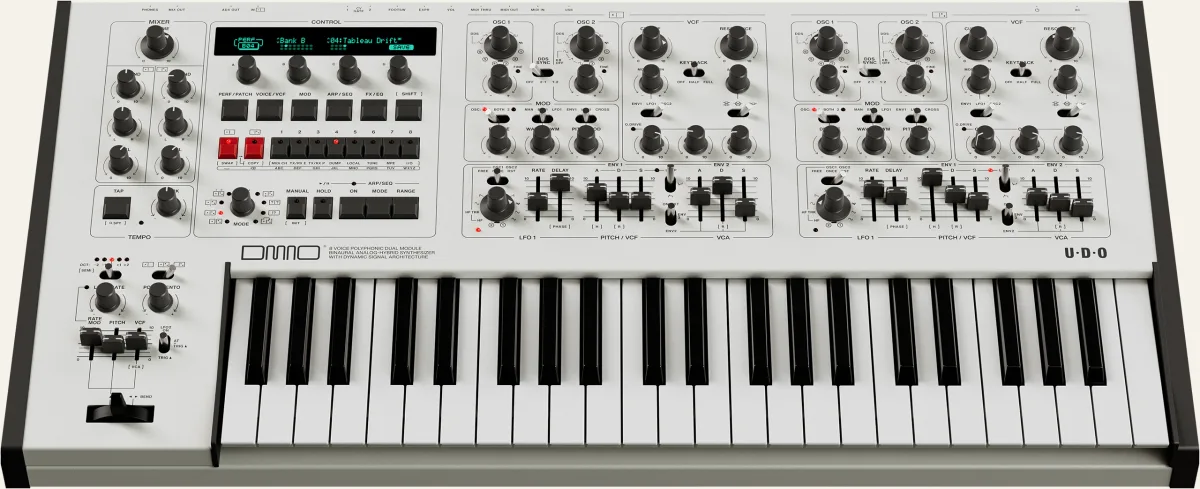
UDO’s DMNO is built as two four-voice synths sharing one 44-note keyboard, but its most useful idea is not the doubled control panel. Eight Play Modes decide how notes and audio move between the two engines, turning a familiar split-and-layer setup into an instrument that can change its behaviour while you play.
Single, Dual and Split do what their names suggest. One-Two sends the first key press to DMNO 1 and following notes to DMNO 2, which can separate a bass note from an upper chord without fixing a split point. Cycle alternates between the engines with each note. Random chooses either one, while Chaos also introduces controlled note randomisation.
Because the two sides can hold completely different patches, those modes do more than redistribute voices. A basic arpeggio can move between a short, percussive sound and a longer answer, or between two related versions of the same patch. The pattern stays intact while its articulation changes from note to note.
Series mode goes further. It routes the audio output of DMNO 1 into the oscillator mixer of DMNO 2, effectively turning the first synth into a complex sound source for the second. The left panel shapes what enters the second engine; the right panel can then add its own oscillators, filter, envelopes and modulation. This is the mode that makes the DMNO feel less like a bi-timbral polysynth and more like a self-contained patching system.
Two digital oscillators, two analogue filters
Each half has two FPGA-based digital oscillators feeding a per-voice analogue stereo filter. UDO’s Super oscillator design uses a central oscillator with six related “sister” oscillators that can be spread and dephased across the stereo field. The available shapes include sine, sawtooth, square, triangle and pulse, with slots for alternative waveforms.
The new Dynamic Multi-Core Stereo VCF is more configurable than the filters in UDO’s Super series. Its two filter cores can work in parallel, series or stereo, with low-pass, high-pass, band-pass, all-pass and phase-shifting responses available in different combinations. A delta-cutoff control separates the two filter peaks, and the filter stage can be overdriven before the signal reaches the effects.
DMNO can run as a conventional eight-voice instrument or pair its signal paths into four Binaural voices. In Binaural mode, the left and right channels each receive a complete voice that can be detuned, dephased and modulated differently. It costs half the polyphony, but the movement is created inside the voice rather than added by a chorus at the end.
Built for external signals too
The rear panel includes a stereo audio input with a variable-gain preamp, gate detector and envelope follower. That envelope can enter the modulation matrix, so a drum loop or another synth can control parameters while its audio passes through the DMNO. There is also a separate stereo auxiliary output, MIDI in, out and thru, two assignable CV and gate or clock outputs, and a class-compliant 24-bit USB audio interface with two inputs and two outputs.
A 32-bit digital effects section covers delay, reverb, EQ, overdrive, distortion and chorus. Patch management, the modulation matrix and the onboard 64-step sequencer use a high-contrast vacuum fluorescent display, while the main synthesis controls remain on the panel. The Fatar keyboard has channel aftertouch, joined by UDO’s two-axis bender and spring-loaded octave selector.
The DMNO is available in black and white. At the time of writing, Thomann lists the black version at €2,999, 10% below its previous 30-day price of €3,333. UDO’s support page lists firmware 1.12 as the current release.
Producer’s note
Copy the same patch to both halves before trying Cycle or Random, then change only one thing on DMNO 2: transpose it a fifth or lengthen its attack. Large contrasts turn the routing into an effect. Small differences make it sound as if one player is changing their touch from note to note.
Read more at UDOhttps://www.udo-audio.com/dmno