UAD's EMT 140 and 250 plate reverbs now run without Apollo hardware
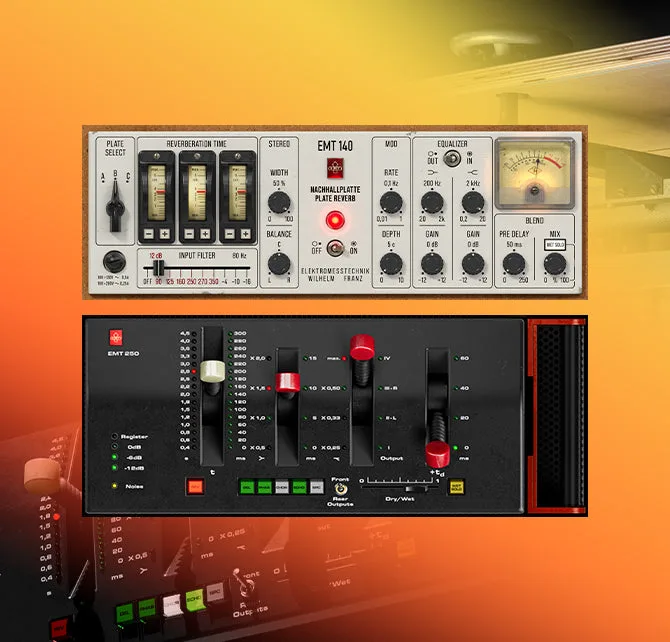
Reissues usually arrive with a new panel and a claim larger than the change deserves. This one is the opposite. Universal Audio’s EMT 140 and EMT 250 emulations have not been rewritten; they have simply stopped needing an Apollo interface or a UAD-2 card. Both now run as UAD Native plugins on the computer’s CPU.
The emulations themselves are long established. EMT 140 models three physical plates. Universal Audio says A and B use the original EMT electronics and carry a worn-in quality suited to vocals and acoustic sources, while C runs recently serviced Martech electronics with a fuller and more extended response. On top of the hardware controls sit Balance, Width, Modulation, predelay and an onboard EQ, none of which the steel plate ever had.
EMT 250 carries the original reverb algorithm plus five more modes: Delay, Echo, Chorus, Phase and Space. Universal Audio says the algorithm comes from an original unit held at Ocean Way Recording. The plugin adds Dry/Wet Mix, Wet Solo and Hard Bypass.
Both interfaces have been redrawn at higher resolution, which is welcome and beside the point. The change that matters is who can run them. Apollo owners already had these on DSP. Everyone else now has the same processing on macOS or Windows, with no interface to buy first.
Universal Audio lists AU, VST3 and AAX for the EMT 140, and VST, AU and AAX for the EMT 250. Neither product page carries a release date.
Both are at Plugin Boutique: EMT 140 and EMT 250.
Producer’s note
A plate has no room in front of it. A real chamber gives you the early reflections that tell the ear how far away a source is, and a plate skips straight to a dense tail, which is exactly why it sits so well on vocals: no geometry to argue with the dry signal. It also means predelay is doing more work here than on an algorithmic room, because it is the only distance cue in the reverb at all.
Start at 100 percent wet on a send with predelay around 20 ms, then move in 5 ms steps. You are listening for the point where the consonants finish before the tail arrives. Push past roughly 40 ms and it stops reading as space and starts reading as a separate event, which is a different effect and occasionally the one you want.
Read more at Universal Audiohttps://www.uaudio.com/blogs/ua/emt-140-250-classic-uad-reverbs-explained