Two ways to put MIDI in a TR-808: a commercial mod and open-source firmware
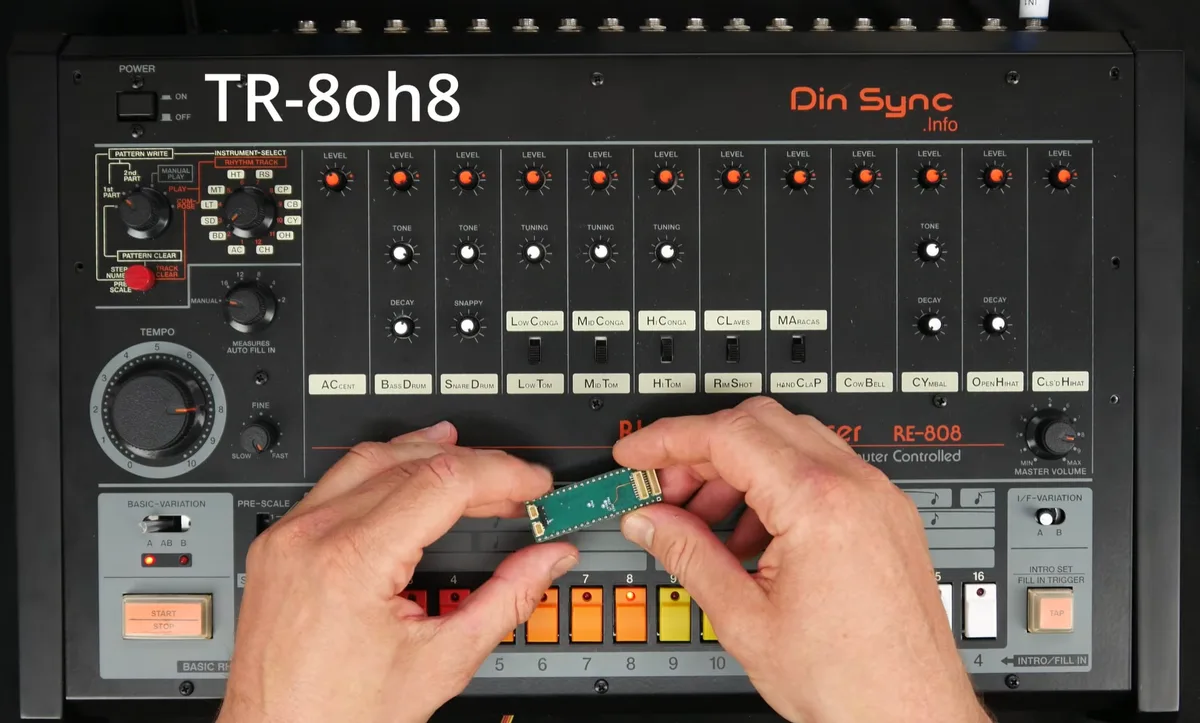
The TR-808 has no velocity sensitivity and no MIDI. Every hit on the original hardware fires at a fixed level, and syncing it to anything modern means going through DIN sync or triggering it by hand. Producers who want the 808’s specific drum sounds inside a MIDI-sequenced setup have had to sample it, run it alongside a converter box, or just accept the limitation as part of the instrument’s character.
Two projects have turned up within days of each other, and both work the same way: replace the chip that runs the machine. Past that they have almost nothing in common. One is a commercial mod fitted to your hardware. The other is free firmware you flash onto a board you buy separately.
Tubbutec TR-8oh8
Tubbutec’s TR-8oh8 goes inside the machine instead of working around it. It’s a hardware mod, a new CPU plus MIDI in/out ports, installed directly into a Roland TR-808 or a Din Sync RE-808 (which the Berlin-based developer says is a 1:1 replica and fully compatible). Once fitted, the drums respond to velocity over MIDI, and the mod is reversible if you want the machine back to stock.
The mod also adds 11 extra instruments, accessed through the existing I/F variation switch: an alternative bass drum, two snares (one clicky), tom noise, simultaneous maracas and handclaps, muted rimshots, a second clap, a second cowbell with adjustable tuning and oscillator spread that’s playable as its own MIDI instrument, extra cymbals, and a click head. A pattern variation slider swaps between the A and B instrument sets so you can compare them while playing.
On the sequencing side, Tubbutec says it’s rebuilt step programming with four velocity levels per step, selectable via a scale switch, closing the gap between the 808’s original sequencer and what a modern drum machine offers.
No price or release date yet. Given this modifies original vintage hardware, expect installation to matter as much as the feature list once details land.
SuperOS-808
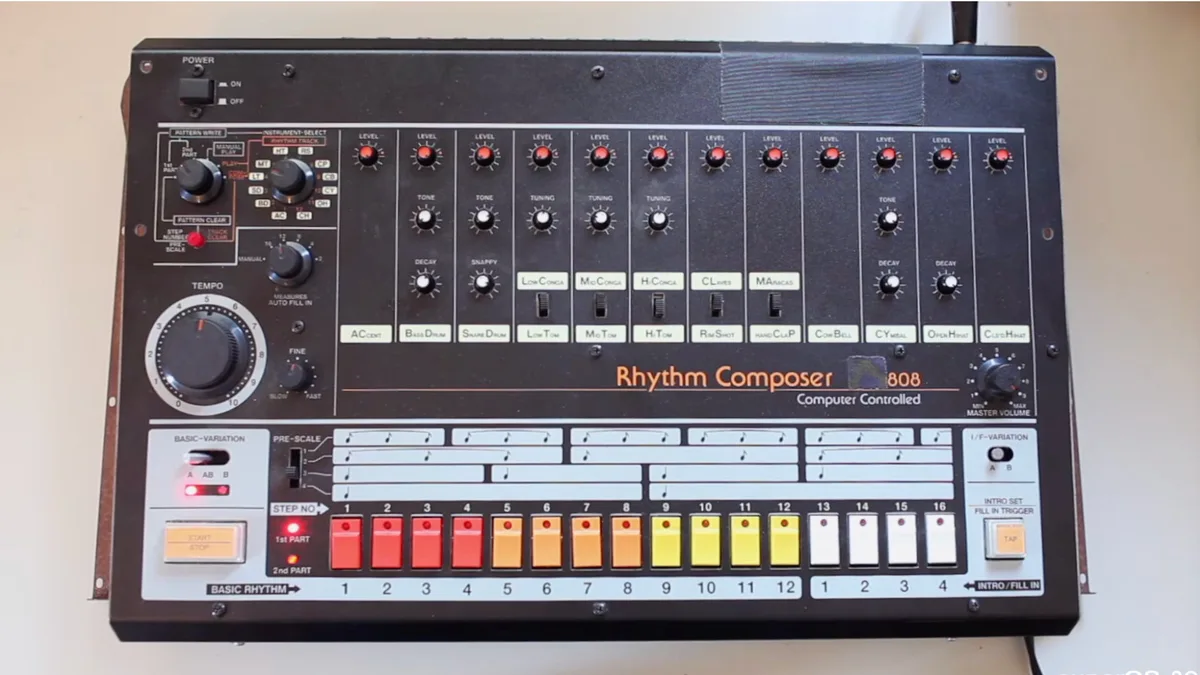
SuperOS-808 comes at it from the other direction. The firmware itself is open source and free, and it runs on an AT90USB1286 CPU replacement board sitting in the original µPD650C socket. The board is the part you pay for. Michigan Synth Works sells the Vox DEI, which is compatible, at just under 67 euros before import fees and VAT. There is no drop-in option: a stock 808 with its original chip cannot run this.
What that buys is a sequencer rebuilt well past what retrofits usually reach for. Patterns go from 32 steps to 64, arranged as four sections rather than two, and sections three and four default to zero length so anything written on the stock machine still plays exactly as it did. Per step there is probability and ratchet. Per instrument there is loop length and polymeter. Swing, play direction, live reslice, an arpeggiator and pattern generation sit alongside the usual copy, paste, transform and mute.
MIDI covers in and out: drum notes with a velocity of 100 or above asserting accent, program change for pattern selection, clock sync as either slave or master, and soft thru. A SysEx web editor handles patterns, panel calibration and firmware updates over MIDI, so changing versions does not mean pulling the board. An optional build bundles an emulator of the original µPD650C-085 running genuine machine code, which lets one board boot either stock or extended behaviour.
The catch is the front panel. The 808 has exactly one spare momentary button, so the whole extended layer hangs off gestures on CLEAR: tap, hold, CLEAR plus a step key, double-tap for the config menu, long-press to confirm. Holding CLEAR at least puts a map of the sixteen tools on the step LEDs, so it is not blind menu-diving. Whether it stays fast on an instrument built around instant tactile access is worth seeing demonstrated rather than described.
Which one
They are aimed at different people, despite the overlapping headline feature.
The Tubbutec mod is the one to want if the goal is an 808 that behaves itself in a modern setup and has more drums in it. You buy it fitted, the velocity works over MIDI, the extra instruments are the real draw, and it comes back out again if you change your mind. The unknown is the price.
SuperOS-808 is for someone who wants the sequencer itself to become a different instrument. Probability, ratchets and polymeter per instrument are not things any commercial 808 retrofit offers, and the firmware costs nothing. You pay in a board purchase, a flashing session, and a control scheme built around one button.
There is one more difference worth weighing on hardware this old. The open-source route means you can read the code before you put it in a machine worth more than the car most of us learned to drive in. That is not nothing when the alternative is trusting a binary.
View more at the Tubbutec YouTube channelhttps://www.youtube.com/@tubbutec