MONOCHORD plays a chord per key and sends the whole performance out as MIDI
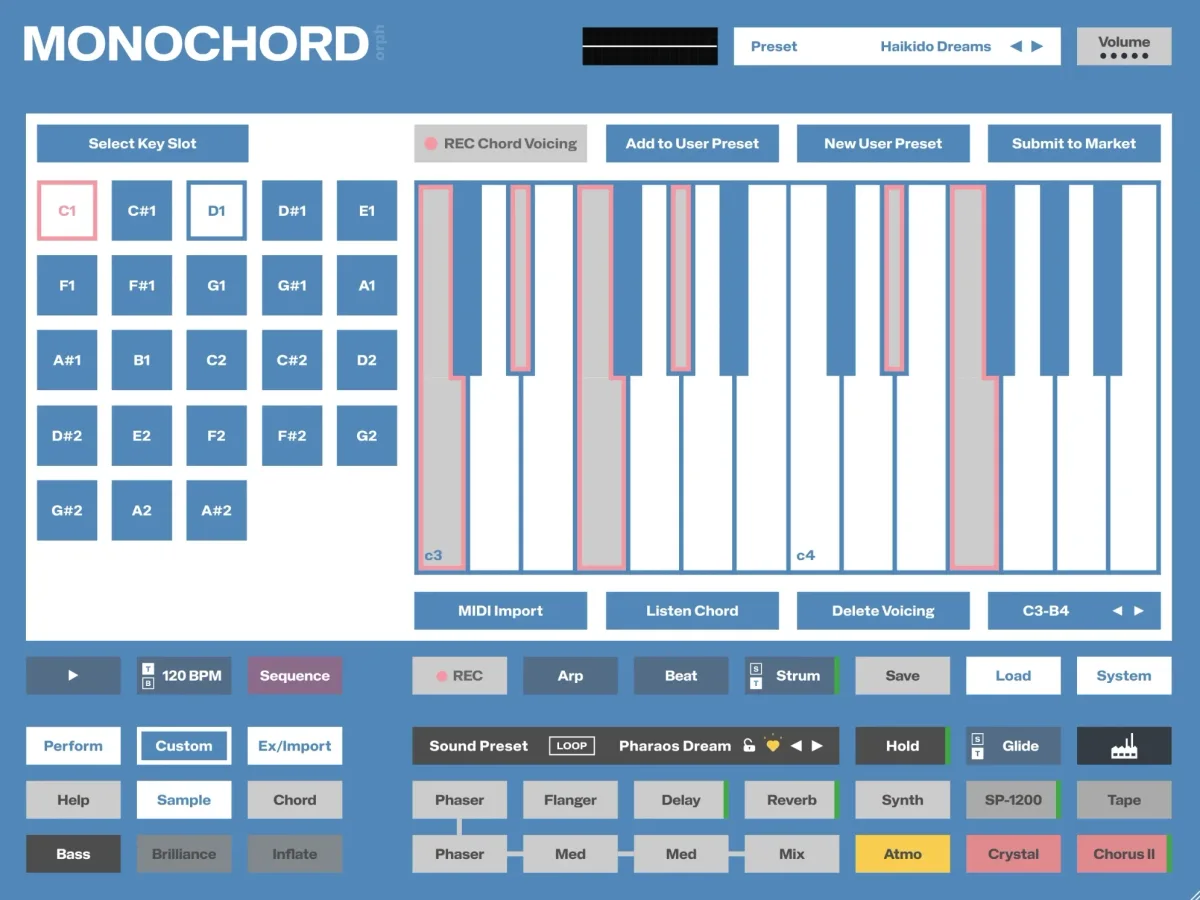
Chord plugins usually stop at the chord. You pick a key and a scale, the plugin hands you voicings under one finger, and what comes out is a MIDI clip you drag somewhere else and re-voice by hand. The playing, the strum, the timing you found while noodling, none of that survives the drag.
MONOCHORD, from the German company orph, is built around the part that normally gets thrown away. Its 24 keys each play a complete voicing, and everything it plays leaves as MIDI: not the chords alone but the arpeggios, the strum, the humanisation and the timing, routed to outboard hardware or to any other instrument in the session. Whatever you were playing is what the other synth receives.
The library is the other half. orph says it holds 425 sounds across more than 70 multisampled instruments, sampled from 1980s to 2000s hardware, and lists the sources openly: Fairlight CMI, PPG Wave, Jupiter-8, DX7, M1, D-50, Prophet-5, CP-70 and a long tail besides. Six synthesis engines sit alongside the samples, covering FM, analog, wavetable, additive, granular and PCM. Chords run to more than 600 hand-voiced shapes across 70 tonal sets, from nine-note pianistic spreads down to triads, each editable. Four keyboard modes cover full voicings, single notes filtered to the key, trimmed three and four note versions, and a plain chromatic layout.
The part that will interest samplists is that the library is not sealed. Your own WAV, AIFF or FLAC files drop into the sample zones, as do SFZ, Decent Sampler and SoundFont instruments, with automatic key zones and root and loop detection. The instrument then voices your material the way it voices its own.
Fifteen effect engines with more than 80 sub-modes sit across the signal path. orph names their references as openly as the instrument list, from the Juno-60 chorus and Dimension D to the Lexicon 480L and Bricasti M7, and its own footer is careful to say these describe character rather than any endorsement.
It runs standalone, VST3 and AU, on macOS 10.13 or later and Windows 10 or 11, at 139 dollars or euros, with rental and trial options. Two things to weigh before buying: the sample library is about 11.8 GB, downloaded once on first launch and wanting roughly 12 GB free on an SSD, and activation needs an internet connection, after which the manual states it runs offline for up to two weeks.
Producer’s note
If you buy this, the MIDI output is the feature to build a habit around, and it changes the order you work in.
The usual chord-plugin workflow is to audition sounds inside the plugin, commit, then discover the part wanted a different instrument. Turn it around: play the progression with whatever preset is loaded, ignore how it sounds entirely, and route the MIDI to the synth you actually want to hear. You are using it as a harmony and performance controller rather than a sound source, and its voicings and strum land on your own instruments.
That also solves the two-week offline problem in the least dramatic way available. Print the MIDI to your session as you go and the parts survive independently of whether the plugin can phone home on the day you reopen the project.
Read more at orphhttps://orph.audio/monochord