Native Instruments Super*Saw: Dense Sawtooth Sounds Without the Clutter
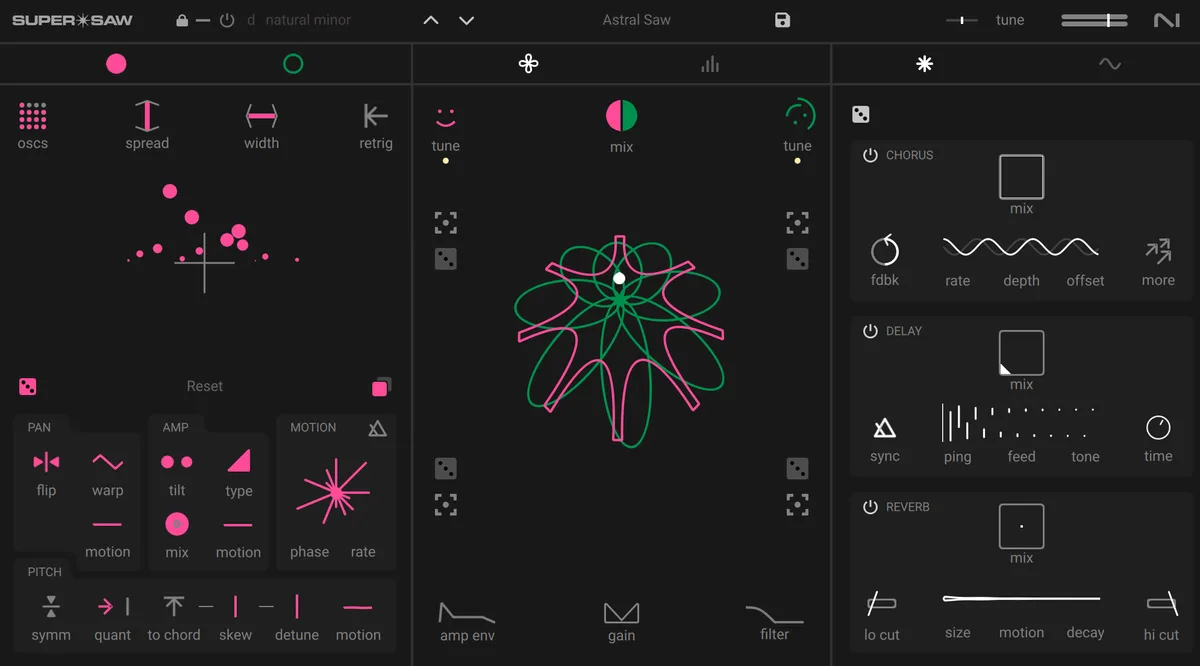
Native Instruments’ Super*Saw is a $99 synth plugin built around two eight-voice sawtooth oscillator layers. Its four-corner Morpher enables continuous movement between sound variations, while onboard chorus, delay, reverb, scale quantization, and chord tools keep most of the sound-design workflow inside the plugin. It runs on macOS and Windows in VST3, AU, and AAX formats.
Stacked saw oscillators create weight quickly, but excessive detuning can turn that weight into mud. Use voice offset to separate the layers across the stereo field, then add slight pitch movement rather than pushing every oscillator far out of tune. Glide times between 50 and 200 milliseconds can connect pitch changes without smearing them into a wall of sound.
The Morpher is most effective when its corners contain related versions of the same patch. Start with a focused, lightly detuned sound in one corner and place a wider, more animated variation in another. Moving between them changes the texture while preserving the patch’s harmonic identity. This is more controlled than adjusting several parameters independently during a performance.
Filtering and reverb require restraint. Sawtooth waves already carry substantial upper-harmonic energy, so aggressive processing can make them tiring. A high-pass filter around 80-120 Hz can remove unnecessary low-frequency buildup. For reverb, decay times of one to three seconds usually preserve clarity; longer settings work for ambient material but can quickly blur stacked chords.
Super*Saw is best suited to electronic and ambient production, particularly when a track needs bright leads, wide pads, or harmonically dense textures. Its main strength is not simply the number of oscillators it can stack, but the control it provides over how that density moves.
Super*Saw is at Plugin Boutique.
Read more athttps://www.native-instruments.com/en/products/komplete/synths/superstarsaw/