MadeOnEarth's LedRover is a stereo diode distortion built around the TB-303
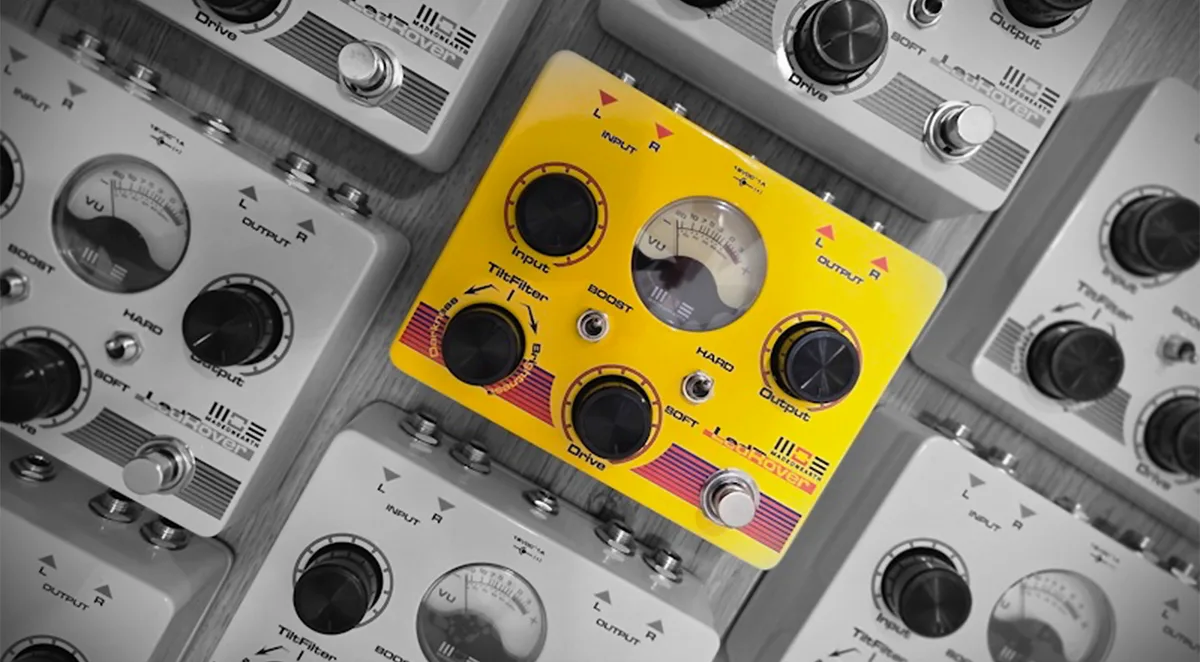
Most distortion pedals are designed for guitar and then sold to everyone else. The compromises that follow are familiar: input stages expecting a pickup, a voicing built around six strings, and a mono path that turns a stereo synth into half of one.
MadeOnEarth built the LedRover the other way round. It is a fully analogue stereo diode distortion, and the company says it started as a search for the right distortion for the TB-303, settling on a circuit after about a year of trying diodes, LEDs, germanium and custom potentiometers against each other.
Diodes in a feedback loop, borrowed from a filter
The circuit idea does not come from a distortion pedal at all. MOE says it took it from a well-known filter resonance design that puts diodes in the feedback loop, which is where the pedal’s character comes from: a rounder distortion that can get aggressive without flattening what went in. Two clipping modes, soft and hard, come from placing the diodes differently rather than from switching a gain stage.
That heritage explains the target. A resonant acid line is a hard thing to distort well, because the part of it you care about is a moving resonant peak, and most clipping stages either squash it or turn it into fizz.
The tilt filter is the unusual part
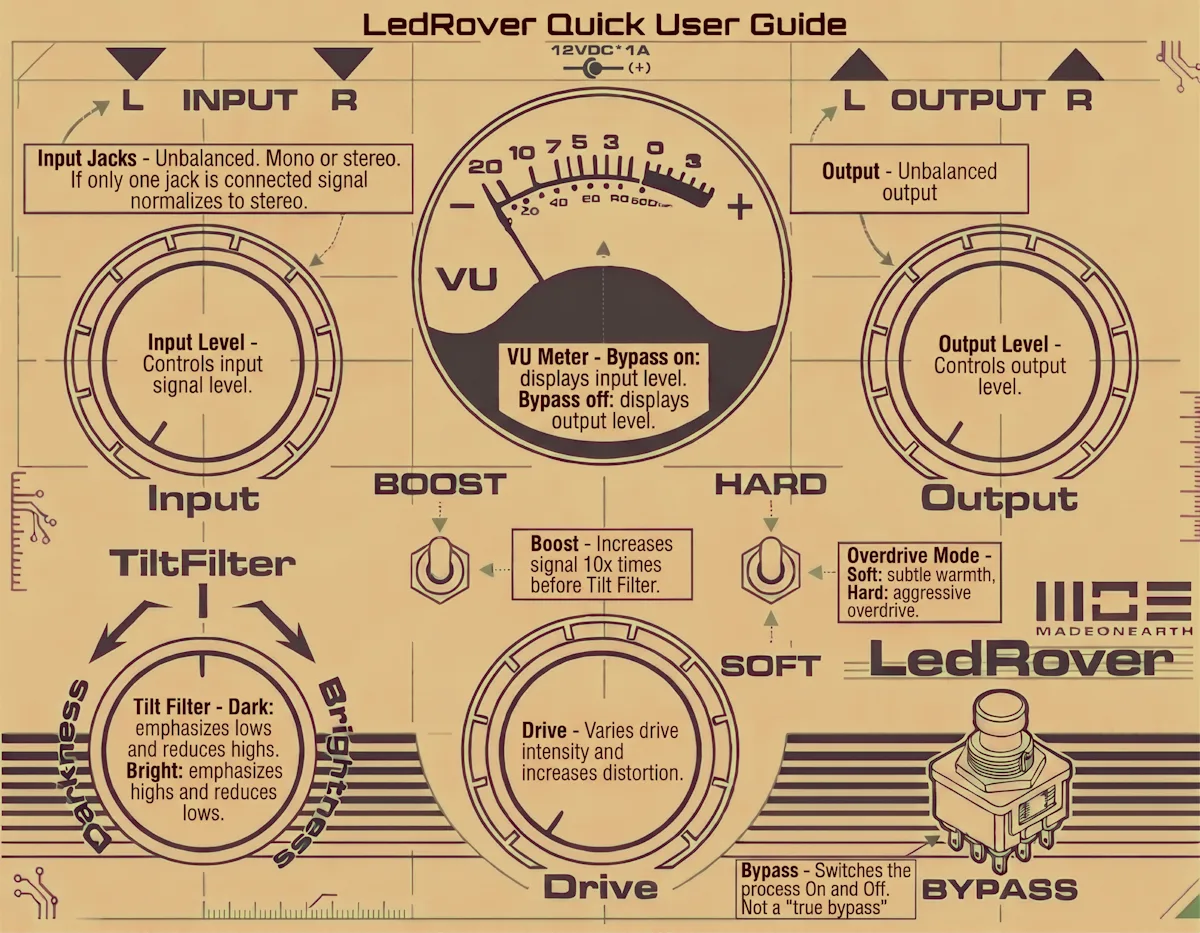
A tilt control is a low shelf and a high shelf moving in opposite directions from one knob: turn one way for more lows and fewer highs, the other way for the reverse. It is a single-knob tone control, and MOE puts theirs before the drive on the grounds that what you feed a clipper matters more than what you do afterwards.
Their claim is a 15 dB per octave slope against the 6 dB per octave a typical tilt control gives. Worth hearing before believing, since that is not a standard filter order and a tilt control’s effective slope depends on how the two shelves are built and spaced. It is the maker’s figure, and a steep one.
MOE also says the reference point was chosen by trial and error to pivot around the midrange rather than the extremes, which is the sensible choice if the filter exists to feed a distortion rather than to sit on a master bus.
The boost is a bigger deal than it sounds
There is an x10 boost switch sitting before both the tilt filter and the drive. Ten times the voltage is 20 dB, which is a lot to put in front of a filter, and that is the point: it is there for instruments with weak outputs, and it distorts at the filter’s input rather than at the clipper.
The company describes the interaction as the useful part. Pull the input level down and the filter’s action gets more pronounced; push it up and you get op-amp saturation stacked on top of the diode clipping. Two different kinds of dirt from one signal path, set by a level control rather than a mode switch.
The rest is straightforward. Separate input and output levels, a two-mode VU meter that reads either the wet or the dry signal, buffered bypass, two 6.3 mm unbalanced jacks in and out, and a 12 by 10 by 5.5 cm aluminium enclosure with UV printing and custom pots.
Not out yet
The LedRover was shown at Superbooth in Berlin, and both MOE’s own shop and Juno currently list it as coming soon. MOE has published no price for it. For reference, their Analog Chorus 60 is listed at 500 euros excluding sales tax, so this is not a company competing at the budget end.
MadeOnEarth started in 2008 as a DIY project, and the LedRover sits alongside a KickBox and a TwinBooster in a small catalogue, all of it currently out of stock.
The interesting question is the stereo part. A diode distortion voiced for a mono synth is a well-served category, and one built to take a stereo pair without collapsing it is not. Whether the two channels track each other closely enough to keep a wide source intact is the thing to listen for, and it is not something a spec sheet can answer.
Read more at MadeOnEarthhttps://www.moe-shop.net