Filter slopes: what 12 dB and 24 dB per octave actually do
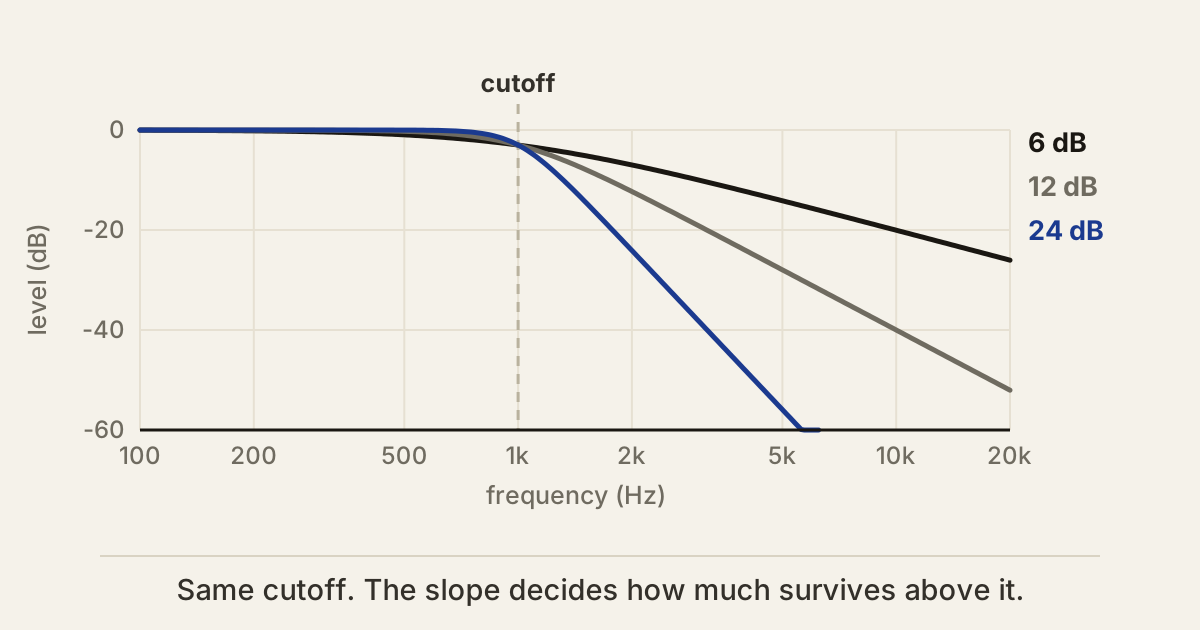
Most synth filters have a slope switch, and most people never touch it. It usually reads 12 or 24, sometimes with a 6 as well, and the number decides more about how a filter sweep feels than the cutoff knob does.
The number is decibels per octave. An octave is a doubling of frequency, so a 12 dB per octave low-pass set to 1 kHz is roughly 12 dB down at 2 kHz, 24 dB down at 4 kHz, and 36 dB down at 8 kHz. At 24 dB per octave those figures double: 24 down at 2 kHz, 48 down at 4 kHz. Same cutoff, completely different amount of surviving signal.
Where the numbers come from
Slopes move in steps of 6 because of how filters are built. Each stage, or pole, contributes about 6 dB per octave. One pole gives 6, two poles give 12, four poles give 24. The Moog ladder filter that defines a lot of what people mean by analogue character is a four-pole design, which is why 24 dB per octave sounds like the default setting for bass.
You will also see the cutoff frequency defined as the point where the signal is 3 dB down rather than untouched. Some designs use 6 dB down instead. Either way, the cutoff is not a wall. It is where the roll-off begins.
What each one is for
6 dB per octave barely removes anything. Above the cutoff the signal is still clearly there, just tilted. That makes it useful as a tone control rather than a filter, and it is a sensible choice for a high-pass on a full mix where a steeper slope would sound like something had been cut away.
12 dB per octave is the usable middle. Sweeps stay musical, harmonics survive far enough above the cutoff to keep a sound recognisable, and it rarely draws attention to itself. If a filter sweep sounds thin or disappears too fast at 24, this is what to try.
24 dB per octave is the dramatic one. Everything above the cutoff goes quickly, so a slow sweep reads as a real event rather than a tone change. It also keeps a bass part out of the way of everything else, because the harmonics are gone rather than merely reduced.
Why resonance needs two poles
A single-pole filter cannot resonate. A resonant peak at the cutoff needs at least two poles, which is why the 6 dB setting on a synth usually has no resonance control, or has one that does nothing.
That connection matters in practice. When you switch from 24 to 12 to hear a gentler sweep, you also change how the resonance behaves, because there are fewer stages for it to act on. If a patch loses its bite when you drop the slope, the resonance is usually what you are missing, not the slope itself.
Choosing without thinking about it
If a sweep needs to be the moment, use 24. If a sound needs to stay itself while you move the cutoff, use 12. If you are trying to clear low end from a full mix rather than shape a synth, start gentle and only get steeper if the problem is still there.
Producer’s note
Steep filters shift phase hard around the cutoff, and that is easy to miss on one track and impossible to miss across several. High-passing a kick, a bass and a sub at 24 dB per octave with cutoffs a few Hz apart can leave the low end weaker than before you started, because the phase relationships between them have moved. Filter one element steeply and leave the others gentle, then check the result in mono.