The Dangerous Music BAX EQ plugin puts a 1952 hi-fi tone control on a mastering bus
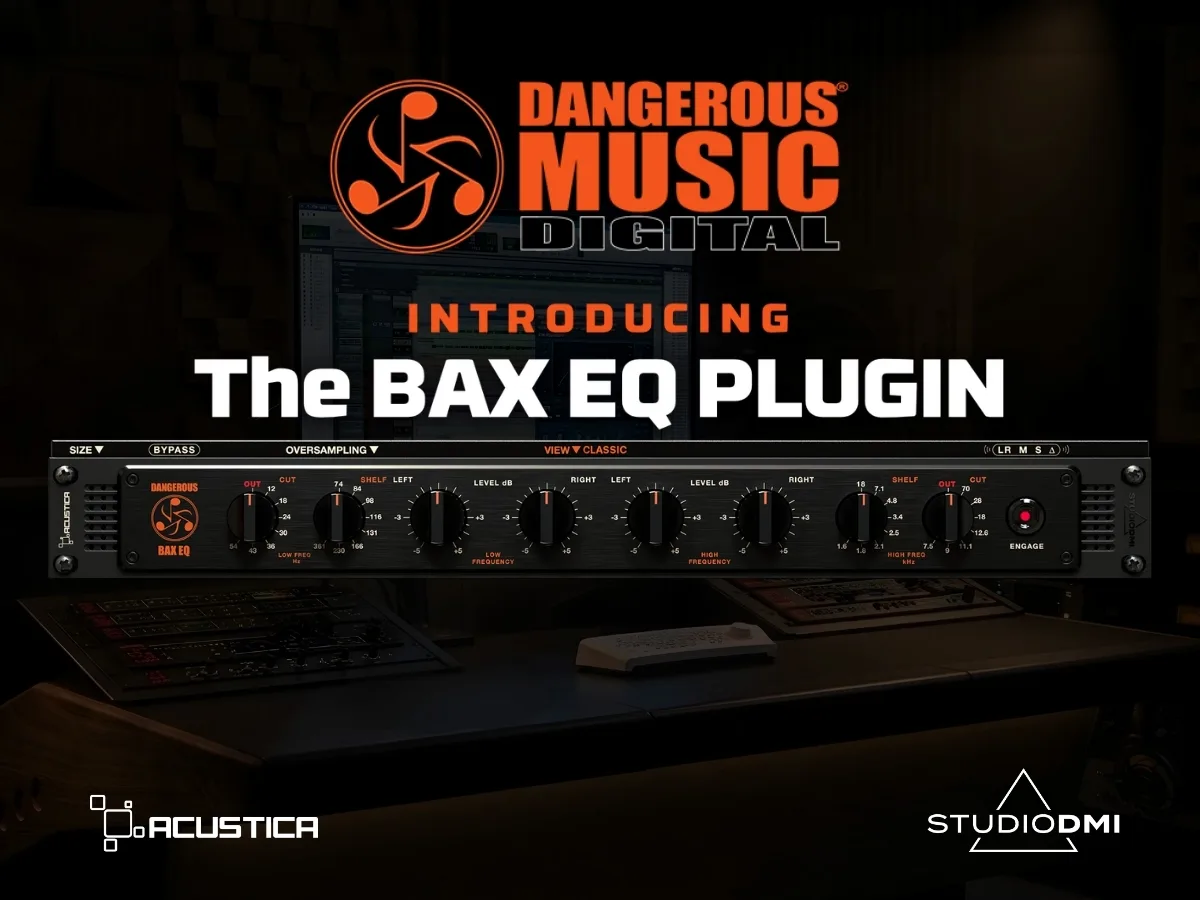
“Officially licensed” usually means a logo agreement and a photograph of the front panel. The Dangerous Music BAX EQ plugin, built by Acustica Audio, comes with an unusually specific account of how it was checked, which is worth more than the badge.
But the more interesting thing is what the circuit is, because it is not a mastering EQ design at all. It is a hi-fi tone control, and that is the entire point.
What a Baxandall actually is
Peter Baxandall published his negative-feedback tone control in Wireless World in 1952, and some version of it has been in the bass and treble knobs of domestic amplifiers ever since. It is a shelving design, and its defining characteristic is that the curves are broad, gentle and overlapping. There is no Q control because there is nothing narrow to control.
That makes it useless for the job most engineers reach for an EQ to do. You cannot notch a resonance with it, you cannot carve a 200 Hz box out of a guitar, and you cannot do anything surgical whatsoever.
What you can do is tilt an entire mix. Broad shelves that start their move well inside the audible band do not sound like an EQ move, they sound like the balance was always that way. That is why the topology keeps reappearing in mastering hardware despite starting life as a consumer tone control: the failure mode of mastering EQ is audible correction, and a curve with no corners cannot produce one.
Dangerous Music built theirs around circuitry by Chris Muth, and the plugin adds phase-coherent low and high cut filters for the ends of the spectrum, with the shelves stepping in 0.5 dB increments.
The certification is doing real work here
Most licensed emulations are a brand deal. The process described for this one is not.
Acustica were given a BAX EQ production unit to work from. Chris Muth and Dangerous Music president Marek Stycos then evaluated the software against their own units, comparing measured responses and filter behaviour. Across four major revisions Dangerous supplied a second production unit, reviewed measurement plots, and sent their own Convert-AD+ and Convert-2 converters to the development team for the impulse-response capture.
That last detail is the one that matters technically. Acustica’s method is capture-based rather than circuit-modelled, so the plugin is only ever as good as the recording chain used to sample the hardware. Sending the manufacturer’s own mastering converters to do the capture removes the most likely source of error in the whole exercise. It is a small thing to report and a large thing to actually do.
Three views, and things the hardware cannot do
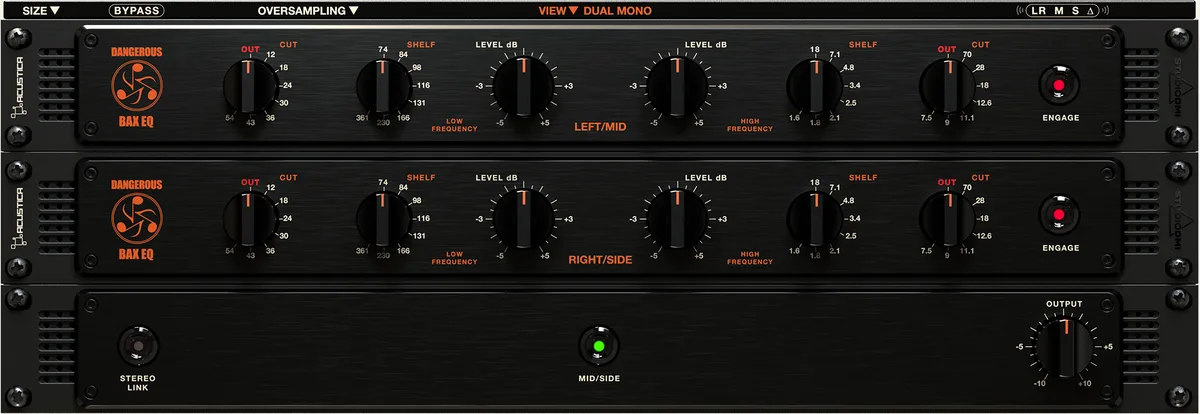
The plugin ships in three layouts. Classic is the hardware panel as it exists. Classic Exp adds mid/side processing, stereo link, an output control and monitoring options. Dual Mono splits left and right entirely, including separate cut filters.
Mid/side is the addition worth noting, because the hardware has no such mode. Running a Baxandall shelf on the sides alone is a different tool from running it across the stereo image: broad, cornerless curves are exactly what you want when adjusting a side signal, where anything sharp tends to announce itself the moment the mix is folded to mono.
Monitoring covers LR, mid, side and delta, the last of which plays only what the plugin changed. Output runs from -10 to +10 dB, oversampling is available at 1x, 2x and 4x, and there is a low-latency ZL build alongside the standard one for tracking.
Price and formats
VST3, AAX and AU, on Windows 10 and 11 and macOS 10.15 through Sonoma, with native Apple Silicon support and no Rosetta fallback. Sample rates run to 96 kHz. Installation and authorisation go through Acustica’s Aquarius Desktop, and there is a fully functional 30-day trial.
Acustica list it at 155 euros. Sound on Sound reported 179 pounds at launch, which is not the same figure by any conversion, so check the price in your own region before assuming either.
The trial is the sensible move regardless. A broad shelving EQ is the hardest kind to evaluate from a specification, because everything interesting about it is in how the curves overlap rather than in any number on the page.
Read more at Acustica Audiohttps://www.acustica-audio.com/shop/products/BAXEQ