Cherry Audio's Pentaphonic revives a synth that solved tuning with microprocessors
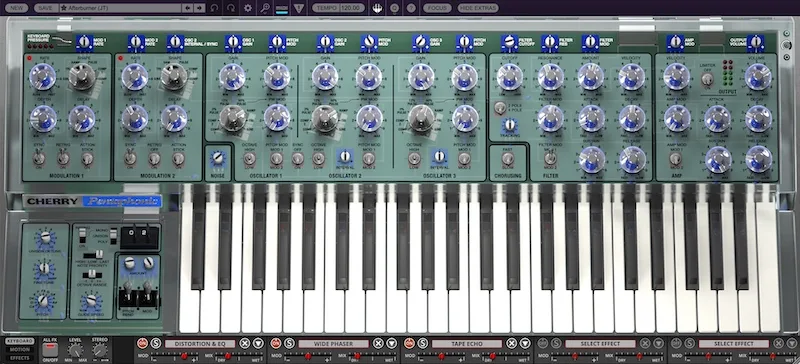
Cherry Audio has released Pentaphonic at $59, a recreation of the 1981 Gleeman Pentaphonic. Cherry Audio says fewer than 70 of the original were ever built.
The interesting part is not the rarity. It is why the thing existed at all.
A garage in Mountain View, solving the wrong-sounding problem
Cherry Audio’s history of the instrument is worth reading. Two brothers, Bob and Al Gleeman, built a portable polysynth in the early 1980s while everyone around them was building personal computers. Al engineered it, Bob handled the business.
Their problem was tuning. An analogue polysynth of that era drifted under stage lights, and the market was full of them: the Prophet-5, the Memorymoog. The Gleeman answer was to stop using analogue oscillators.
Five voices, hence penta, built from fifteen DCOs, with a pair of Intel 80186 microprocessors keeping them in tune. Cherry Audio’s framing is that this gave it tuning stability its analogue rivals could not achieve, at under $3,000 against the Prophet-5 at $4,600.
That is a real engineering argument rather than a marketing one, and it is the reason a two-person operation could sell against Sequential at all.
The waveforms are the detail worth knowing
Each oscillator offered eight waveforms, two of which Cherry Audio describes as harmonically rich “complex” shapes. Those were low-resolution 32-sample waveforms, played back at a variable clock rate.
Thirty-two samples is very little. Changing pitch by changing the playback clock rate rather than by interpolating means the character of those waveforms shifts with the note, and at thirty-two samples per cycle the harmonics reach a long way up. That is the same arithmetic behind why a digital source can sound cheap for no obvious reason, and in 1981 it would have been an unavoidable consequence of the parts available rather than a choice.
The rest was analogue. A Curtis CEM 3320 four-pole low-pass resonant filter at 24 dB per octave, and a CEM 3360 dual VCA. Digital oscillators into analogue filters, which is the hybrid arrangement that became normal a decade later.
What was around it
An 18-pound black chassis with a handle and a built-in speaker, a 37-note keybed, a 300-note real-time polyphonic sequencer, computer-tuned chorusing, and a joystick for pitch. Around 30 black units were handmade with evolving specifications.
There was also a Pentaphonic Clear, with acrylic housing, plexiglass knobs and optional lighting so an audience could see the circuit board lit up from the front.
What Cherry Audio changed
Not a straight emulation. Cherry Audio lists greater polyphony, two expanded LFOs where the original had one digital triangle-based LFO, pulse-width modulation, oscillator sync, more filter options, extended modulation, an arpeggiator, a sequencer and effects.
Formats are AU, VST, VST3, AAX and standalone, with a free 30-day demo. macOS 10.13 or above with native Apple Silicon support, Windows 7 or above, 64-bit either way, 196 MB of disk. Activation needs an internet connection.
Producer’s note
If you want the character the original was known for rather than a general-purpose polysynth, the complex waveforms are where it lives, and they will behave differently across the keyboard by design rather than by fault.
Worth knowing before you compare it to Cherry Audio’s other recreations: the thing that made this synth unusual in 1981 was stability, which is the one quality every software instrument now has for free. The sound was a side effect of how they achieved it.
Read more at Cherry Audiohttps://cherryaudio.com/products/pentaphonic-synthesizer
Buy atPlugin Boutique