Audiocube Space moves 3D sources between separate plugin instances
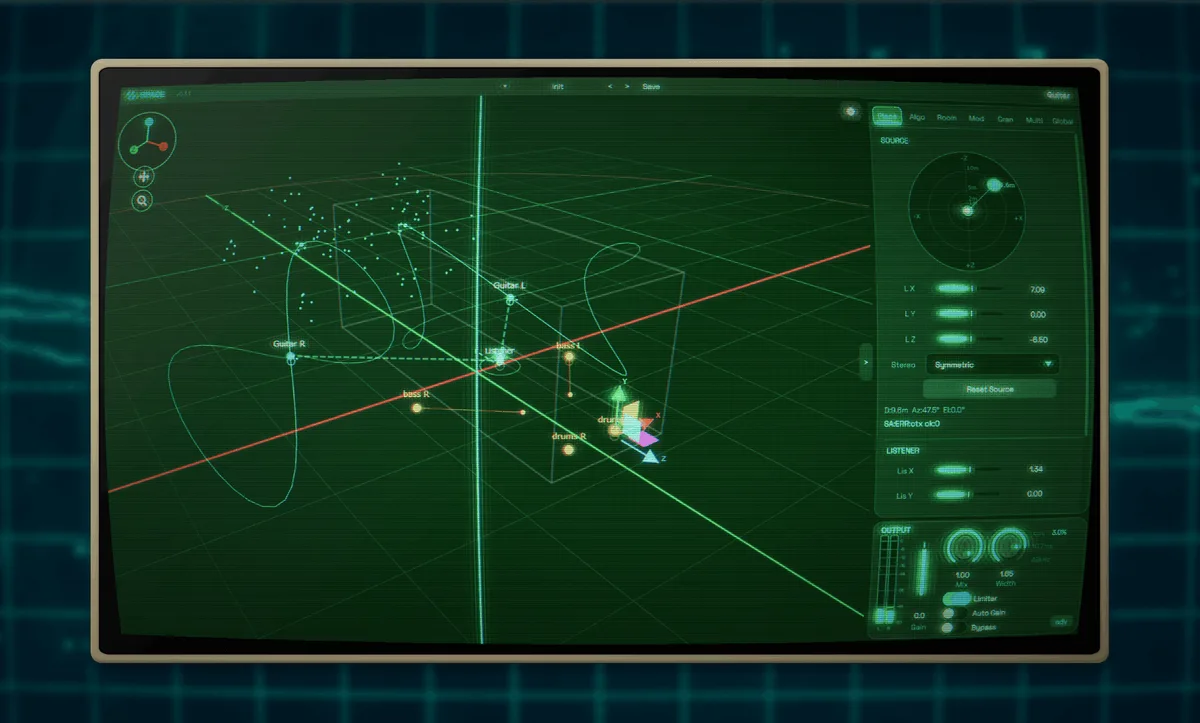
Most spatial plugins give you one window per track. You place a source, close it, open the next one, and hold the arrangement of the room in your head. Audiocube Space is built the other way around: one instance can move sources that other instances are hosting, and selected global parameters can be shared between them. The 3D view stops being a panner for one channel and becomes a scene.
Source and listener move independently in three dimensions. Output can be stereo, binaural, or multichannel up to 9.1.6, so the same session serves headphones and a room without a second tool.
The processing around the position is where the CPU goes. Audiocube’s Ripple engine handles reflections and air simulation. The reverb section offers 10 shapes and 12 materials, and will import convolution impulse responses instead. Sources can follow preset or user-drawn motion paths, and there is a cloud granulator for anyone who wants the position to fall apart.
Whether that is worth $50 depends entirely on how many tracks share the space. For left-to-right movement on one synth, a pan knob already exists and this is a large answer to a small question. For a scene where six sources need consistent distance, materials and reflections, moving them from one window is the reason to buy it. Binaural output at least means headphone users can hear the result without building a speaker array first.
Space runs as VST3, AU or AAX on macOS and Windows, and does not need the standalone Audiocube application. One licence activates on three machines and works offline afterwards. There is a limited free version. The $50 is a launch price, and the product page gives neither a release date nor an end date for it.
Producer’s note
Build the first scene with the processing switched off. Disable the reverb and the granulator, move a single mono source along one axis, and listen to what distance alone does. Spatial plugins stack several cues at once, level, filtering, reflection density and timing, and when they arrive together it is impossible to tell which one you are reacting to or which one is fighting the mix.
Then bring back one processor at a time. If the source becomes vague when reflections come on, the problem is the room you built rather than where you put the source in it, and the fix is a smaller shape or a more absorbent material, not a new position.
Read more at Audiocubehttps://main.audiocube.app/space