AIR's Fabric Vintage Andromeda samples the Alesis A6, which is a different thing from modelling it
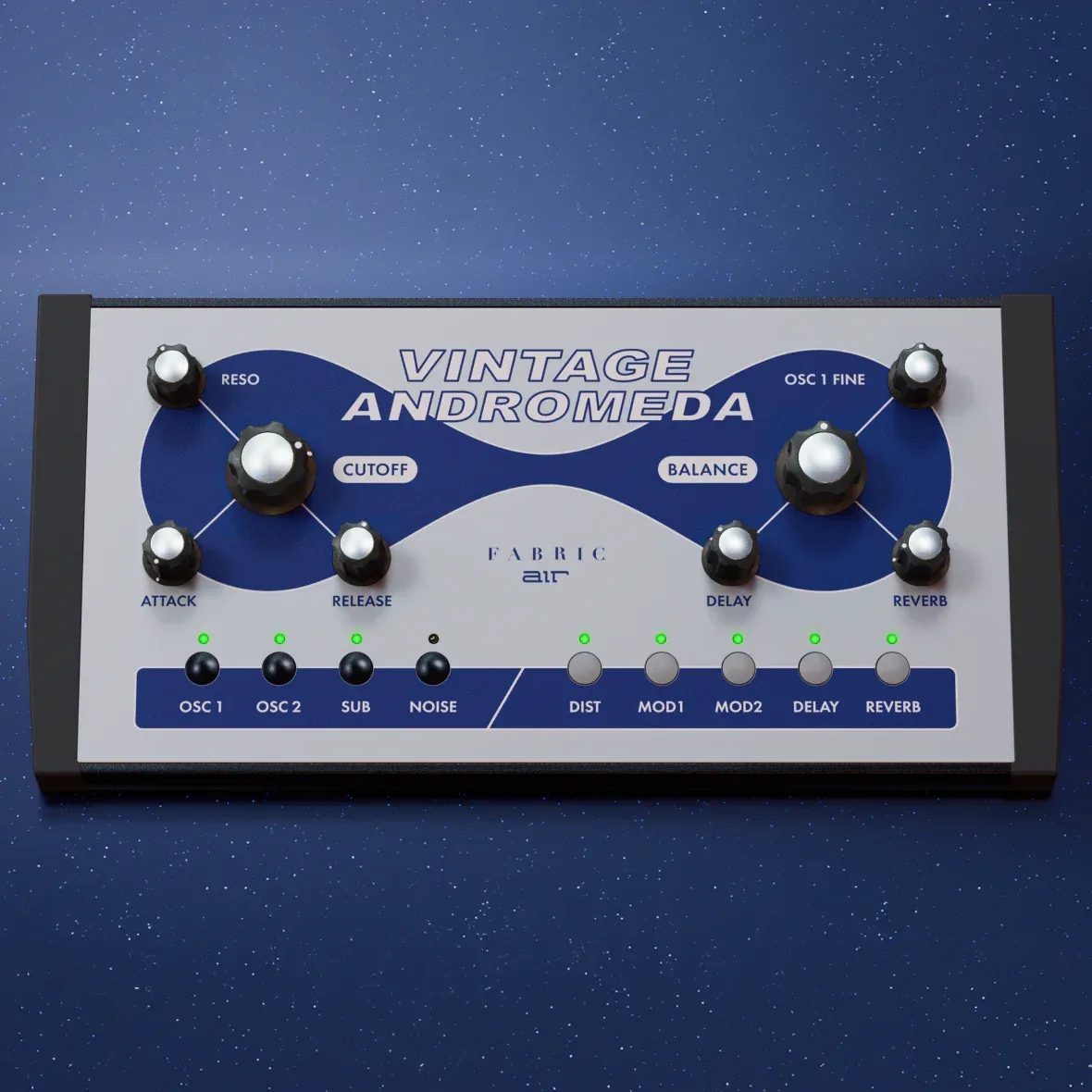
AIR Music Tech have released Fabric Vintage Andromeda, built around the Alesis Andromeda A6. It is a multisample instrument, and AIR say so plainly if you read the specification rather than the headline: the Fabric engine is described as “an advanced multi-sample synthesis platform”, with two multi-sample layer oscillators and a percussive layer.
That is worth separating from the copy around it, which describes the original’s fully analogue signal path and then invites you to carry that impression across. What you are buying is recordings of an A6, played back and shaped by AIR’s own digital engine.
What the A6 actually was
The Andromeda arrived in 2000 and was discontinued in 2010, and it is remembered because of how much analogue circuitry Alesis put in one box.
Sixteen voices, each with two VCOs and a sub-oscillator per VCO. Then the part that made it unusual: two filters per voice, a 2-pole multimode in the SEM tradition and a 4-pole in the Moog tradition, runnable together. Sixteen voices times two filters is 32 analogue filters in a single instrument, which is not a specification anyone has repeated since. Each voice also carried three 6-stage envelopes and there were three dedicated LFOs plus sample and hold.
It is a machine whose character lives in what those circuits do while you play, and in the fact that no two of its sixteen voices are electrically identical.
What a multisample can and cannot carry
Sampling captures timbre at the points you sample it. It does not capture behaviour.
A recording of an A6 patch holds exactly what the filters were doing at the moment of capture, at that cutoff, that resonance, that envelope position. Move the filter afterwards and you are hearing AIR’s digital filter operating on a recording, not a 4-pole analogue circuit responding to your hand. Sweep resonance up towards self-oscillation and the sampled instrument has to fake something the hardware simply does.
The per-voice variation goes the same way. On the hardware it is a consequence of sixteen sets of components with real tolerances. Fabric offers pitch randomisation, drift and a sample start offset to put some of that back, and those are sensible tools, but they are a deliberate reintroduction of a thing the original could not avoid.
None of this makes the instrument dishonest. It makes it a different category of product, and the useful question is not “does it sound like an A6” but “does it sound good, and can I get an A6 any other way”. An original in working order is a rare and expensive machine with 32 analogue filters to keep calibrated.
What it does have
The Fabric engine is shared across AIR’s instruments, so the layout will be familiar if you own others. Two main oscillators with categorised selectors, volume, pan, formant, and octave, coarse and fine tuning, each with a BPM-syncable LFO offering eight shapes plus rate, fade-in and depth. A separate noise generator with its own filter, decay and LFO. Independent filter, envelope and LFO controls per layer.
Envelopes are ADSR for amp and filter, with velocity sensitivity, velocity-to-attack-time mapping and bipolar depth on the filter envelope, plus a dedicated pitch envelope. Worth noting against the hardware’s 6-stage envelopes, which is a real reduction in what you can draw.
The arpeggiator is the most developed part: multiple shapes, note order and maximum note settings, swing, ratchet, repeat, momentary freeze, octave randomisation and pause, with MPE support and assignable modulation sources. The front panel gives eight macros, four oscillator toggles and five effect toggles.
Price and formats
VST, VST3, AU, and MPC Standalone and Desktop, which is the part that will decide it for some people. Running an A6-derived instrument on MPC hardware with no computer attached is not something a circuit-modelled plugin tends to offer.
Listed at 99 euros, currently 59 as part of a Vintage Synths Vol 2 launch promotion.
For that money the comparison is not really the hardware. It is other sample libraries and other virtual polysynths, and against those the arpeggiator and the MPC compatibility are the things that separate it.
Fabric Vintage Andromeda is at Plugin Boutique.
Read more at AIR Music Techhttps://www.airmusictech.com/virtual-instruments/